
Global Payments' $50 billion valuation gap exposes the cash-flow test that separates private equity conviction from public-market skepticism
GTCR is weighing a $50 billion buyout of Global Payments. The real question is who values merchant acquiring and the Worldpay integration more: public markets or private owners.
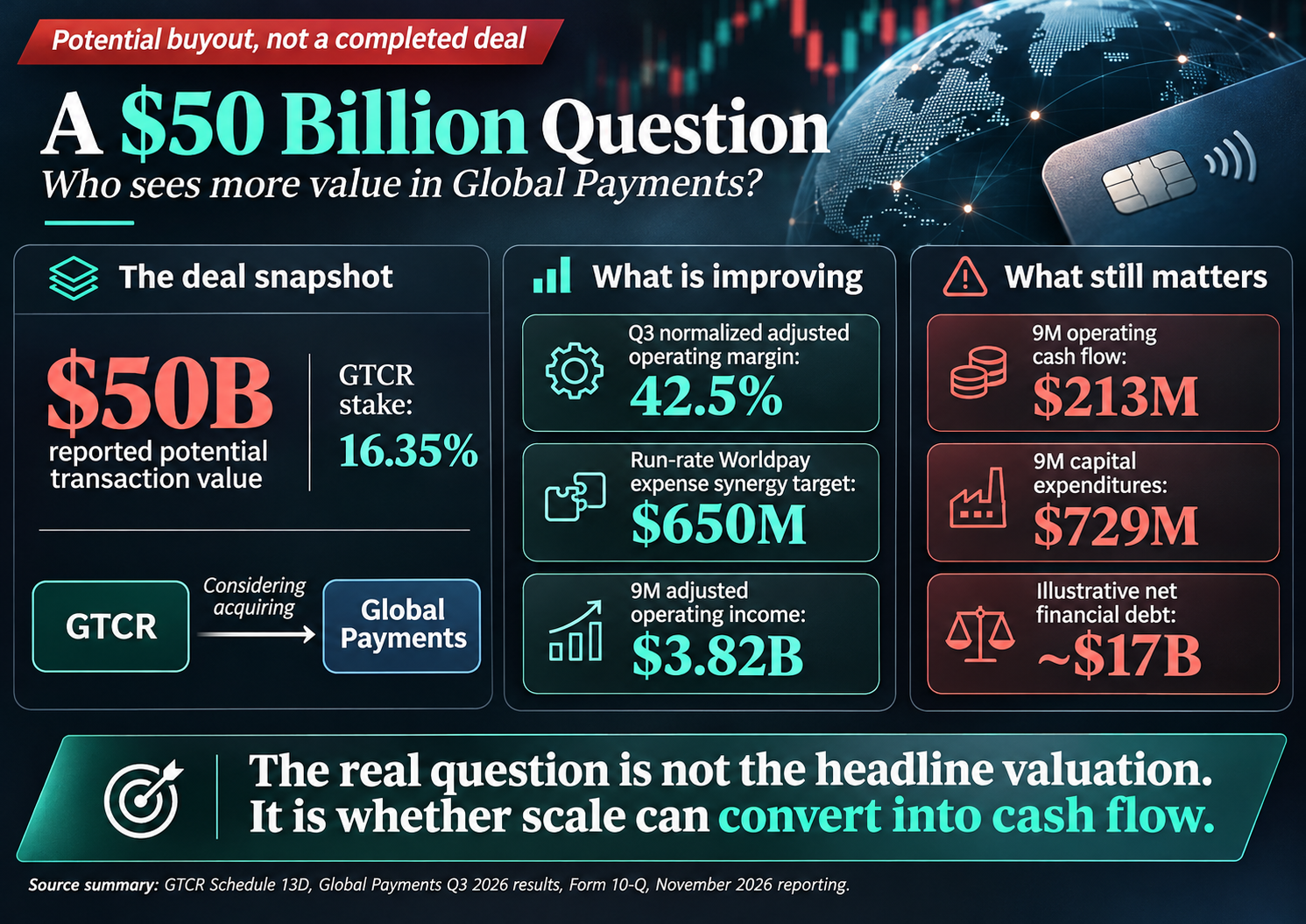
A $50 Billion Question: Who Sees More Value in Global Payments?
GTCR's renewed buyout interest puts merchant acquiring economics, Worldpay integration, and the price of private ownership under scrutiny.
Global Payments spent much of the past year reshaping itself into a focused merchant payments company. Now, less than eleven months after completing its acquisition of Worldpay, its largest shareholder is exploring whether to buy the entire business—and is putting a number on it that is well above what public investors are paying.
On November 20, GTCR disclosed in a Schedule 13D filing that it is evaluating possible strategic transactions involving Global Payments, potentially including a proposal to acquire all outstanding shares it does not already own. The filing puts GTCR's stake at 16.35%. The same day, Bloomberg reported that a transaction could be worth about $50 billion including debt and a premium, and that GTCR is working with a group of other private equity firms on financing. Global Payments shares jumped more than 11% on the report. No decision has been made, and no proposal has been announced.
This is the second round of reported buyout interest in three weeks. On October 30, the Financial Times reported that CD&R and GTCR were exploring a joint take-private at roughly $40 billion of enterprise value. On November 12, Reuters reported that the firms had shelved that effort, with financing complexity among the obstacles. Eight days later, a new report put the potential transaction value at approximately $50 billion. The figures reflect separate, preliminary reports rather than successive formal bids.
The question is not only whether GTCR can finance a transaction of this magnitude. It is what a buyer believes the combined Global Payments and Worldpay platform can earn, how much cash it can generate, and why that view differs so sharply from the market's.
A company still digesting a major transaction
In January 2026, Global Payments completed its acquisition of Worldpay from FIS and GTCR while divesting its Issuer Solutions business to FIS. The company moved away from a combination of merchant acquiring and issuer processing to concentrate on merchant acceptance, embedded payments, software, and commerce solutions.
Combining two large merchant payments businesses creates opportunities to consolidate infrastructure, rationalize technology, and serve merchants across more markets and channels. But those benefits do not arrive when a transaction closes. Payment processing platforms are deeply interconnected with merchant contracts, financial institutions, payment networks, settlement operations, fraud systems, and software partners. Combining them takes years of execution.
The early evidence is mixed in an instructive way. Management is delivering on the measures it controls most directly. Third-quarter normalized adjusted net revenue grew more than 4%, normalized adjusted operating margin expanded 220 basis points to 42.5%, and the company raised its run-rate Worldpay expense synergy target to $650 million. Cash flow is a different story.
What the numbers tell us
Global Payments reported third-quarter 2026 GAAP revenue of $3.31 billion and adjusted net revenue of $3.18 billion. For the first nine months, adjusted net revenue reached $9.20 billion and adjusted operating income $3.82 billion—against GAAP operating income of $568 million.
The gap between those two operating income figures reflects acquisition-related amortization and expenses tied to acquisitions, integration, separation, and business transformation. Not all of those adjustments are recurring cash costs. But neither should they be ignored while an integration of this size is under way.
The cash flow statement makes the point more directly. For the first nine months of 2026, operating cash flow was $213 million, compared with $2.14 billion in the same period of 2025. Capital expenditures rose to $729 million from $450 million. Operating cash flow fell roughly $516 million short of covering capital spending.
Part of the weak operating cash conversion reflects acquisition- and integration-period payments and movements in operating assets and liabilities. Accounts payable and other liabilities declined by approximately $876 million. Separately, changes in settlement processing assets and obligations consumed $573 million of cash, classified under financing activities rather than operating activities. Those movements should not be mistaken for normalized earning power. They do show why adjusted margins and reported cash generation can diverge sharply after a major combination—and why a prospective buyer must examine the full cash-flow statement.
The balance sheet reflects the scale of the Worldpay transaction. As of September 30, Global Payments reported approximately $22.54 billion in current and long-term debt and $5.57 billion in cash and cash equivalents. Subtracting the two produces approximately $17 billion in illustrative net financial debt. That is a simplified measure: it excludes $1.17 billion of settlement lines of credit and assumes reported cash can be netted fully against financial debt. Some analysts use a higher figure; William Blair has cited net debt of nearly $22 billion.
Interest and other expense reached approximately $796 million for the first nine months of 2026, up from $445 million in the comparable 2025 period, a period that includes the Worldpay financing.
Global Payments — Financial snapshot
| Metric | Reported amount |
|---|---|
| Q3 2026 GAAP revenue | $3.31B |
| Q3 2026 adjusted net revenue | $3.18B |
| First nine months adjusted net revenue | $9.20B |
| First nine months adjusted operating income | $3.82B |
| First nine months GAAP operating income | $568M |
| First nine months operating cash flow | $213M |
| First nine months capital expenditures | $729M |
| First nine months interest and other expense | $796M |
| Current and long-term debt, September 30 | $22.54B |
| Cash and cash equivalents, September 30 | $5.57B |
| Illustrative net financial debt | $16.97B |
| Reported potential transaction value | ~$50B |
Sources: Global Payments Q3 2026 earnings release and Form 10-Q; Bloomberg reporting on November 20. Adjusted metrics are company-defined non-GAAP measures. Transaction valuation remains speculative.
What would $50 billion actually buy?
The reported $50 billion is an estimated transaction value including debt and a premium, not an announced equity purchase price. Using the September 30 debt and cash balances, a $50 billion enterprise value implies approximately $33 billion of equity value.
Using the approximately 264.6 million shares outstanding as of October 30, that illustrative equity value would equate to roughly $125 per share. Global Payments shares reached an intraday high of $95.50 on November 20, following the report; the $125 scenario is approximately 31% higher than that intraday level. If transaction-adjusted net debt were instead $22 billion, the same enterprise valuation would imply roughly $28 billion of equity value, or approximately $106 per share. Neither figure is an offer price or a valuation disclosed by GTCR. They are sensitivities showing how the assumed debt deduction changes the result.
That calculation is deliberately simplified. Actual equity value would depend on the treatment of settlement-related financing, cash availability, other liabilities, minority interests, subsequent balance-sheet movements, and deal-specific adjustments. The range itself illustrates how much the answer depends on those definitions.
Two multiples add perspective. Annualizing the first nine months of adjusted net revenue produces approximately $12.26 billion, so a $50 billion enterprise value represents roughly 4.1 times that figure. Annualizing adjusted operating income produces approximately $5.09 billion, or roughly 9.8 times. Both are illustrative, not formal transaction multiples or forward forecasts; nine-month annualization likely understates revenue in a business where the fourth quarter is seasonally strong, and adjusted operating income should not be confused with EBITDA or free cash flow. A buyer evaluating a leveraged transaction would build a full earnings and cash-flow bridge before arriving at a defensible price.
What private equity might see
GTCR is not approaching Global Payments as an unfamiliar investor. It held a controlling interest in Worldpay and received cash and Global Payments shares when the acquisition closed. It has direct familiarity with a significant portion of the operating assets, the business model, and the integration challenges.
It also faces contractual limits. Under the shareholders agreement signed at the Worldpay closing, GTCR is subject to a standstill that restricts additional share acquisitions while it owns more than 5% of the voting securities, subject to stated exceptions. Its November 20 Schedule 13D explicitly says any potential action remains subject to that agreement. A transaction would therefore have to navigate the existing contractual restrictions and the board’s response; an independent board committee could also become part of the process. The agreement separately limits when GTCR may dispose of shares, with an initial release scheduled twelve months after the January closing. A take-private could provide a different path for GTCR to realize or retain exposure to its investment, but no such structure has been announced.
A buyout could reflect a belief that the combined platform can create additional value through integration, expense discipline, product investment, and execution—and that private ownership would let management work through a multiyear integration without quarterly public-market scrutiny.
But private equity does not eliminate the underlying economics. A leveraged transaction adds financing obligations to a company that has already absorbed the Worldpay debt, and whose operating cash flow this year has been well short of its capital spending. The buyer must generate enough incremental value to service and reduce that debt. Private ownership changes the capital structure and the accountability model. It does not make the operating risks disappear.
Scale is valuable. Integration determines how valuable.
Merchant acquiring has always rewarded scale. Larger portfolios spread processing, compliance, network connectivity, and technology costs across greater transaction volume, and support international acceptance, software distribution, and investment in fraud prevention and merchant services.
But transaction volume is an incomplete measure of value. A large merchant portfolio can contain pricing pressure, contract complexity, costly servicing obligations, and duplicated technology environments. Merchants are not economically interchangeable: enterprise merchants, small businesses, and software-led channels differ in pricing, acquisition cost, service requirements, retention, and growth.
The Worldpay integration is therefore an exercise in deciding which platforms, contracts, capabilities, and operating structures produce the most durable returns. Removing duplicate costs improves margins. Cutting investment in reliability, fraud controls, customer support, or product development can undermine the merchant relationships that generate the revenue. A merchant may renegotiate pricing; it is far less willing to tolerate settlement failures, weaker authorization performance, or service disruptions. The opportunity is to remove complexity without compromising the services that make the portfolio valuable.
What public investors and private equity may be pricing differently
There are three plausible explanations for the gap between the market price and the reported deal value.
The first is that public markets are discounting the long-term economics of traditional merchant acquiring. Competition, pricing pressure, and the growing role of integrated software platforms may be reducing investors' willingness to pay up for established processors. If that is right, additional scale offers limited protection.
The second is timing. Global Payments is showing margin expansion and synergy progress, but its cash flow has not yet caught up. A patient owner with detailed knowledge of the acquired business may be willing to underwrite the cash conversion that public investors want to see first.
The third is financial structure. A sponsor considering a price near ten times annualized adjusted operating income would need to evaluate leverage, synergy realization, cash conversion, and the valuation available at a future exit—not simply assume a public-market mispricing. The reported difficulties financing the earlier exploration illustrate the challenge of structuring a transaction of this size.
These explanations are not mutually exclusive, and the company's future performance—realized synergies, merchant retention, organic growth, capital expenditure, and above all free cash flow—will provide stronger evidence than takeover interest alone.
The larger payments industry question
The implications extend beyond Global Payments. Merchant acquiring is shifting where value is created and captured. Processing remains essential, but providers increasingly compete through software distribution, integrated commerce, risk management, merchant analytics, and the services surrounding acceptance. That shift demands investment at the same time that competition pressures portions of the acquiring market.
For established processors, the challenge is to preserve the economics of existing portfolios while financing the capabilities required to stay competitive. Consolidation can create the scale to support that investment; it can also create organizational and technical complexity that delays the returns. Public or private, the commercial test is the same: can the company retain merchants, grow profitable relationships, modernize its infrastructure, and convert transaction activity into sustainable cash flow?
The question that remains
GTCR may still decide not to pursue a transaction. Financing, valuation, the board’s response, and execution risk could all prevent a deal from progressing.
The reported $50 billion enterprise valuation nevertheless suggests that prospective financial sponsors see a potentially substantial opportunity in the combined platform. How much value would accrue to shareholders depends on the financing structure, treatment of debt, and terms of any eventual proposal. No offer price has been announced.
Global Payments has assembled one of the industry’s largest merchant acquiring platforms, and its adjusted margins and synergy targets are moving in the right direction. Reported cash generation has not yet followed.
What matters beyond the headline is whether the combined platform can convert its scale into cash flow that justifies the capital required to own it.
The Payments Corner
30+ years across payments, fintech, banking, and financial infrastructure. Operator-level perspectives on the systems that move money.
The author is employed at Euronet Worldwide, a card issuer processing company. The author may own securities or assets referenced across The Payments Corner ecosystem. Content is provided for informational and editorial purposes only and should not be considered investment advice.
Related Insights
PayTabs' SeaPay acquisition tests whether owning more of the payments stack improves unit economics
PayTabs is acquiring SeaPay to consolidate merchant aggregation, collection and settlement within its group—a move that could reduce handoffs and third-party dependencies in Saudi Arabia. The harder question is whether taking on regulatory responsibilities, operational costs and settlement risk will actually improve margins and merchant service.
The PayPal Valuation Paradox
Stripe and Advent walked away, PayPal lost nearly 13% in a day, and the takeover premium disappeared. The failed deal exposed a more important question: how much value is the public market actually assigning to Venmo?