
PayTabs' SeaPay acquisition tests whether owning more of the payments stack improves unit economics
PayTabs is acquiring SeaPay to consolidate merchant aggregation, collection and settlement within its group—a move that could reduce handoffs and third-party dependencies in Saudi Arabia. The harder question is whether taking on regulatory responsibilities, operational costs and settlement risk will actually improve margins and merchant service.
Subscriber · Sign in to listen to the audio briefing
Audio briefings are available to subscribers. Sign in with the email you used to subscribe — we'll send a one-time code.
PayTabs–SeaPay: The Economics of Owning More of the Payments Stack
PayTabs' proposed $9.3 million acquisition of SeaPay could give it greater control over merchant payment operations in Saudi Arabia. Whether that control improves the economics is a more complicated question.
Payment technology providers do not always control the merchant relationship, funds collection or settlement. Those responsibilities may sit with banks, acquirers and aggregators, determining who earns the fees, carries the risk and resolves problems.
That is what makes PayTabs' proposed acquisition of SeaPay worth examining. On October 22, 2026, PayTabs signed a memorandum of understanding to acquire 100% of Arab Sea Financial Company (SeaPay) from Saudi-listed Arab Sea Information Systems for SAR 35 million, approximately $9.3 million. The October 25 Saudi market disclosure makes clear that this is not a completed acquisition: due diligence, a definitive agreement and regulatory approvals remain outstanding.
PayTabs already provides payment acceptance, processing, switching and orchestration technology. SeaPay operates a SAMA-licensed payments business with merchant aggregation, collection and settlement-related services. PayTabs' announcement explicitly identifies improved transaction economics and reduced dependencies as intended benefits.
The question is whether the deal changes who performs the work, manages the merchant and retains the revenue.
A small price, and a revealing seller-side story
The proposed SAR 35 million consideration is not entirely cash. In an interview with Argaam, Arab Sea's vice chairman and CEO, Haitham Al-Suhaibani, said the structure comprises SAR 15 million in cash and SAR 20 million in equity in PayTabs Group's ultimate holding company. He also described the buyer's separate commitment to inject another SAR 10 million into SeaPay for growth and operations. That additional funding is not part of the purchase consideration.
Al-Suhaibani said SeaPay's revenue and operating results had fallen short of expectations despite investment. Arab Sea's 2025 audited consolidated statements disclose a SAR 4.54 million impairment of intangible assets following impairment testing by SeaPay's management. That is an accounting charge, not SeaPay's standalone operating loss; the available disclosures do not provide enough standalone figures to calculate a meaningful purchase-price-to-revenue or earnings multiple.
Arab Sea could redirect capital while retaining indirect exposure to payments. Could SeaPay become more productive alongside PayTabs' larger merchant and processing operation? That remains unproven.
A license changes responsibilities, not the entire payment chain
SeaPay's regulatory position is the heart of the proposed acquisition. SAMA announced its authorization to provide e-commerce payment services in September 2022. PayTabs describes SeaPay as licensed for an aggregation account and says its activities span online gateway integrations, merchant-services partnerships, collection and settlement support.
PayTabs also uses the phrase “acquiring capabilities.” That description needs to be read carefully. Under SAMA's payment-services regulations, payment aggregation and payee acquiring are separately defined regulated activities. A payment institution license does not automatically grant card-scheme membership, clearing-system access or independent settlement authority. SeaPay's detailed permissions and banking arrangements remain unclear.
There is a practical illustration in PayTabs' mada activation guidance, last updated in March 2024. It describes a merchant applying through a participating bank, obtaining bank approval and receiving settlement into its bank account while PayTabs provides the payment interface. This is evidence of one documented operating arrangement, not proof that all PayTabs transactions follow the same model today.
SeaPay could allow PayTabs to consolidate some merchant contracting, aggregation, collections, reconciliation and servicing within the group. That may reduce handoffs and dependence on third parties. But the underlying roles of banks, card networks and national payment infrastructure would remain. The economic effect depends on which specific activities and contracts can move, and at what cost.
The margin opportunity—and its price
Payment acceptance is an exercise in shared economics. Depending on the method and contract, a merchant's charges may fund interchange, scheme fees, acquiring, processing and other services. A technology provider earns what its own contractual role allows it to earn. Taking on more functions may let it retain fees previously paid to another participant or renegotiate an existing commercial arrangement.
That creates an opportunity, not a guaranteed margin improvement. Interchange does not disappear. Nor do relevant scheme, banking or infrastructure charges. And removing a service provider from a contract does not remove the work that provider was doing.
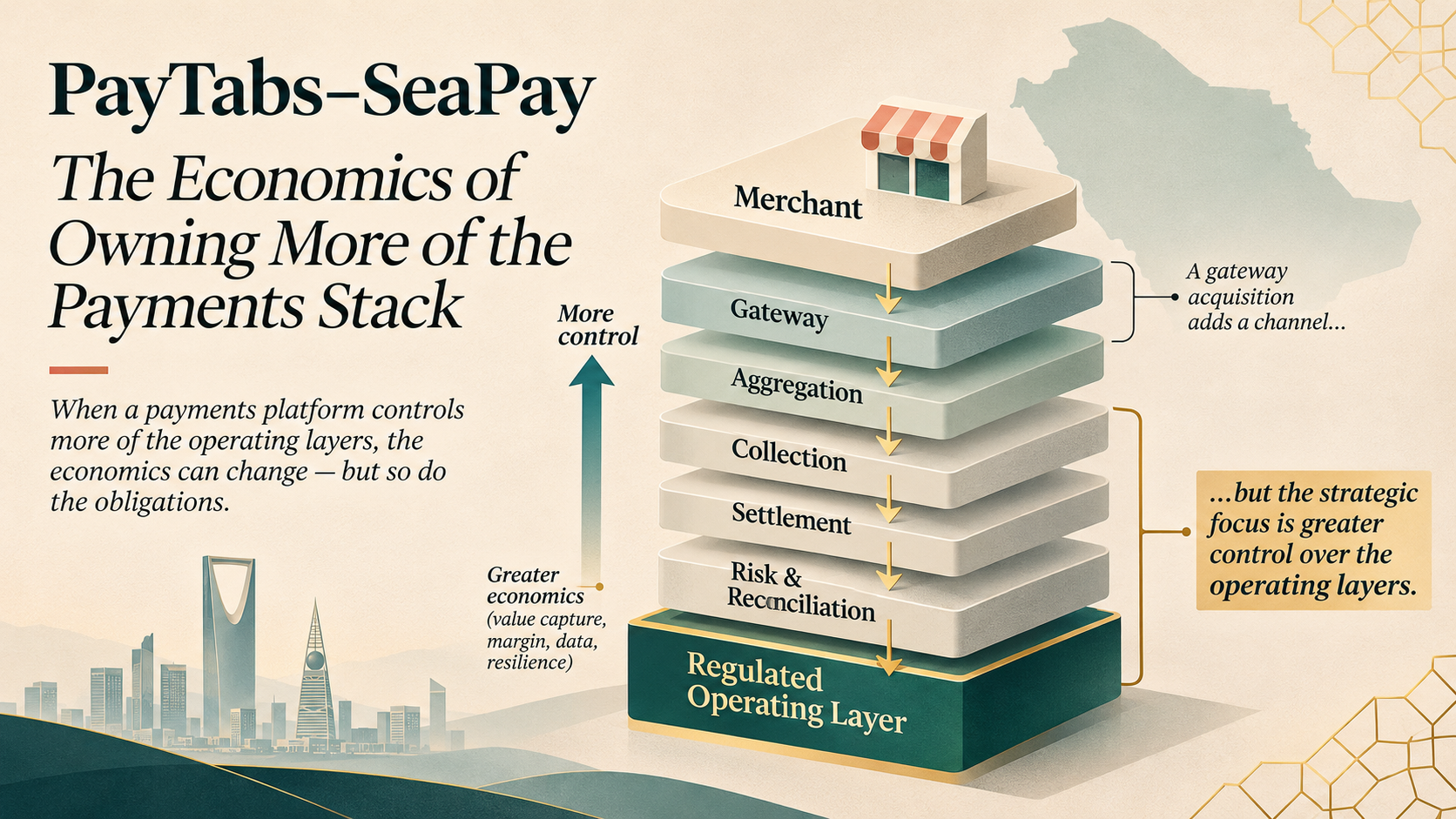
Operational gains may matter more than fee changes. Merchant onboarding, approval, reporting and exceptions frequently cross institutional boundaries. When authorization succeeds but settlement fails, the merchant wants an answer, not an explanation of the industry's division of labor. A more integrated platform could improve response times, reporting and retention if it executes reliably.
But taking responsibility for money is different from processing payment messages. An authorized transaction can still fail to settle. Funds may be paid to a merchant while some transactions remain subject to reversals, disputes or refunds. Someone must reconcile bank balances with transaction ledgers, manage cutoffs and exceptions, safeguard applicable client funds and maintain clear accountability for losses.
SAMA's regulations require safeguarding of relevant funds and specify controls, including reconciliation requirements. Depending on its activities, an expanded operating model also entails compliance, fraud monitoring, capital, liquidity and governance costs. These are not peripheral expenses; they are part of delivering a regulated payment service.
The test is therefore straightforward: does the additional retained revenue and better merchant service outweigh the investment, operating cost and risk of assuming those responsibilities? A company can control more steps in a payment and still end up with worse unit economics.
Saudi Arabia has moved beyond the adoption question
Saudi Arabia is an attractive place to test that model. SAMA reported that electronic payments accounted for 85% of retail payment transactions by number in 2025, up from 79% in 2024. National payment systems handled 14.6 billion electronic transactions, compared with 12.6 billion the previous year.
Those figures establish adoption, not provider profitability. With electronic acceptance routine, competition turns on merchant acquisition, reliability, pricing and service. Specialization and bank partnerships can remain viable alongside integration.
PayTabs says it aims to serve 200,000 Saudi merchants by 2030 and exceed $100 billion in annual processed volume across the group by that year. These are company targets, not current results. SeaPay might support those ambitions, but neither national transaction growth nor a new subsidiary establishes future margins.
Three transactions, three different objectives
SeaPay becomes more interesting when viewed alongside PayTabs' other 2026 activity.
In April, PayTabs announced it had acquired 100% of TAPn'GO technology, adding contactless acceptance capability. In September, it agreed to acquire Amazon Payment Services' MENA operations in a transaction valued above $100 million. Amazon Payment Services serves more than 3,500 businesses across nine regional markets; the companies expect the combined operation, if completed, to process more than SAR 150 billion annually.
Their purposes and statuses differ: TAPn'GO adds functionality, the Amazon agreement promises regional scale, and SeaPay could strengthen PayTabs' Saudi regulated operating base. The last point is my hypothesis, not a disclosed integration plan; it depends on SeaPay's permissions and existing arrangements.
Together, they suggest a possible effort to align technology, merchant relationships and regulated execution rather than merely broaden a product catalogue.
There is a distant precedent in Fiserv's 2019 acquisition of First Data, which brought banking technology, processing and merchant acquiring under one group. The scale and regulatory context are entirely different. The useful comparison is the test of integration: whether combining businesses changes operating performance, rather than merely expanding the number of services sold.
PayTabs has not quantified SeaPay-related cost savings, published enough standalone financials to establish a valuation multiple, or explained which merchant activities would move between its existing platform, SeaPay and the proposed Amazon Payment Services business. Those questions remain open, and the separate SAR 10 million funding commitment suggests there would be investment to make before any payoff.
For payment processors, gateways, acquirers and banks, that is the broader lesson. Owning a larger part of the payment chain matters only if it improves how the chain works. The measure is not the number of subsidiaries or licenses, but what changes in merchant service, retained revenue, reconciliation, risk and total operating cost.
If PayTabs completes SeaPay and makes those improvements, the SAR 35 million transaction could prove more consequential than its price suggests. Until then, it is a credible strategic proposition with an economic case still to be demonstrated.
Franco L. Di Pietro
The Payments Corner
30+ years across payments, fintech, banking, and financial infrastructure. Operator-level perspectives on the systems that move money.
The author is employed at Euronet Worldwide, a card issuer processing company. The author may own securities or assets referenced across The Payments Corner ecosystem. Content is provided for informational and editorial purposes only and should not be considered investment advice.
Related Insights
Grab's Atome deal consolidates checkout control, not BNPL market entry
Grab is not entering buy-now-pay-later; it already operates PayLater in Southeast Asia. The US$1.49 billion acquisition of Atome integrates a consumer lending book with wallet, acceptance and settlement—collapsing the stack that card schemes and acquirers currently mediate—and hinges on regulatory approval from Singapore's competition and banking authorities.
Citi's card-linked offer acquisition bets on cost, not on proven category economics
Citi's acquisition of Kard Financial rests on operational and financial logic—lower rewards spend, faster platform build—but the card-linked offer category itself has never demonstrated standalone profitability. Cardlytics, the only pure-play, has burned $1.15bn cumulatively since its 2018 IPO and generated negative shareholder equity last year.
How are FIs successfully migrating to modern core banking systems?
Visa's core migration playbook cites an anonymous national bank. The Kansas City Fed names it: Zions, $90 billion. The patterns are right — but they assume a negotiating position most institutions don't have.