
Banks risk losing visibility into customer spending as AI agents move transactions off the payment rail
When AI agents autonomously spend against prepaid accounts at platforms like Stripe, banks see only the funding event—not the thousands of micro-transactions or the logic that triggered them. Control over machine-spend policy may matter more than control over the card itself.
Subscriber · Sign in to listen to the audio briefing
Audio briefings are available to subscribers. Sign in with the email you used to subscribe — we'll send a one-time code.
Axios reported on August 17 that Stripe has agreed to acquire OpenRouter for more than $8 billion. As of this writing, I was not able to find an official announcement in Stripe's newsroom.
OpenRouter is not a name that circulates much in banking, so better to start there. It is a gateway. It sits between developers and roughly 400 AI models, so a company integrates once instead of holding separate contracts, keys, and billing relationships with every provider. Requests route across those providers on price, latency, or availability, metered per request at fractions of a cent.
Around eight million developers use it, a good share of them building agentic software. Stripe already powers its payments infrastructure.
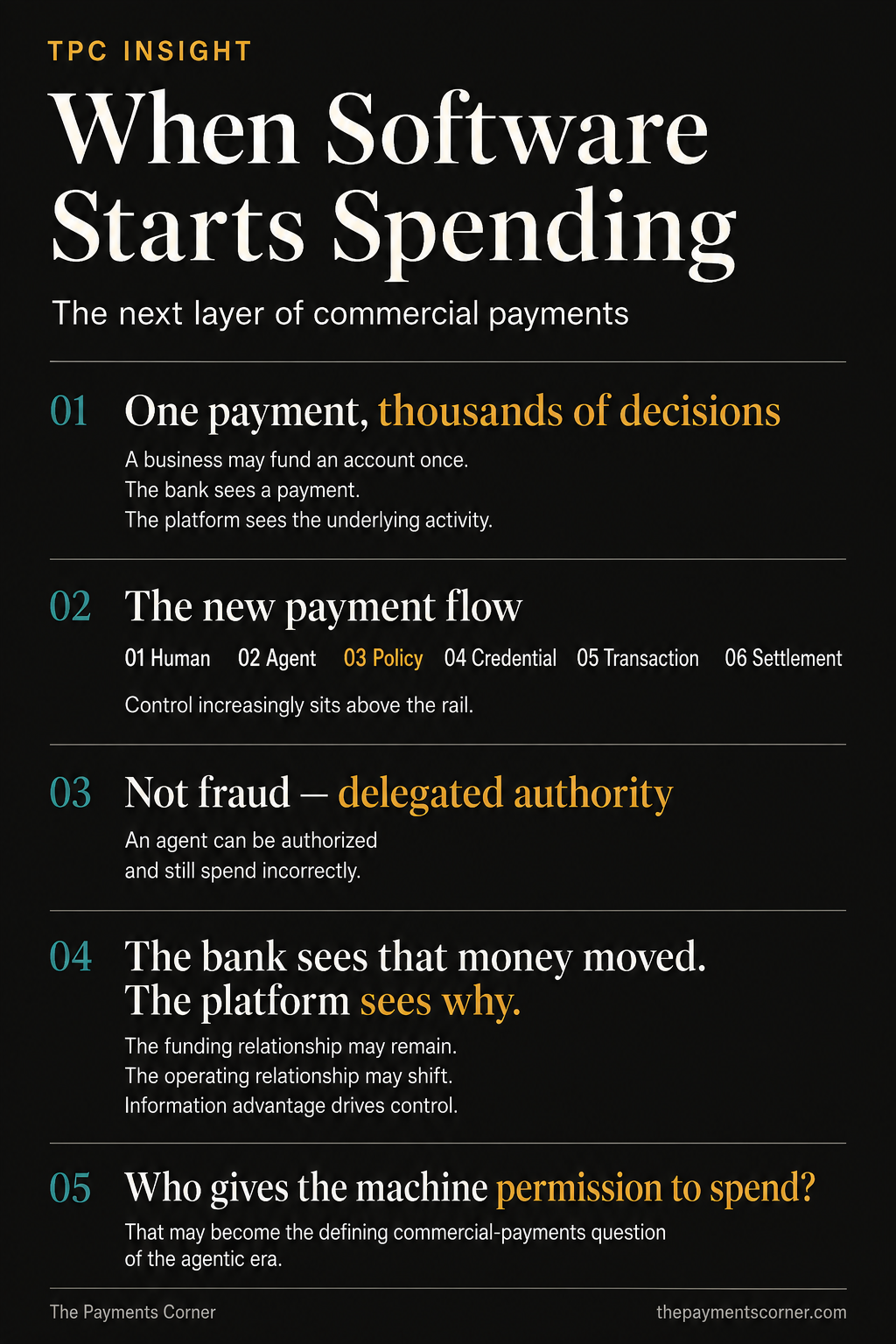
The payment transaction is separated and different from the economic activity that originated the flow.
A business funds an account once — think of it as a prepaid wallet for AI usage. Applications, workflows, and AI agents then draw that balance down thousands of times. OpenRouter already supports usage credits, spend controls, and workspace budgets that stop requests automatically when limits are reached.
Payment data has been valuable because it revealed economic activity. When a single payment funds thousands of software-driven decisions inside another platform, much of that visibility moves away from the financial institution.
Card rails do not disappear here. Stripe is already building Issuing for agents — virtual cards created for AI agents, with spending controls and authorization decisions made in real time.
The shift is in where the intelligence and control sit above the rail.
Commercial payment systems were built around people. Employees get cards, departments get budgets, transactions are approved, categorized, and reviewed after the fact.
Software creates a different problem.
Say an authorized AI agent consumes $25,000 of services because a workflow was configured incorrectly. The credential was not stolen. The merchant was legitimate. The service was delivered. The agent was authorized to act.
That is a delegated-authority problem, and our fraud frameworks do not reach it.
As software begins to transact autonomously, commercial payments will need to move from card controls to machine-spend controls: programmable credentials, purpose-based limits, vendor restrictions, real-time authorization, auditability, and clear escalation back to a human when something falls outside policy.
The stack starts to look less like:
Employee → Card → Transaction
and more like:
Human → Agent → Policy → Credential → Transaction → Settlement
So who owns the policy layer?
That layer may end up mattering more than the credential or the settlement. The advantage could go to whoever understands the context well enough to decide whether a transaction should happen at all.
Stripe already sits close to the revenue flows of many technology businesses. OpenRouter sits close to AI consumption, a growing cost line for AI-native companies. Together they could offer a far more current view of how a business is operating than periodic financial statements, balances, and traditional credit data allow.
Deposits are not leaving the banking system over this. The risk is that the bank becomes the funding endpoint rather than the operating relationship.
The customer keeps its checking account. But the decisions governing how money is allocated, controlled, and spent increasingly happen somewhere else.
The bank sees that $50,000 moved. The platform sees why.
The institution with the better read on a customer's operating activity is better positioned to provide expense management, working capital, treasury services, and eventually credit.
None of this argues for building an AI marketplace. It argues for payments modernization that extends past issuing cards to employees. The next generation of commercial banking may also require financial identities for software, agents, and workflows, along with the ability to control what those identities are permitted to do.
Who controls the financial identity and spending authority of the software acting on behalf of your commercial customer?
The next battle in commercial payments may not be over which card the employee carries.
It may be over who gives the machine permission to spend.
Franco Di Pietro
The Payments Corner
30+ years across payments, fintech, banking, and financial infrastructure. Operator-level perspectives on the systems that move money.
The author is employed at Euronet Worldwide, a card issuer processing company. The author may own securities or assets referenced across The Payments Corner ecosystem. Content is provided for informational and editorial purposes only and should not be considered investment advice.
Related Insights
Agentic AI in Payments Isn't Just Another Innovation Layer
AI agents are no longer simply assisting consumers. They're increasingly executing payments autonomously on their behalf. Not hypothetically. In present tense. That changes the architecture of payments itself — and forces a deeper question about whether infrastructure can support that level of machine autonomy safely.
Top of Permission — Agentic Commerce (3 of 4)
Issuers face a fork: be the passive endpoint of an agent's decision, or the layer that governs it.
Visa's Sixty-Year-Old Playbook for Agentic Commerce
Visa's announcements at the Payments Forum apply its sixty-year-old tollbooth playbook to agentic commerce: don't pick the AI winner, become the trust layer every transaction has to clear through. The standards for agent-driven commerce are being written this week — with you at the table or without you.