
Transaction Velocity, Not a Consumer-Credit Boom
Wall Street's blowout quarter was about money moving — not consumers borrowing more. Spending is up; borrowing is flat. That decoupling is where the next few years of lending and payments strategy get decided.
Subscriber · Sign in to listen to the audio briefing
Audio briefings are available to subscribers. Sign in with the email you used to subscribe — we'll send a one-time code.
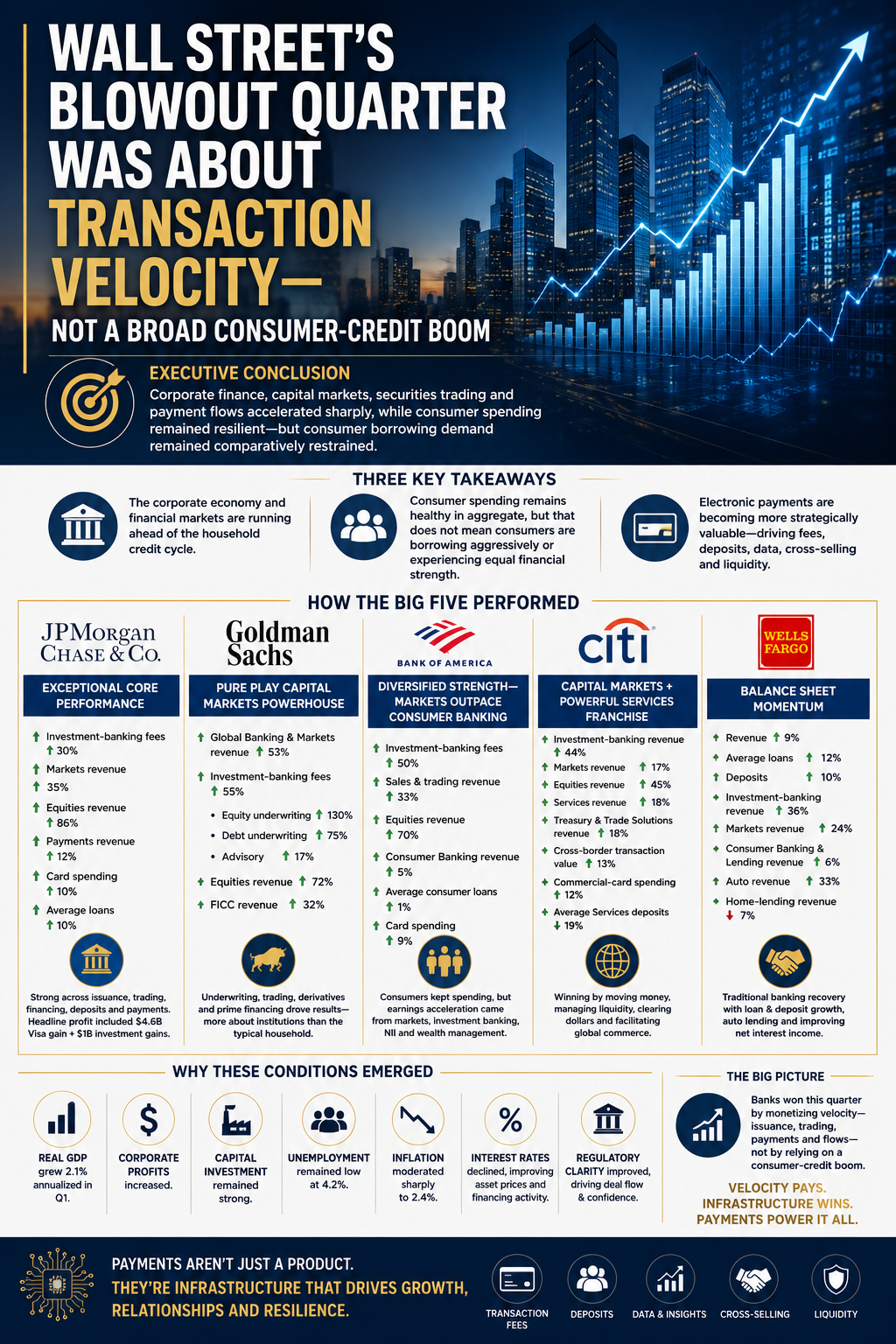
Wall Street had a blowout quarter because money was moving — not because consumers were borrowing more. Those are different economies, and the gap between them is the story.
Five banks earned roughly $49 billion in a single quarter, and the headlines read it as a strong economy. The prints said something narrower. The acceleration came from underwriting, trading, dealmaking, and payment flows — transaction velocity — not from households taking on debt. Goldman's banking and markets revenue rose 53%. JPMorgan's equities rose 86%. Strip out the movement of institutional money and the consumer chapter is quieter: spending resilient, borrowing flat.
That decoupling is the signal worth holding onto. Card spend rose roughly 10% across the majors — JPMorgan up 10%, Citi's U.S. cards up 11%, Bank of America's combined spend up 9%. Yet Federal Reserve data show revolving credit contracting, at a 4.7% annualized rate in May, with loan demand softening across cards and autos. Consumers are still transacting. They are not levering up to do it. Payment volume and credit appetite have come apart.
Two consequences follow. For consumer lending, the era of broad balance-sheet expansion is not back — precision is. Banks are competing hard for prime and affluent cardholders, growing lines selectively, and increasingly underwriting on transaction and deposit behavior rather than bureau scores alone. The consumer economy is a barbell, and it is being financed like one.
For payments, interchange is no longer the point. The transaction flow is valuable for the deposit it parks, the data it generates, the treasury relationship it anchors, and the lending it eventually cross-sells. Citi's Treasury and Trade Solutions revenue rose 18% — that is the tell. Whoever holds the payment credential increasingly holds everything downstream of it.
The banks did not report that everyone is doing well. They reported that money moved — and that the institutions positioned where it moved got paid. The question the next few years will answer is who owns the flow when spending and borrowing have stopped moving together.
#Banking #ConsumerCredit #Payments #IssuingRisk #Fintech
Franco Di Pietro
The Payments Corner
30+ years across payments, fintech, banking, and financial infrastructure. Operator-level perspectives on the systems that move money.
The author is employed at Euronet Worldwide, a card issuer processing company. The author may own securities or assets referenced across The Payments Corner ecosystem. Content is provided for informational and editorial purposes only and should not be considered investment advice.
Related Insights
Banks Post Record Earnings While Stock Prices Stall on Multiple Compression Fears
Major U.S. banks delivered exceptional Q3 results—Goldman up 23% in net revenue, JPMorgan up 6%, Morgan Stanley posting record wealth management—yet their share prices fell as investors reset valuation multiples downward. The disconnect suggests markets are pricing in earnings sustainability risks rather than disputing the current numbers.
BNPL Sits Directly in the Gap Between Consumer Behavior and Traditional Credit Models
BNPL sits directly in the gap between how consumers experience credit and how institutions traditionally model it. The consumer-side behavioral pattern is consistent and well-documented. But the issuer-side value proposition is discussed far less often — even though it may be just as important.
Consumers Experience Credit Very Differently Than Institutions Model It
Most credit models assume people think in terms of credit limits, utilization, APRs, and revolving balances. But consumer behavior tells a very different story. Households experience credit through a much more immediate and practical lens — and that disconnect shapes everything from product design to underwriting logic.