
A Map, Not a Portfolio
The methodology behind the 50 TPC Payments Index — the reasoning that turns fifty tickers into an instrument for reading the payments ecosystem, and the discipline that keeps it from becoming a watchlist.
The problem this framework exists to solve
Payments is one of the few industries where the words used to describe it have quietly stopped working. "Fintech" now covers a lender, a wallet, a bank, and a piece of infrastructure with equal imprecision. "Processor" describes companies whose businesses share little beyond a suffix. "Bank" names an institution that may be an issuer, an acquirer, a network participant, and an infrastructure customer at the same time. The labels survive out of habit, but they no longer tell you what a company does to a transaction, where it sits in the flow of money, or whose results explain its own.
That failure of vocabulary is not cosmetic. It is why the industry is so often read badly — as a collection of independent stories, each company narrated on its own terms, each quarter treated as a verdict on a single business rather than a data point about a system. The payments industry does not actually work that way. Its most important movements happen between companies, not inside any one of them. A network reprices cross-border interchange and the effect surfaces in acquirers, issuers, and travel platforms that never appear in the network's own release. A core processor guides its revenue down and the read-through reaches every bank whose modernization budget just tightened. An installment lender's loss rate moves and it anticipates, by a quarter or two, what a card issuer's charge-offs will later confirm. Read in isolation, each of these is a footnote. Read against one another, they are the same event seen from four windows.
The 50 TPC Payments Index exists to provide those windows in a single frame. It is not a ranking and not a recommendation. It is an instrument for reading an industry that no longer fits its own labels — a way of holding fifty vantage points against each other, over time, so that the connections between them become legible. The premise is simple and, once stated, hard to unsee: no single company shows the whole picture, and the analytical value lives in the comparison.
Why public companies
If the goal is to read the system continuously, public companies are the only instrument fine enough to do it. They report earnings on a schedule they do not control, disclose operating metrics under rules they did not write, publish management commentary that is legally constrained from being fanciful, and generate a market reaction to every strategic move. That cadence of disclosure — audited, recurring, and comparable across companies and across cycles — is the closest thing the industry has to a live instrument panel.
Private companies matter enormously to payments; some of the most consequential businesses in the ecosystem are private, and the framework is honest about not seeing them directly. But private companies surface only when they choose to — a funding round, a leak, a conference remark — and what they surface is curated. The public set surfaces on a clock nobody controls, in a format built to be compared quarter to quarter and peer to peer. That comparability is the whole point. A single private disclosure is an anecdote. A public disclosure is a reading you can place next to fifty others and forty prior quarters.
This is also where the framework parts company with the way markets are usually discussed. The index reads the panel; it does not bet on the gauges. Price is present in the framework, and it is treated with respect, because price is a candid signal — it aggregates what thousands of participants are willing to stake on where this industry is heading, and unlike management commentary, it cannot hedge. But price is an input to the reading, never its output. What price reveals is conviction and its changes; what it conceals is why. A stock can fall on a strong quarter and rise on a weak one, and the gap between the number and the reaction is frequently the most informative thing in the release. The framework uses price the way a physician uses a fever: as a real signal that something is happening, and as a prompt to look for the mechanism, never as the diagnosis itself.
It is worth being precise about what each kind of disclosure can and cannot support, because the framework leans on some signals more heavily than others. Reported operating metrics — volumes, active accounts, take-rate, charge-offs — are the load-bearing evidence; they are audited or audit-adjacent, defined with enough consistency to compare across peers, and slow enough to move that a trend in them is usually real. Management commentary is softer: useful for the questions it is asked and the questions it evades, valuable as a read on tone and priority, but constrained by the incentive to narrate favorably. Price is softer still in one sense and harder in another — it is the noisiest signal quarter to quarter, buffeted by positioning and flows that have nothing to do with payments, and simultaneously the most honest over longer horizons, because sustained conviction is expensive to fake. The framework weights these accordingly: it builds its readings on operating metrics, uses commentary to interpret them, and treats price as the market's contested vote on what the metrics and commentary add up to. Conflating the three — reading a price move as though it were an operating fact — is the most common error in payments analysis, and the framework is structured to keep them separate.
What earns a place
Because the instrument is built to read function rather than reward attention, the rule for inclusion is deliberately indifferent to the things that usually decide these lists. Market capitalization, price momentum, popularity, fintech branding, and membership in a conventional financial-sector index are explicitly not criteria. They describe how much notice a company attracts. The framework is built to track what a company reveals.
A company earns a place when it meets several of the following, not merely one. It controls, enables, influences, or monetizes a meaningful part of the payment flow. Its financial or operating performance discloses something about the broader ecosystem that is not clearly visible elsewhere. Its results help explain the performance of companies in other categories. It represents an important business model, infrastructure layer, customer interface, funding mechanism, or distribution channel rather than a variation on one already present. And it carries enough public history to be read across cycles rather than in a single quarter. The test, compressed to a sentence: a name belongs when its movements help explain other companies' movements, and when it adds a signal the set does not already hold.
Two recent decisions show the rule working in both directions. Bread Financial earned a place in The Balance Sheets not because the category lacked a card issuer, but because it carries a different read on the card consumer than the diversified issuers already present: a concentrated private-label and co-brand book that normalizes faster and harder, giving the sharp end of retail credit where the larger issuers give the smooth one. That is non-duplicative signal, which is the standard. The Bancorp earned its place by filling a layer the set did not cover at all — the sponsor-bank rails underneath the fintech programs the index already tracks elsewhere, the balance sheet on which banking-as-a-service pressure first registers. Neither was added to complete a number.
The exclusions are as instructive as the inclusions. Several of the largest companies touching payments are deliberately absent, because their payments signal is buried inside a business that is mostly something else. When payments revenue is folded into a device franchise, a cloud segment, or a retail-and-advertising conglomerate, the disclosure does not isolate the payments read cleanly enough to compare it to a company that does nothing else. Size is not the qualification; separability of signal is. A company is also excluded when its signal merely duplicates one already held, or when its public history is too short to read across a cycle. Presence on the list is a statement that a company shows the ecosystem something specific and comparable — nothing more, and nothing about its prospects.
Applied honestly, this rule produces a list that stays deliberately unsettled. The universe is capped at fifty and, for most of its life, sat below the cap — forty-seven, then forty-eight, numbers no one builds a name around, and that never mattered. A name enters when it begins carrying a signal no incumbent provides; it leaves when that signal goes quiet or collapses into one already in the set. The discipline lives in the criteria, not in defending a round number. The list reached fifty only when the final places were earned on merit rather than assigned to complete the count, which is the only condition under which a round number is worth having.
The discipline of the set
A framework built on a criterion has to be maintained against that criterion, or it drifts into the thing it was designed not to be. Two design choices keep it honest.
The first is the cap. Fifty is a ceiling, not a target, and its purpose is to force a trade-off. Without a cap, a tracking universe grows monotonically — every plausibly relevant company is eventually added, because there is always an argument for one more, and the set decays into a directory that tracks everything and therefore explains nothing. The cap makes addition costly. Past a certain point, a new name must displace an existing one, which means the case for inclusion becomes a comparative case: not "does this company matter" but "does this company reveal more than the name it would replace." That comparison is where the discipline lives, and it is only possible because the ceiling exists. A set that can always grow never has to choose, and a set that never chooses is not an instrument.
The second is the willingness to sit below the cap. For most of its life the universe held under fifty, and the refusal to fill it was deliberate. An empty seat is not a failure to be corrected; it is a statement that no available company has yet earned the place. The alternative — reaching for the round number because the number is marketable — is precisely the failure the criterion exists to prevent, and it is a failure that compounds, because a name added to complete a count sets the standard for the next one. Holding a seat open until a company earns it is what keeps the criterion credible for every name already inside.
Entry and exit are therefore continuous rather than scheduled. A name is added when it crosses from interesting to necessary — when it begins carrying a signal the set demonstrably lacks — and a name is a candidate for removal when its signal fades, when it is acquired or restructured out of relevance, or when the ecosystem produces a company that reveals the same thing more clearly. Category placement is reviewed on the same standard, because a company's primary signal can migrate as its business evolves; a name assigned to one function on the strength of its dominant signal may, a year later, belong to another. The set is meant to be revised. Its stability is in the criterion, not in the roster.
The six categories
The fifty are organized into six categories, and the categories are the argument. They are named for functions rather than sectors, because a category that names the function tells an analyst exactly what to watch for in the numbers, where a sector label tells them almost nothing. Each category is defined below by four things: the signals it surfaces, what those signals let an analyst observe about the wider system, how it interacts with the other five, and where its boundary is deliberately imperfect.
The Tollbooths — card networks
Signals. The networks sit closest to the flow of money and see it first. Their disclosures carry payment volume, transaction counts, cross-border volume, incentive and rebate commentary, and the spread between reported and organic growth — the broadest, earliest read on spending and acceptance the public set contains.
What it lets you observe. Because the networks toll nearly every card transaction regardless of who issued it or who acquired it, their volume commentary is the closest thing to an aggregate spending index that reports on a corporate calendar. Cross-border volume, in particular, is a read on travel, international commerce, and the health of the higher-margin transactions that drive network economics. When a network describes a change in consumer behavior, the other five categories are usually about to confirm it.
How it interacts. The Tollbooths lead. Their volume shows up downstream as issuer spending, acquirer processing revenue, and platform take-rate, typically a quarter before those companies report the same underlying activity in their own terms. A divergence between network volume and issuer commentary is one of the most useful cross-category signals the framework produces.
Where the boundary blurs. Networks are no longer only networks. They sell tokenization, identity, fraud, data, and increasingly money-movement services that overlap with The Engines and The Corridors. The category tracks the switching-and-acceptance signal because that is what the networks explain most clearly for the rest of the set; it does not pretend their businesses stop at the toll.
The Balance Sheets — issuing banks and lenders
Signals. This category holds the credit relationship with the consumer. Its disclosures carry loan and receivable growth, deposit behavior, net interest margin, reserve builds and releases, delinquency and charge-off trends, and the tone of management on the state of the borrower.
What it lets you observe. The Balance Sheets are where the cost and availability of credit become visible before they reach the products built on top of them. Charge-off and delinquency trends read the consumer's ability to pay; reserve behavior reads the institutions' expectations for that consumer; deposit and funding commentary reads the price of the money the whole system runs on. When these companies tighten, the effect propagates outward to everything that depends on consumer credit being extended.
How it interacts. This category is the funding and credit backstop for the ecosystem. Its charge-off trends confirm, a quarter or two later, what installment lenders in The Interfaces and network volume in The Tollbooths signalled earlier. Its funding costs set the benchmark against which thinly capitalized platforms elsewhere are measured.
Where the boundary blurs. A large issuer is also an acquirer, a network participant, and an infrastructure customer, and its card business is one line in a diversified bank. The category isolates the consumer-credit signal because that is the read these companies contribute most cleanly; the rest of their franchise is noise for this particular purpose, even when it dominates their earnings.
The Engines — processing and core-banking infrastructure
Signals. The Engines run the rails underneath everyone else. Their disclosures carry recurring-revenue growth, processing volumes, bookings and backlog, renewal and attrition commentary, and capital spending on platform modernization — the operating metrics of the companies banks and issuers pay to keep the system running.
What it lets you observe. This is the category that exposes the parts of payments the public rarely sees directly: bank technology budgets, issuer priorities, modernization demand, and the slow migration off legacy platforms that takes years and touches every institution eventually. When an engine's bookings accelerate, banks are investing; when renewals soften, budgets are under pressure. The Engines convert invisible infrastructure spending into a readable signal.
How it interacts. When an engine stalls, the banks and programs riding on it feel it next, and the framework can watch that transmission happen. Modernization demand here is the leading edge of change that will surface later as new capabilities in The Interfaces and new program launches in The Balance Sheets.
Where the boundary blurs. "Infrastructure" spans a pure software processor, a merchant-acquiring platform, a decisioning-and-scoring layer, and a sponsor bank that is technically a balance sheet performing an infrastructure function. The category groups them by the signal they contribute — the health of the rails and the demand to modernize them — while acknowledging that the businesses inside it are less alike than the label suggests. It is the category whose internal seams are widest, and the framework says so rather than smoothing them over.
The Interfaces — consumer and merchant platforms
Signals. The Interfaces are where payments meet the people using them. Their disclosures carry gross payment volume, take-rate, active accounts and users, merchant counts, attach and penetration metrics, and — for the lenders among them — origination volume, funding costs, and loss rates.
What it lets you observe. This category reads the transaction at the surface: merchant health, the degree to which commerce has been converted into payments revenue, the terms on which consumers are being extended credit at checkout, and the steady migration of financing toward the moment of purchase. Wallets, merchant software, installment credit, and digital banks sit here together because they compete for the same surface — the transaction itself — even as their business models diverge sharply.
How it interacts. The Interfaces sit at the confluence of every other category. Their volume reflects network activity from The Tollbooths; their lending reflects credit conditions from The Balance Sheets; their capabilities reflect modernization from The Engines; and their cross-border features reach into The Corridors. This is where the system's other signals arrive at the consumer, which makes it the richest category to read against the others and the easiest to misread in isolation.
Where the boundary blurs. This is the category doing the most work, and its internal diversity is deliberate and imperfect. A single company here can be a merchant acquirer, a consumer wallet, and a lender in the same quarter; the sixteen names span four distinguishable functions that a stricter taxonomy might separate. The framework keeps them together because they contest one surface, and it accepts the coarseness as the price of that clarity — while flagging, rather than hiding, that The Interfaces is where the lens is broadest.
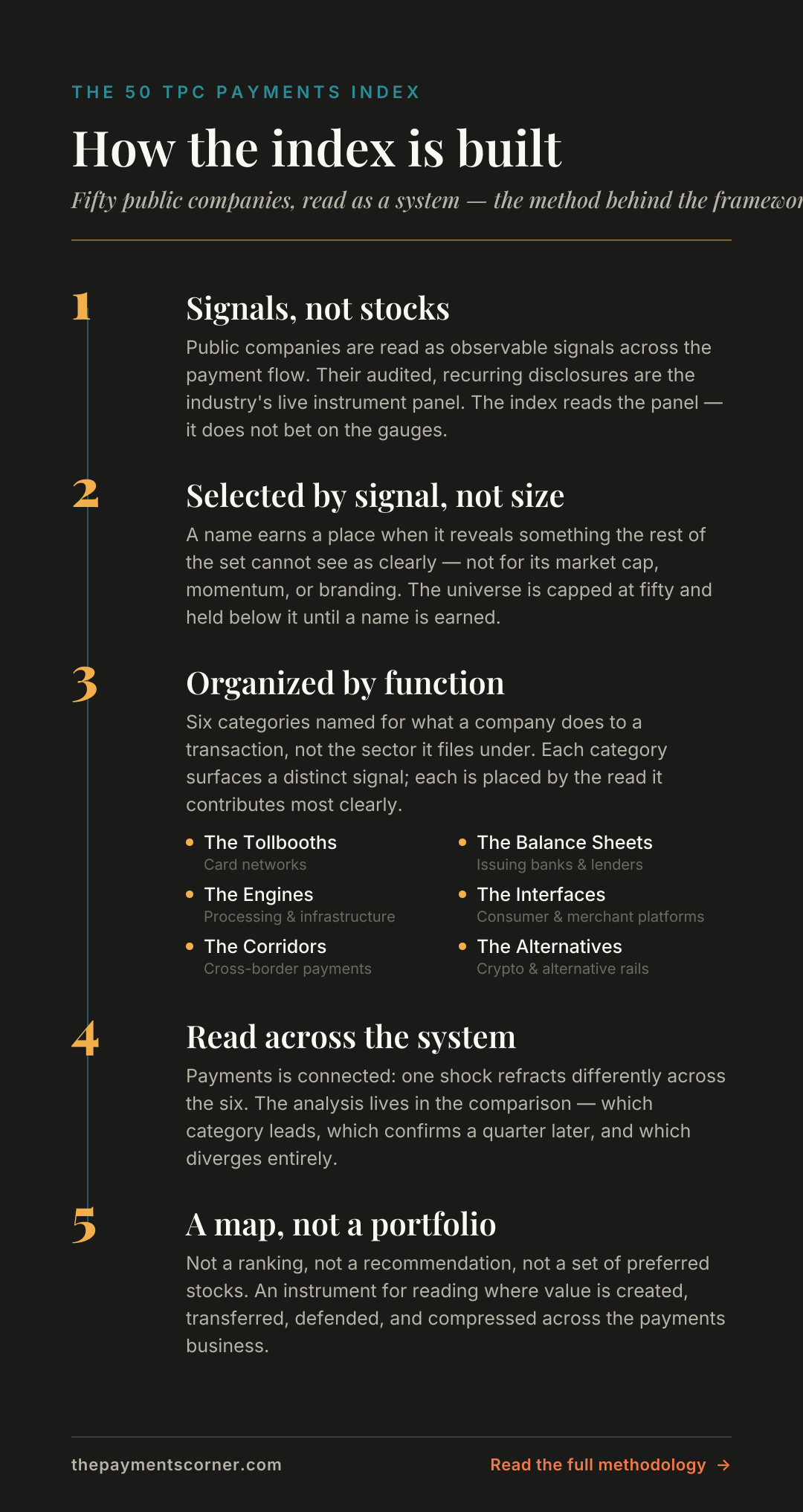
The Corridors — cross-border payments and remittances
Signals. The Corridors monetize money in motion between countries. Their disclosures carry send volume, corridor mix, take-rate, foreign-exchange economics, digital-versus-cash transition metrics, and active-customer trends across specific geographic routes.
What it lets you observe. This category reads migration flows, remittance demand, international commerce, and the economics of moving value across borders — signals that are largely invisible in the domestic-facing categories. It also reads the slow displacement of the correspondent-banking system by digital-first rails, a structural shift the incumbents and the challengers narrate from opposite sides within the same category.
How it interacts. The Corridors overlap with The Tollbooths on cross-border card volume, with The Interfaces on the platforms embedding remittance features, and with The Alternatives where stablecoin and on-chain settlement compete for the same flows. Cross-border is where several of the framework's other threads converge on a single economic activity, which makes the category a useful check on claims made elsewhere.
Where the boundary blurs. A corridor operator that adds a wallet becomes part-Interface; a processor that adds cross-border rails reaches into this category from The Engines; a network's cross-border volume is a Tollbooth signal about the same activity. The category tracks the money-in-motion signal specifically, and treats the overlaps as features of a connected system rather than classification errors.
The Alternatives — crypto and alternative rails
Signals. The Alternatives price the part of the system still arguing for its own future. Their disclosures carry trading and transaction volumes, assets on platform, stablecoin supply and settlement metrics, and — more than any other category — a market reaction dominated by conviction about what has not happened yet.
What it lets you observe. This category is where narrative and adoption are tested against each other in real time. It reads the market's shifting belief about whether stablecoin settlement, on-chain money movement, and alternative rails displace the incumbents or remain adjacent to them. The signal here is as much about expectation as about current economics, which makes it the category where the gap between price and fundamentals is widest and most informative.
How it interacts. The Alternatives are the pressure test for claims made in every other category. When stablecoin settlement is discussed as a threat to The Corridors or a complement to The Engines, this category is where that thesis meets a tradable market. Its volatility is a feature: it registers changes in conviction faster than the slower-moving categories register changes in fundamentals.
Where the boundary blurs. The category contains a regulated stablecoin issuer, crypto exchanges, and consumer platforms whose crypto exposure is one line among several — businesses united more by the future they are pricing than by what they currently do. It is the category most defined by a thesis rather than a function, and the framework holds it lightly, ready to reclassify names as their primary signal resolves.
The categories are a lens, not a filing system
Every boundary described above is imperfect on purpose, and the imperfection is not a flaw to be corrected. Many of these companies operate across several layers at once. A commerce platform can be an acquirer, a wallet, and a lender simultaneously. A network sells processing, identity, and risk services alongside its switching business. A sponsor bank is both a balance sheet and a piece of infrastructure. Forcing each of these into a single airtight definition would produce a tidier taxonomy and a worse instrument.
The framework resolves this by assigning each company to the category that best represents the primary signal it contributes — the thing it explains most clearly for the rest of the set — rather than the category that captures the largest share of its revenue. Where a name sits is an editorial judgment about signal, and the framework treats it as a judgment rather than a fact, revisable as a business evolves. The overlaps are acknowledged in the open, because they are real, and because the seams between categories are frequently where the most interesting reading happens. A taxonomy that hid its own imperfections would be claiming a precision the industry does not have.
The framework at work: two readings
The value of the framework is not in the categories individually but in how they move together. A single development shows up differently across the six, and the differences are the analysis. Two worked cases — one cyclical, one structural in its mechanism — show the instrument doing two distinct kinds of reading.
Case one: a consumer-spending slowdown
Begin with a broad softening in consumer spending, the kind that arrives gradually and is contested in real time. The framework does not wait for confirmation from any single company; it watches the signal propagate in sequence, and the sequence is itself the evidence.
It appears first in The Tollbooths. Network volume growth decelerates, and cross-border — the higher-margin, more discretionary slice — softens ahead of domestic. Because the networks toll nearly everything, this is the earliest systemic read, and it lands a quarter before most of the companies whose activity it describes will report.
It reaches The Interfaces next, unevenly. Merchant platforms tied to discretionary categories see volume growth slow and take-rate pressure build. The installment lenders in this category are the leading edge of stress: as consumers stretch, origination may actually rise even as loss rates begin to turn, and the framework reads that combination — more lending into a weakening consumer — as a warning rather than a strength.
It confirms in The Balance Sheets, later and more slowly. Delinquencies tick up first, then charge-offs; reserve builds follow as issuers acknowledge the trend their own charge-off data now forces. This is the confirmation the earlier categories anticipated, arriving on the lag that makes the sequence readable. When The Balance Sheets confirm what The Tollbooths signalled two quarters earlier, the reading is complete.
The Engines feel it last and least directly, through the demand side of their business: as banks absorb credit costs, modernization budgets tighten, and bookings commentary softens with a long lag. The Corridors may diverge entirely — remittance flows are often counter-cyclical or driven by factors unrelated to domestic discretionary spending, and a corridor operator holding volume while domestic categories weaken is a genuine signal, not noise. The Alternatives, meanwhile, react to the macro conviction shift faster than to any payments-specific fundamental.
Read together, these are not six separate slowdowns. They are one slowdown, refracted, and the framework's contribution is the sequencing: it shows which category leads, which confirms, which diverges, and how long the transmission takes. No single company could show that. The comparison is the instrument.
Case two: a higher-for-longer rate regime
Now take a shock with a different mechanism: not a change in the volume of spending but in the cost of money, sustained rather than transitory. This case demonstrates a different analytical move — the same shock reading with opposite signs across adjacent categories at the same moment.
For much of The Balance Sheets, sustained higher rates are a tailwind. Net interest margins widen, and well-capitalized issuers earn more on the credit they extend — provided the same rates do not break the consumer's ability to pay, which returns the reading to the charge-off data from the first case. The category's signal here is a balance between margin benefit and credit risk, and the framework reads both sides rather than either alone.
One category over, in The Interfaces, the same rates are a headwind for the installment lenders, whose funding costs rise and whose unit economics compress precisely as the balance-sheet issuers benefit. A thinly capitalized platform that funds its originations in the market is squeezed by the environment that helps the deposit-funded issuer. The framework places these companies in different categories specifically so that this sign-flip is visible: the same rate regime, read as a tailwind and a headwind, in two categories that both extend consumer credit.
The Engines refract it differently again. Higher rates raise the cost of capital for the bank customers whose budgets fund modernization, which can slow discretionary technology spending — but they also raise the return on the efficiency that modernization delivers, which can accelerate it. The category's signal becomes the net of those pressures, readable in bookings and renewal commentary.
The Corridors absorb rates primarily through foreign-exchange economics and the relative cost of digital versus incumbent rails, a mechanism largely orthogonal to the domestic credit story. And The Alternatives, once more, price the conviction shift: sustained higher rates compress the valuation of businesses whose value is weighted toward a distant future, and this category, holding the names most exposed to that discounting, moves first and hardest on the macro signal.
The lesson of the second case is the opposite of the first. Where the slowdown propagated in sequence, the rate regime refracts simultaneously and divergently — helping and hurting different categories at the same instant. An analyst reading any one category would draw a confident and incomplete conclusion. The framework's contribution is to hold the tailwind and the headwind in the same frame and refuse to resolve them into a single verdict, because the system does not resolve them either.
What the framework is not
The tracked universe is not a portfolio. It is not a list of preferred stocks, a set of recommendations, a ranking of expected returns, or a model portfolio to be replicated. Inclusion is a statement that a company reveals something specific and comparable about the ecosystem — nothing about whether its shares are attractive, and nothing about where they are headed. A company can carry a valuable signal and a falling stock; the framework tracks it for the signal.
The instrument has limits, and naming them is part of the method. It sees only public companies, which means the private businesses shaping payments — some of the most important in the ecosystem — are visible to it only indirectly, through the disclosures of the public companies they touch. It reads price as a signal of conviction, which means it inherits every distortion of sentiment, positioning, and short-term flow that price carries; the framework treats those distortions as information to be interpreted, not as truth to be trusted. Its category boundaries are editorial judgments, revisable and occasionally wrong. And it is a map, not the territory: it describes how value moves through the payments business, and a map that were fully complete would no longer be useful.
A word on independence. The author works in the payments industry, and that fact is disclosed rather than hidden. The Payments Corner maintains a documented conflict-of-interest framework, and the worked examples in this document are kept clear of names where the publication's editorial coverage and the author's professional role could intersect. Sharp characterizations throughout are structural — statements about mechanisms and positions in the flow of money — rather than claims about the intentions or prospects of named institutions. The full framework is published at /disclosures. None of this is investment advice.
What this anchors
This methodology is not a document that sits apart from the rest of The Payments Corner. It is the foundation the rest of the publication stands on, and its logic is visible in everything downstream.
The weekly Pulse is this framework applied on a calendar. When the Pulse reports that a category led or lagged, that the corridors held while the alternatives sold off, or that a signal in one category anticipates a move in another, it is running the exact instrument described here across a single week of tape. The categories in the Pulse are these six categories. The cross-category readings in the Pulse are the transmission mechanisms worked through above. The Pulse is not a separate product with a separate logic; it is this document, in motion.
The same is true of the ecosystem framing that runs through the publication's longer analysis. When a piece traces how one development — agentic commerce, stablecoin settlement, a shift in credit toward checkout — reshapes several parts of the industry at once, it is using the connected-system model this methodology formalizes. The framework is what lets that analysis be more than a collection of company notes. It is the reason the parts cohere.
That is the whole design. Fifty companies, six functions, one instrument for reading a business that no longer fits its old labels — published in full and in the open, because a method worth trusting is a method worth showing. The analysis can be earned; the method should be free.
What you have just read is how the instrument is built. The value is in what it does every week. The Pulse applies this framework to the live tape — which category led, which lagged, which signal in one corner of the ecosystem is quietly anticipating a move in another — while the index behind it updates as the fifty report, revise, and occasionally change places. The categories are these categories; the cross-readings are these mechanisms; the model is this model, in motion. A methodology explains how to read the payments business once. A subscription is how you read it continuously — the weekly markets intelligence, the index as it moves, and the framework applied to whatever the industry does next, arriving as it happens rather than found long after it mattered.
Subscribe to read the payments business the way this framework reads it — one week, and one signal, at a time.
Not a watchlist of stocks. A map of how payments makes money — and a way to watch that map redraw itself.
Franco Di Pietro
The Payments Corner
30+ years across payments, fintech, banking, and financial infrastructure. Operator-level perspectives on the systems that move money.
Disclosure: The Payments Corner's founder is employed at Euronet Worldwide, a global infrastructure and transaction processing company. The publication may discuss securities or assets touching that domain. Content is provided for informational and editorial purposes only and should not be considered investment advice.
Related Insights
Offline authorization is not resilience — it's the foundation of it
European payment networks are mandating offline card capabilities across the continent, but the real challenge lies not in the terminal's ability to approve locally, but in how issuing infrastructure, issuer processors, and merchants manage the gap between the moment of authorization and the eventual settlement of accounts.
Mexico Decides Who Pays to Leave Cash Behind
A framework law approved in Mexico's lower house in early October delegates the cost of digital acceptance to whoever moves last in the chain—card issuers, acquirers, or the state itself—without requiring any party to absorb it. A six-month trial that zeroed interchange at gas stations shows why: the subsidy leaked away, the regulatory ceiling on interchange removes the tool the trial used, and the law gestures toward SPEI-based QR codes as the permanent answer, leaving the market structure choice to regulators who have not yet chosen.
The Regulator Writes the Screen
On September 3rd the Central Bank did not issue a payments rule. It issued an interface specification — and behind it sits exclusion from the arrangement for sixty months.