
Agentic Commerce and the New Role of Card Issuers
Why Processing Infrastructure Becomes the Control Plane for Delegated Payments
Executive Summary
Agentic commerce will not simply change the digital shopping experience. It will change the underlying authorization model of payments.
For most of the card industry's history, payments have assumed a relatively direct relationship between the consumer and the transaction. A cardholder presents a credential, a merchant requests authorization, the issuer approves or declines, and the network, acquirer, processor, and issuer execute the payment lifecycle.
Agentic commerce introduces a different construct. The consumer may no longer be the direct actor at every step. Instead, the consumer may delegate a task to an AI agent: find the product, compare options, evaluate delivery terms, apply preferences, select a merchant, initiate checkout, and potentially complete payment.
That shift creates a new strategic question for card issuers:
Was this economic action properly delegated, authenticated, controlled, funded, protected, and recorded?
This is not only a user-experience question. It is a processing, risk, compliance, fraud, servicing, and liability question.
Visa, Mastercard, American Express, Stripe, and OpenAI are already shaping the infrastructure around agentic commerce. Visa Intelligent Commerce focuses on secure AI-initiated transactions by embedding payment credentials, controls, authentication, and protections into automated buying experiences.1 Mastercard Agent Pay is designed around trusted, tokenized agentic transactions and has expanded the concept into machine-to-machine payments.23 American Express is emphasizing trust, visibility, and registered agents, and has announced a forthcoming purchase-protection commitment for eligible agentic-commerce errors.45 Stripe and OpenAI's Agentic Commerce Protocol is positioned as an open standard for commerce flows between buyers, AI agents, and businesses.6
The common denominator is clear: agentic commerce requires a more intelligent payment infrastructure layer.
For card issuers, this means the processing stack becomes more strategic, not less. The processor must evolve from a transaction execution platform into a real-time policy engine that can interpret intent, permissions, token context, risk signals, authentication events, and downstream servicing requirements.
The issuer of the future will not only approve a transaction. It will govern the delegation of economic intent.
1. Market Context: From Checkout to Delegated Commerce
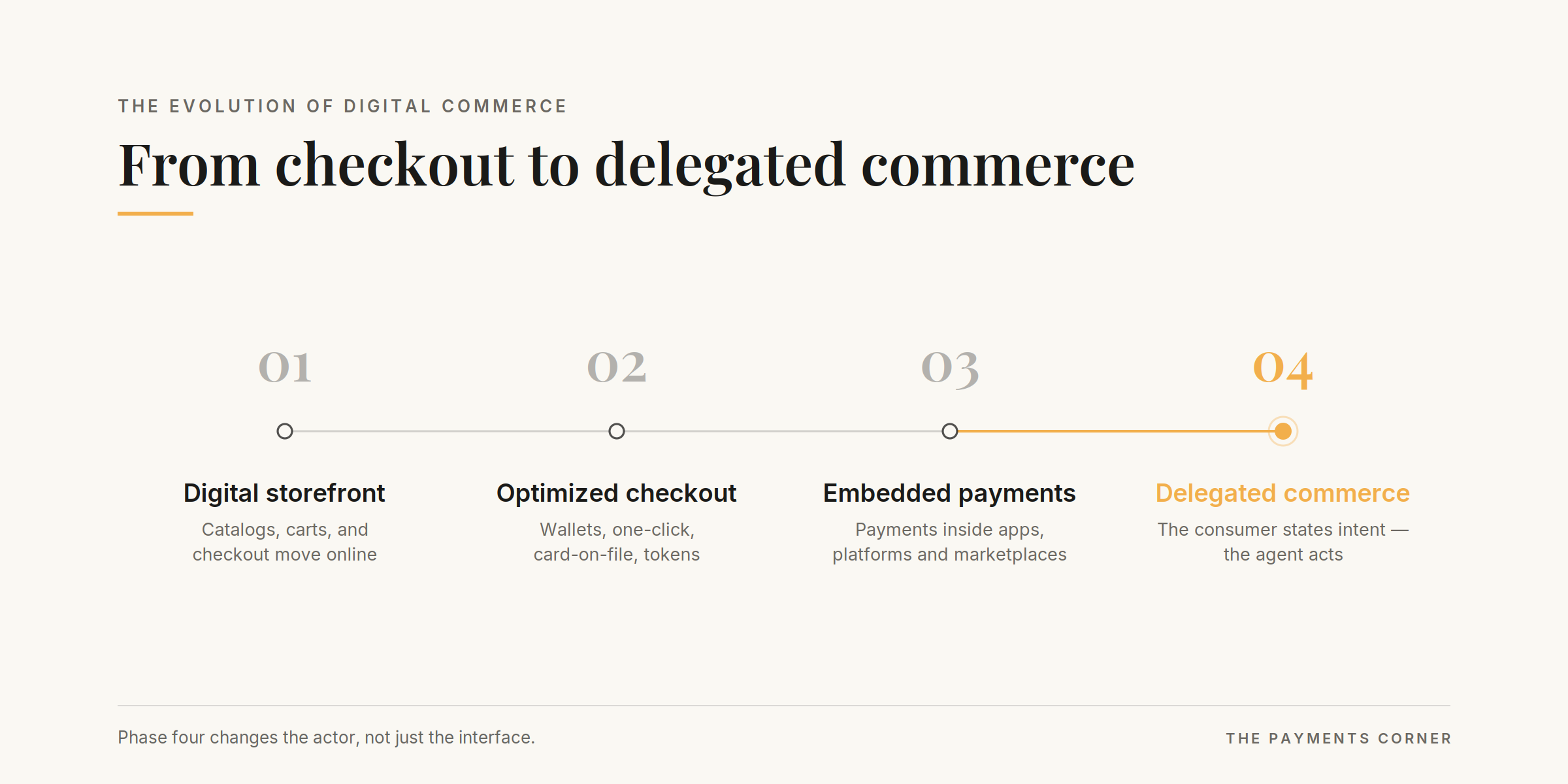
Digital commerce has evolved through several distinct phases.
The first phase digitized the storefront. Merchants moved catalogs, carts, and checkout flows online.
The second phase optimized the checkout experience. Stored credentials, wallets, one-click checkout, card-on-file, network tokens, and embedded payments reduced friction.
The third phase embedded payments inside platforms. Consumers and businesses increasingly transacted inside marketplaces, apps, software platforms, and vertical ecosystems.
Agentic commerce introduces a fourth phase: delegated purchasing.

In this model, the customer does not merely browse and pay. The customer expresses intent. An AI agent interprets that intent and may act on it.
A consumer might say:
"Find me the best family hotel in Miami under $350 per night, with breakfast included, and book it if cancellation is flexible."
A small business owner might say:
"Reorder printer supplies from an approved vendor if pricing is within 5% of last month."
A commercial fleet system might say:
"Authorize vehicle charging, tolls, and maintenance only within approved routes and approved service networks."
These examples are materially different from traditional e-commerce. The payment credential is no longer just a credential. It becomes a permissioned financial capability.
That shift changes the questions that payments infrastructure must answer.
Traditional e-commerce asks:
- Can this credential be used?
- Is there available credit or balance?
- Does the transaction appear fraudulent?
- Should the issuer approve or decline?
Agentic commerce asks:
- Who delegated the authority?
- Which agent is acting?
- What was the permitted scope?
- Is the purchase consistent with consumer intent?
- Was the merchant or product substituted?
- Does the transaction require human confirmation?
- What evidence exists if the consumer disputes the outcome?
These questions bring card issuers back into the center of the commerce model.
The visible experience may occur inside ChatGPT, Gemini, Copilot, a merchant agent, a wallet, or a vertical software platform. But the payment decision still depends on infrastructure that can establish trust, enforce controls, manage risk, and preserve accountability.
That is why agentic commerce is not merely a front-end innovation. It is an infrastructure transition.
2. The Role of Card Issuers in Agentic Commerce
Card issuers have historically played several roles: credit provider, payment credential issuer, authorization decision-maker, fraud manager, statement provider, rewards sponsor, dispute handler, and customer-service owner.
Agentic commerce expands that role.
The issuer becomes a governance layer for delegated commerce.
This does not mean the issuer controls the entire agentic ecosystem. AI platforms, merchants, networks, wallets, acquirers, processors, identity providers, and fraud platforms will all participate. But the issuer has a distinctive position because it controls the cardholder relationship, the account, the credit line or deposit account connection, the authorization decision, the servicing experience, and often the consumer's first point of recourse.
In agentic commerce, issuers will need to manage at least five new functions.
2.1 Delegated authority management
The issuer must understand whether the consumer has authorized an agent to act.
That authority cannot be vague. It must be specific enough to operationalize:
- Which agent is authorized?
- What type of transaction is allowed?
- What merchants or merchant categories are permitted?
- What amount limits apply?
- What time window applies?
- Can the agent accept substitutions?
- Can the agent enroll the consumer in a subscription?
- Can the agent use installments or credit offers?
- When is step-up approval required?
The strategic requirement is not just "consent." It is structured, revocable, auditable permission.
2.2 Agent-aware authorization
Issuers must be able to identify whether a transaction is human-initiated, wallet-initiated, agent-assisted, or agent-executed.
This matters because the risk profile changes.
A human buying from a known merchant is different from an AI agent selecting a merchant based on a recommendation flow. A card-on-file transaction is different from a token bound to a registered AI agent. A recurring subscription is different from an autonomous agent accepting renewal terms on behalf of the consumer.
Authorization logic must therefore incorporate more context: agent identity, token type, consent scope, transaction purpose, merchant reputation, cart data, price variance, historical behavior, authentication status, and risk score.
This moves issuer authorization from static transaction approval to contextual policy enforcement.
2.3 Consumer protection and servicing continuity
If something goes wrong, the consumer will likely contact the issuer.
That creates a servicing burden. Consumers may not distinguish between an agent error, merchant error, wallet error, network token issue, or issuer authorization issue. They will ask the issuer to resolve the problem.
Agentic commerce may produce disputes such as: the agent selected the wrong item, the agent selected the wrong merchant, the merchant changed price or terms, the agent accepted a substitution, the item was ineligible for return, the agent enrolled the consumer in a subscription, the purchase exceeded the consumer's intended scope, or the consumer thought human approval was required.
These scenarios require evidence. The issuer will need access to a richer transaction record than it receives in many traditional card transactions.
2.4 Risk, fraud, and bot distinction
Agentic commerce will blur the line between good automation and malicious automation.
Fraud systems will need to distinguish a verified agent acting within scope, a compromised agent, a malicious bot, a merchant manipulating an agent, a synthetic identity using an agent flow, a consumer claiming agent error after receiving goods, and an account-takeover actor using delegated credentials.
This is not a simple fraud-score problem. It is an ecosystem-trust problem.
2.5 Product and loyalty orchestration
Agentic commerce also creates issuer upside.
If agents can evaluate payment options, then cards, rewards, installments, offers, virtual credentials, and credit products become more programmable.
Issuers may compete not only to be top-of-wallet, but to be top-of-agent.
That may require clearer rewards logic, API-accessible benefits, transaction-level installment offers, merchant-funded offers, virtual card controls, family or household permissioning, commercial spend rules, and better product metadata.
The issuer's product value must become machine-readable, not only consumer-readable.
3. Mastercard Perspective: Trusted Agentic Payments at Network Scale
Mastercard's agentic-commerce strategy is especially important because it focuses on trust, tokenization, and rules for agentic payments.
Mastercard has framed Agent Pay as a foundation for secure, trusted AI-driven commerce, and has emphasized the need for clear rules governing what an agent can and cannot do.2
The central Mastercard concept is the agentic token.
A traditional token protects the underlying card credential. It allows transactions without exposing the primary account number. Agentic commerce requires tokenization to do more. The token must carry context about the agent, the scope of permission, and the transaction environment.
A standard payment credential answers:
Can this card be used?
An agentic token needs to answer:
Which agent is using the credential? Was the agent authorized? What is the agent allowed to do? Is the current transaction within the authorized scope? Can the merchant, issuer, and network trust the transaction?
That changes the role of the issuer processor.
The processor can no longer look only at card status, available credit, expiration date, merchant category, fraud rules, and transaction velocity. It must be able to interpret richer token context and apply real-time controls.
Mastercard's strategy also extends beyond consumer purchases. In June 2026, Mastercard launched Agent Pay for Machines, describing it as a way for businesses to support secure, continuous machine payments across cards, accounts, and stablecoin-based rails, built around four foundational capabilities: credentialing (each agent recognized through "Verifiable Intent"), permissioning (programmatically enforced authorization rules and spending limits), transacting, and guaranteed multi-rail settlement.3
That expansion is important. It suggests agentic payments will not be limited to retail shopping. They may extend into vehicles, logistics, IoT devices, procurement systems, enterprise software agents, supply-chain workflows, smart infrastructure, and autonomous machine environments.
For commercial issuers, this has direct implications. Commercial card platforms may need to support not only employee credentials, but machine credentials and agent credentials. A fleet vehicle, procurement bot, or service-management agent may need controlled purchasing authority.
The commercial card stack may evolve from employee spend management to machine and agent spend governance.
That requires processing capabilities such as agent or device-level credential issuance, virtual card controls, merchant and MCC restrictions, transaction limits, frequency controls, approval workflows, audit trails, automated exception handling, and integration into ERP, procurement, and servicing systems.
Mastercard's approach points toward a network-scale trust model. But the issuer still needs the internal architecture to operationalize that model.
The network may provide the token framework. The issuer must decide whether the transaction is allowed.
4. American Express Perspective: Trust, Protection, and Closed-Loop Visibility
American Express brings a different but complementary perspective.
Amex is leaning heavily into trust, Card Member protection, agent registration, and visibility across the transaction lifecycle. Its Agentic Commerce Experiences (ACE) framework references capabilities around registered agents, tokenized credentials, intent, authentication, authorization, disputes, and cart context.4
A critical and frequently misread detail: Amex Agent Purchase Protection has been announced but is not yet live. It is a forward commitment. Amex has stated that, in the future, where a Card Member authorizes a registered agent and that agent sends Amex the customer's authenticated purchase intent, the company intends to protect eligible customers from charges arising from eligible agent error — available only after the Card Member initiates a return with the merchant where possible. Amex has indicated that a full registry of approved agents and detailed program terms are still "coming soon."5
This is a critical market signal even in commitment form.
Amex is not only asking whether an agent can initiate payment. It is asking what happens when the agent makes a mistake.
That is one of the most important unresolved questions in agentic commerce.
The consumer may authorize the agent generally, but the agent may execute poorly. It may select the wrong item, choose the wrong merchant, accept an unfavorable substitution, miss a return condition, or misunderstand the consumer's preference.
That is not necessarily traditional fraud. It is not necessarily an unauthorized transaction in the classic sense. It may be a new category: authorized delegation, flawed execution.
Amex appears to be positioning protection as part of the trust proposition.
That matters because agentic commerce will require confidence. Consumers will not delegate meaningful purchasing authority to AI agents unless they believe there is recourse when something goes wrong.
Amex has another structural advantage: closed-loop visibility. Amex has emphasized that operating as issuer, network, and acquirer gives it an end-to-end view of each transaction — visibility it argues can reduce chargebacks, confusion, fraud, errors, and friction across the lifecycle.4
That closed-loop model may become more valuable in agentic commerce because the transaction record becomes richer and more complex.
A traditional open-loop issuer may see authorization data, merchant category, amount, token data, and some dispute information. But an agentic transaction may require more: consumer instruction, agent identity, cart contents, merchant alternatives, price history, product substitution, approval path, token context, return attempt, and servicing history.
A closed-loop network/issuer/merchant relationship can potentially connect more of those dots.
For open-loop issuers, this raises the bar. They may need to become more closed-loop-like in how they integrate data from networks, wallets, merchants, processors, fraud platforms, CRMs, and servicing tools.
The Amex lesson is clear: agentic commerce will reward institutions that can connect trust, authorization, protection, and servicing into one operating model.
5. Visa, Stripe, and OpenAI: The Broader Ecosystem Signal
Visa's Intelligent Commerce initiative positions the network as an enabler of secure AI-initiated transactions, describing it as embedding payment credentials, controls, authentication, and protections into automated buying experiences.1 Visa Intelligent Commerce Connect highlights secure payment initiation, tokenization, spend controls, and authentication through a single integration, and Visa has paired the initiative with a Trusted Agent Protocol intended to verify legitimate agents and block malicious bots.78
That framing is important because Visa is not treating agentic commerce as a simple checkout extension. It is treating it as a trust and control problem.
The same is true of Stripe and OpenAI. OpenAI introduced Instant Checkout in ChatGPT and, with Stripe, released the Agentic Commerce Protocol — an open standard for programmatic commerce flows between buyers, AI agents, and businesses, providing a blueprint for making checkouts agent-ready.6
The trajectory, however, has not been linear, and issuers should read it carefully. After launching Instant Checkout in late 2025, OpenAI scaled back the native, in-chat checkout model in early 2026 — shifting toward an app-based approach in which purchases route through individual retailer apps connected to ChatGPT rather than directly from product listings. Reported adoption had stalled at roughly a dozen merchants, and at least one large retailer's in-chat checkout test reportedly converted materially worse than redirecting shoppers to its own site.9 The protocol work continues, but on a narrower footprint.
For issuers, the signal is twofold. The standards are real and advancing. But consumer adoption of fully delegated checkout is still unproven, and the near-term pattern favors controlled, app-mediated flows over open-ended autonomous purchasing. The infrastructure question is durable even where the consumer experience is still being negotiated.
Together, these initiatives suggest agentic commerce will not be controlled by one actor. It will likely develop across an ecosystem involving AI platforms, consumer agents, merchant agents, networks, wallets, acquirers, processors, issuers, fraud platforms, identity providers, loyalty platforms, and servicing systems.
That means the issuer's role depends heavily on interoperability.
If issuers cannot ingest and interpret agentic context, they risk becoming passive endpoints behind AI platforms, wallets, networks, and merchants.
If they can operationalize that context, they can become active trust providers.
The key question becomes: will the issuer processing stack be able to participate intelligently in the agentic transaction, or will it only receive a simplified authorization request after the most important decisions have already been made elsewhere?
That is the strategic infrastructure question for issuers.
6. Why Issuer Processing Infrastructure Becomes Strategic
The issuer processor becomes the control plane for agentic commerce.
Today, issuer processors generally manage account setup, card issuance, authorization, balances, credit lines, fees, interest, payments, statements, rewards, disputes, chargebacks, customer service, collections, and reporting.
In agentic commerce, the processor must also support an additional layer: permission-aware transaction governance.
That requires new capabilities.
6.1 Agent-aware token processing
Tokenization is foundational, but tokenization alone is not sufficient.
The processor must be able to understand the token context. A token may be associated with a specific cardholder, a specific agent, a specific merchant, a specific category, a specific task, a defined spend ceiling, a defined time window, a specific authentication event, or a delegated authority record.
If the processor cannot interpret those attributes, the issuer cannot fully enforce the consumer's intent.
This is where platforms designed only around card, account, merchant, amount, and authorization data face the greatest stretch. Agentic commerce requires richer metadata, and the capability bar rises for every processing environment regardless of vintage.
6.2 Real-time policy controls
Agentic commerce requires configurable real-time rules.
Examples include: allow this agent to spend up to $300 per week on groceries; require human approval above $500; block purchases from non-U.S. merchants; allow travel bookings only if refundable; permit subscription renewal only if the price has not increased by more than 10%; allow procurement purchases only from approved vendors; allow vehicle maintenance only at approved service centers; block gift cards, crypto, gambling, or high-risk merchant categories.
These rules must be operational at authorization speed.
That means issuer processors need flexible policy engines capable of evaluating context at authorization time.
6.3 Intent capture and auditability
Agentic commerce introduces a new evidentiary requirement: the consumer mandate.
What did the consumer actually ask the agent to do?
Without that record, disputes become difficult. The issuer may know that a transaction occurred, but not whether the transaction matched the instruction.
The processing stack or surrounding ecosystem should preserve user instruction, consent record, agent identity, task scope, cart details, selected merchant, price at approval, substitution terms, authentication event, and transaction outcome.
This does not mean every issuer must store every piece of agent interaction data directly. But issuers need access to the evidence when servicing, dispute, fraud, or regulatory review requires it.
6.4 Dynamic authentication
Not every agentic transaction should require human approval. If every transaction requires step-up authentication, the agentic experience loses value.
But some transactions should require confirmation: high-dollar purchases, new merchants, risky categories, changed price, product substitution, cross-border transactions, subscription enrollment, use of credit or installment financing, or transactions outside normal behavior.
The issuer stack must support dynamic authentication rules tied to transaction context.
The objective is not zero friction. The objective is risk-appropriate friction.
6.5 Integrated fraud and identity decisioning
Fraud controls must evolve from card-centric scoring to agent-centric risk assessment.
The risk model should evaluate whether the agent is registered or verified, whether the credential is tokenized, whether the transaction matches delegated authority, whether the merchant is legitimate, whether the cart appears manipulated, whether the agent has abnormal behavior, whether there are signs of account takeover, whether the consumer's device or identity context has changed, and whether similar agents or merchants show elevated dispute rates.
This requires close integration between processor, fraud engine, identity provider, network token data, wallet data, and servicing data.
6.6 Dispute and protection workflows
Traditional dispute workflows were not designed for agent-error scenarios.
A future-ready processing platform must help distinguish unauthorized transaction, merchant fraud, merchant non-delivery, billing error, consumer remorse, agent error, out-of-scope delegation, and ambiguous authorization.
This will require richer reason codes, evidence handling, case management, and consumer communication.
6.7 Product flexibility
Agentic commerce may also create new product opportunities.
Issuers could offer agent-specific virtual cards, temporary credentials, category-bound credit, household spending agents, youth and family permissioning, card-linked installment offers, merchant-funded offers, commercial procurement agents, travel agents linked to corporate policy, and machine-triggered commercial card payments.
These products require flexible processing capabilities across credit plans, authorization controls, account hierarchies, tokenization, APIs, and servicing.
7. Strategic Implications for Issuers
Issuers face two possible futures.
7.1 Passive funding endpoint
In this future, the issuer is pushed behind the agent, wallet, platform, network, and merchant.
The consumer interacts with an AI platform. The agent chooses the merchant. The wallet manages the credential. The network tokenizes the payment. The merchant fulfills the order. The issuer receives an authorization request with limited context.
The issuer still funds the transaction and carries credit, fraud, servicing, and reputational exposure, but loses influence over the customer experience.
This is the strategic risk. The issuer becomes a balance sheet and authorization endpoint.
7.2 Active governance layer
In this future, the issuer participates as a trust provider.
The issuer provides programmable credentials, real-time spend controls, delegated authority rules, agent-aware fraud decisioning, dynamic authentication, credit and installment options, rewards intelligence, consumer alerts, dispute support, and protection workflows.
The issuer becomes a control layer behind delegated commerce.
This is the strategic opportunity. The issuer is not merely "top of wallet." It becomes top of permission.
8. Commercial Card and B2B Implications
The B2B implications may be larger than the consumer implications.
Businesses already operate through delegated authority. Employees, departments, procurement teams, travel managers, fleet managers, and accounts payable teams routinely spend on behalf of the enterprise.
Agentic commerce could automate parts of that delegation.
Potential B2B use cases include procurement agents ordering approved supplies, travel agents booking within corporate policy, fleet agents paying for tolls, charging, fuel, and maintenance, software agents renewing SaaS licenses, inventory agents replenishing stock, AP agents initiating supplier payments, project agents purchasing materials, field-service agents buying parts, and machine agents paying for usage-based services.
In this model, commercial card controls become more important.
The issuer must be able to support company-level policies, department-level policies, employee-level policies, agent-level credentials, vendor restrictions, MCC restrictions, transaction limits, approval hierarchies, ERP integration, expense categorization, invoice matching, and audit reporting.
Agentic commerce could materially expand the role of virtual cards and commercial cards because these products are already designed around controlled delegation.
The opportunity is to modernize them for machine-speed commerce.
Instead of issuing a card only to a person, issuers may issue controlled payment authority to a workflow, software agent, machine, or business process.
That is a profound shift.
Commercial card platforms will need to support multi-level account hierarchies, tokenized virtual credentials, configurable controls, real-time APIs, event-driven authorization, richer transaction data, and integrated exception handling.
For banks and processors serving commercial portfolios, agentic commerce becomes a modernization catalyst.
9. Regulatory and Consumer Protection Considerations
Agentic commerce does not yet have a single unified U.S. regulatory framework. The more likely near-term path is that existing rules and supervisory expectations will be applied to agentic-commerce models.
That includes consumer financial protection, credit card rules, electronic fund transfer rules, billing-error resolution, unfair or deceptive acts and practices, fair lending, third-party risk management, privacy, cybersecurity, AI governance, and complaint management.
The central regulatory principle is straightforward:
The use of an AI agent does not suspend existing consumer protection obligations.
One structural caveat shapes how that principle will be enforced in practice. The statutory and regulatory obligations described below remain in effect, but the federal enforcement posture has shifted materially. Through 2025 and into 2026, the Consumer Financial Protection Bureau underwent a substantial reduction in supervisory and enforcement capacity, dismissed or wound down most pending enforcement matters, rescinded a large body of guidance, and adopted a narrower, more collaborative enforcement stance.10 At the same time, the bureau has proposed to narrow the Equal Credit Opportunity Act, including its disparate-impact reach. The practical effect is not that the rules disappear, but that the active enforcement locus is migrating toward state attorneys general and private litigation. Issuers building agentic-commerce programs should therefore design to the rules as written, while recognizing that enforcement risk now arrives from a more distributed and less predictable set of channels.
9.1 Authorization and liability
The first question is whether the transaction was authorized.
For credit cards, Regulation Z limits cardholder liability for unauthorized use of a credit card to the lesser of $50 or the amount obtained before notice to the issuer.11
For debit, prepaid, ACH, and other electronic fund transfers, Regulation E defines an unauthorized EFT as a transfer initiated by a person other than the consumer without actual authority and from which the consumer receives no benefit, and sets liability tiers for unauthorized EFTs, including the basic $50 limit in certain timely-reporting scenarios.12
Agentic commerce creates a more complex authorization question.
If the consumer authorizes the agent generally, but the agent exceeds scope, buys the wrong item, accepts different terms, or chooses an unintended merchant, is the transaction authorized?
The answer may depend on the facts, the rail, the product, the disclosures, the consent design, and the evidence trail.
That creates a practical requirement for issuers: capture the scope of delegation clearly and preserve evidence of the consumer's mandate.
9.2 Billing errors, disputes, and servicing
For credit cards, Regulation Z includes billing-error resolution requirements. For electronic fund transfers, Regulation E includes error-resolution and liability frameworks.1112
Agentic commerce may create disputes that do not fit neatly into existing operational categories. The agent misunderstood the instruction. The merchant changed the price. The product was substituted. The agent selected a merchant with unfavorable return terms. The agent enrolled the consumer in a subscription. The consumer approved one version of the cart, but the final purchase differed. The agent acted within a broad permission but outside the consumer's expectation.
These cases require better evidence.
Issuers and processors should expect to preserve original consumer instruction, consent and scope, agent identity, merchant identity, product/cart data, price at authorization, authentication details, return attempt, fulfillment data, and post-purchase communications.
In agentic commerce, dispute quality will depend on data quality.
9.3 UDAAP and deceptive practices
Federal consumer financial law continues to prohibit unfair, deceptive, or abusive acts and practices, and the FTC has stated that there is no "AI exemption" from laws against unfair or deceptive practices, having taken enforcement action involving deceptive AI claims.13 As noted above, the intensity and locus of federal enforcement have shifted; state UDAP statutes and private litigation are increasingly the operative exposure.
Agentic commerce may create UDAAP or UDAP risk if firms overstate what an agent can do, obscure who the agent is acting for, hide compensation or sponsored placement, steer consumers to higher-cost options, make cancellation difficult, obtain overly broad payment permissions, fail to disclose when terms changed, or create confusing dispute paths.
The key consumer-protection principle should be: consent must be specific, understandable, revocable, and auditable.
9.4 Fair lending and credit decisioning
If agentic commerce includes credit offers, installment plans, BNPL options, credit-line changes, or personalized financing, fair lending and adverse-action rules become relevant.
Under the Equal Credit Opportunity Act and Regulation B, creditors using complex algorithms — including AI or machine learning — in credit decisions must still provide adverse-action notices that disclose the specific principal reasons for the decision.14 This obligation remains current law, though its future scope is contested: the CFPB has proposed to narrow ECOA, which would alter the fair-lending perimeter agentic-commerce credit products are built against.10
This matters because agents may present or rank payment options. An agent may recommend pay in full, split into installments, use a promotional APR, select merchant financing, use a card-linked installment plan, apply for a new card, or shift spend to another credential.
If the issuer or partner uses AI to determine eligibility, pricing, credit limits, or offer ranking, the institution needs fair-lending controls, model governance, explainability, testing, adverse-action logic, and monitoring.
The key question is: did the AI merely present payment options, or did it influence a credit decision? That distinction will matter.
9.5 Third-party risk management
Agentic commerce will rely heavily on third parties: AI platforms, agents, wallets, processors, token providers, fraud tools, identity vendors, merchant platforms, data providers, and orchestration layers.
The Federal Reserve, FDIC, and OCC issued interagency guidance on third-party relationships in 2023, providing principles for risk-based third-party risk management across the life cycle, including due diligence, contractual controls, ongoing monitoring, and governance.15
For issuers, AI agents and agent-commerce platforms cannot be treated as ordinary marketing channels if they influence or initiate payment activity.
They may need to be incorporated into third-party risk programs covering due diligence, data access, consumer consent, model behavior, cybersecurity, complaint handling, dispute support, subcontractors, audit rights, incident reporting, business continuity, and regulatory cooperation.
A practical rule: if an agent can influence, initiate, or complete payment activity, it belongs inside the risk perimeter.
9.6 AI governance and model risk
The NIST AI Risk Management Framework is voluntary, but it is increasingly used as a reference point for AI governance. NIST describes the framework as intended to help organizations incorporate trustworthiness considerations into the design, development, use, and evaluation of AI systems.16
Agentic commerce requires more than static model documentation. Because agents can act dynamically, issuers and partners need runtime governance: model inventory, use-case classification, risk tiering, testing, monitoring, drift analysis, explainability, human override, incident management, vendor oversight, data lineage, and control evidence.
The higher the agent's authority, the stronger the governance expectation should be. An agent that only recommends a merchant is lower risk than an agent that can complete a purchase, use credit, accept terms, or enroll a consumer in a recurring service.
9.7 Privacy and data minimization
Agentic commerce may require access to sensitive data: transaction history, preferences, location, financial capacity, loyalty status, household needs, credit eligibility, purchase history, merchant behavior, and identity signals.
This creates privacy risk.
Issuers should apply a data-minimization principle: the agent should only receive the data necessary to complete the authorized task.
That implies granular consent, revocable permissions, clear disclosures, limits on secondary use, retention controls, restrictions on training use, merchant data-sharing limits, and access controls.
Privacy will become a trust differentiator.
9.8 Cybersecurity and fraud
Agentic commerce expands the attack surface. Risks include agent impersonation, prompt injection, merchant manipulation, account takeover, synthetic identities, compromised agents, deepfake identity attacks, token misuse, and malicious agent-to-agent interactions.
The New York Department of Financial Services issued 2024 guidance intended to help covered entities understand and assess cybersecurity risks associated with AI and related controls.17
For issuers, cybersecurity controls must be tied to the transaction lifecycle. It is not enough to secure the account. Institutions must secure the delegated authority layer.
10. Issuer Processing Stack Readiness Framework
A practical readiness framework should assess whether the issuer and processor can support agentic-commerce requirements.
| Capability | Strategic Question | Processing Requirement |
|---|---|---|
| Agent-aware token processing | Can the issuer identify agentic transactions? | Support token metadata, agent identity, consent scope, and merchant context |
| Delegated authority | Can the issuer prove what the agent was allowed to do? | Store or access permission records, limits, time windows, and revocation status |
| Real-time policy controls | Can rules be enforced at authorization? | Configurable controls by amount, merchant, MCC, geography, frequency, and agent |
| Dynamic authentication | Can the issuer apply risk-appropriate friction? | Step-up workflows based on amount, merchant, category, substitution, or risk |
| Fraud integration | Can the issuer distinguish trusted agents from malicious bots? | Integrate fraud, identity, network token, wallet, and merchant signals |
| Intent capture | Can the issuer reconstruct the consumer's instruction? | Preserve mandate, cart, price, merchant selection, and approval evidence |
| Dispute handling | Can the issuer service agent-error disputes? | Case workflows, evidence ingestion, reason codes, and consumer communication |
| Product flexibility | Can the issuer create agent-ready products? | Virtual cards, installments, rewards, commercial controls, API-first servicing |
| Third-party risk | Are agent platforms governed as risk partners? | Due diligence, contracts, audit rights, monitoring, incident notification |
| Consumer controls | Can the cardholder manage agent authority? | Permission dashboard, alerts, pause/kill switch, limits, and consent history |
This framework can be used by banks, credit unions, fintechs, program managers, and processors to assess readiness.
The highest-risk gap for many issuers will not be tokenization. Networks are already investing heavily there. The harder gap will be operationalizing token and agent context inside the issuer processing environment.
11. Key Strategic Takeaways
11.1 Agentic commerce makes issuers more important, not less
At first glance, agentic commerce may appear to shift power toward AI platforms and wallets. That is partly true. But as economic activity becomes delegated, the need for trusted financial governance increases.
Issuers are well positioned because they control the account relationship, authorization decision, consumer servicing channel, and liability management function.
11.2 The processor becomes the issuer's control plane
The issuer processor must evolve from a system of record into a policy enforcement layer. The most strategic processing platforms will support agent-aware authorization, token metadata, real-time controls, dynamic authentication, dispute evidence, and product flexibility.
11.3 Mastercard, Visa, Amex, Stripe, and OpenAI are converging around trust
Although their models differ, the direction is consistent. Mastercard emphasizes trusted agentic tokens and machine payments. Visa emphasizes payment credentials, controls, authentication, and protections for AI-initiated transactions. Amex emphasizes registered agents, a forthcoming purchase-protection commitment, and closed-loop trust. Stripe and OpenAI emphasize open standards for programmatic commerce flows — though the pace of consumer adoption has already proven uneven.
The market is converging around the same problem: how to make delegated commerce safe, scalable, and accountable.
11.4 Consumer protection will shape adoption
Consumers will not delegate meaningful spending authority without recourse. The winning models will make permissions clear, limits easy to manage, transaction alerts actionable, and disputes understandable.
Agentic commerce needs trust by design, not trust as a post-transaction repair process.
11.5 Commercial card may be the early proving ground
B2B payments already rely on controlled delegation. Commercial card, virtual card, procurement, fleet, travel, and AP workflows may be natural environments for agentic payment adoption because they already require policy-based controls and auditability.
Issuers with modern commercial processing capabilities may be well positioned.
Conclusion
Agentic commerce shifts the payments industry from a direct-action model to a delegated-action model.
That changes the role of the card issuer.
The issuer is no longer only approving a transaction. The issuer must determine whether an autonomous or semi-autonomous economic action is legitimate, authorized, in scope, risk-appropriate, protected, and supportable if challenged.
This requires a new processing architecture: agent-aware tokenization, delegated authority, real-time controls, dynamic authentication, fraud and identity integration, dispute evidence, consumer permissions, and flexible product design.
The strategic risk is that issuers become passive funding endpoints behind AI platforms, wallets, networks, and merchant agents.
The strategic opportunity is much larger: issuers can become the governance layer for delegated commerce.
In that model, the card is no longer just a payment credential.
It becomes a programmable financial permission layer.
And the processing stack becomes the control plane for the next era of commerce.
Footnotes
-
Visa, "Enabling AI agents to buy securely and seamlessly" (Visa Intelligent Commerce). https://corporate.visa.com/en/products/intelligent-commerce.html ↩ ↩2
-
Mastercard, "Agent Pay" (introduced 2025). https://www.mastercard.com/us/en/business/artificial-intelligence/mastercard-agent-pay.html ↩ ↩2
-
Mastercard, "Mastercard Launches Agent Pay for Machines to Unlock Super-Fast, Always-On Payments," June 10, 2026. https://www.mastercard.com/us/en/news-and-trends/press/2026/june/mastercard-launches-agent-pay-for-machines.html ↩ ↩2
-
American Express, "Agentic Commerce Experiences (ACE)." https://www.americanexpress.com/en-us/company/agentic-commerce/ ↩ ↩2 ↩3
-
American Express / BusinessWire, "American Express Debuts Agentic Commerce Experiences (ACE) Developer Kit and Announces Industry-First Protection for Registered Agent Purchases," April 14, 2026. Amex Agent Purchase Protection is described as a forward commitment ("in the future"), with the registry of approved agents and full program terms noted as "coming soon." ↩ ↩2
-
Stripe, "Stripe powers Instant Checkout in ChatGPT and releases Agentic Commerce Protocol," Sept. 29, 2025 (https://stripe.com/newsroom/news/stripe-openai-instant-checkout); OpenAI, "Buy it in ChatGPT: Instant Checkout and the Agentic Commerce Protocol," Sept. 29, 2025 (https://openai.com/index/buy-it-in-chatgpt/). ↩ ↩2
-
Visa Developer, "Visa Intelligent Commerce." https://developer.visa.com/capabilities/visa-intelligent-commerce ↩
-
Visa, "Visa and Partners Complete Secure AI Transactions, Setting the Stage for Mainstream Adoption in 2026" (Trusted Agent Protocol), December 2025. https://usa.visa.com/about-visa/newsroom/press-releases.html ↩
-
Reporting on OpenAI's early-2026 shift of Instant Checkout toward an app-based model, including an OpenAI spokesperson statement that "Instant Checkout is moving to Apps," and reporting that a major retailer's in-chat checkout test converted roughly three times worse than redirecting shoppers to its own site. Recommend confirming against a primary OpenAI source before publication. ↩
-
U.S. Government Accountability Office, "Consumer Financial Protection Bureau: Status of Reorganization Efforts," GAO-26-108448 (January 2026); CFPB "Enforcement Principles" (June 2026). Independent reporting and analysis project that federal fair-lending supervision and enforcement will recede materially in 2026, with state attorneys general and private litigation assuming a larger share of enforcement activity; the CFPB has separately proposed to narrow the Equal Credit Opportunity Act, including its disparate-impact reach. ↩ ↩2
-
Regulation Z, 12 CFR § 1026.12(b) (cardholder liability for unauthorized use of a credit card limited to the lesser of $50 or the amount obtained before notice). ↩ ↩2
-
Regulation E, 12 CFR § 1005.6 (consumer liability for unauthorized electronic fund transfers); CFPB Electronic Fund Transfers FAQs. ↩ ↩2
-
Federal Trade Commission Act § 5 (unfair or deceptive acts or practices); FTC guidance on AI-related claims (2023). Note that FTC enforcement emphasis has shifted under current leadership. ↩
-
Equal Credit Opportunity Act and Regulation B, 12 CFR § 1002.9 (adverse-action notice requirements); CFPB Circular 2022-03 ("Adverse action notification requirements in connection with credit decisions based on complex algorithms"). ↩
-
"Interagency Guidance on Third-Party Relationships: Risk Management," 88 Fed. Reg. 37920 (June 9, 2023) (Board of Governors of the Federal Reserve System, FDIC, OCC). ↩
-
National Institute of Standards and Technology, "Artificial Intelligence Risk Management Framework (AI RMF 1.0)," January 2023. ↩
-
New York State Department of Financial Services, Industry Letter, "Cybersecurity Risks Arising from Artificial Intelligence and Strategies to Combat Related Risks," October 2024. ↩
The Payments Corner
30+ years across payments, fintech, banking, and financial infrastructure. Operator-level perspectives on the systems that move money.
Disclosure: The Payments Corner's founder is employed at Euronet Worldwide, a global infrastructure and transaction processing company. The publication may discuss securities or assets touching that domain. Content is provided for informational and editorial purposes only and should not be considered investment advice.
Related Insights
Bank charters split into two distinct fintech strategies, each with different economics and points of failure
The 2025–26 surge in OCC de novo applications masks two economically separate charter routes—uninsured trust banks for custody and digital-asset firms, and insured deposit-taking banks for payments and lending platforms. Each trades different benefits against different constraints, and regulators have demonstrated that operational capability, not just a compelling business case, determines approval.
The stablecoin remittance case rests on the on-ramp and off-ramp, not the blockchain
A dollar-backed stablecoin offers no inherent financial return and occupies the same monetary value as fiat currency. The economic argument for stablecoins in cross-border payments depends entirely on whether they reduce the total cost of money movement—on-ramps, settlement, and off-ramps combined—and whether those savings actually reach the consumer sending the money.
Offline authorization is not resilience — it's the foundation of it
European payment networks are mandating offline card capabilities across the continent, but the real challenge lies not in the terminal's ability to approve locally, but in how issuing infrastructure, issuer processors, and merchants manage the gap between the moment of authorization and the eventual settlement of accounts.