
Mexico Decides Who Pays to Leave Cash Behind
A framework law approved in Mexico's lower house in early October delegates the cost of digital acceptance to whoever moves last in the chain—card issuers, acquirers, or the state itself—without requiring any party to absorb it. A six-month trial that zeroed interchange at gas stations shows why: the subsidy leaked away, the regulatory ceiling on interchange removes the tool the trial used, and the law gestures toward SPEI-based QR codes as the permanent answer, leaving the market structure choice to regulators who have not yet chosen.
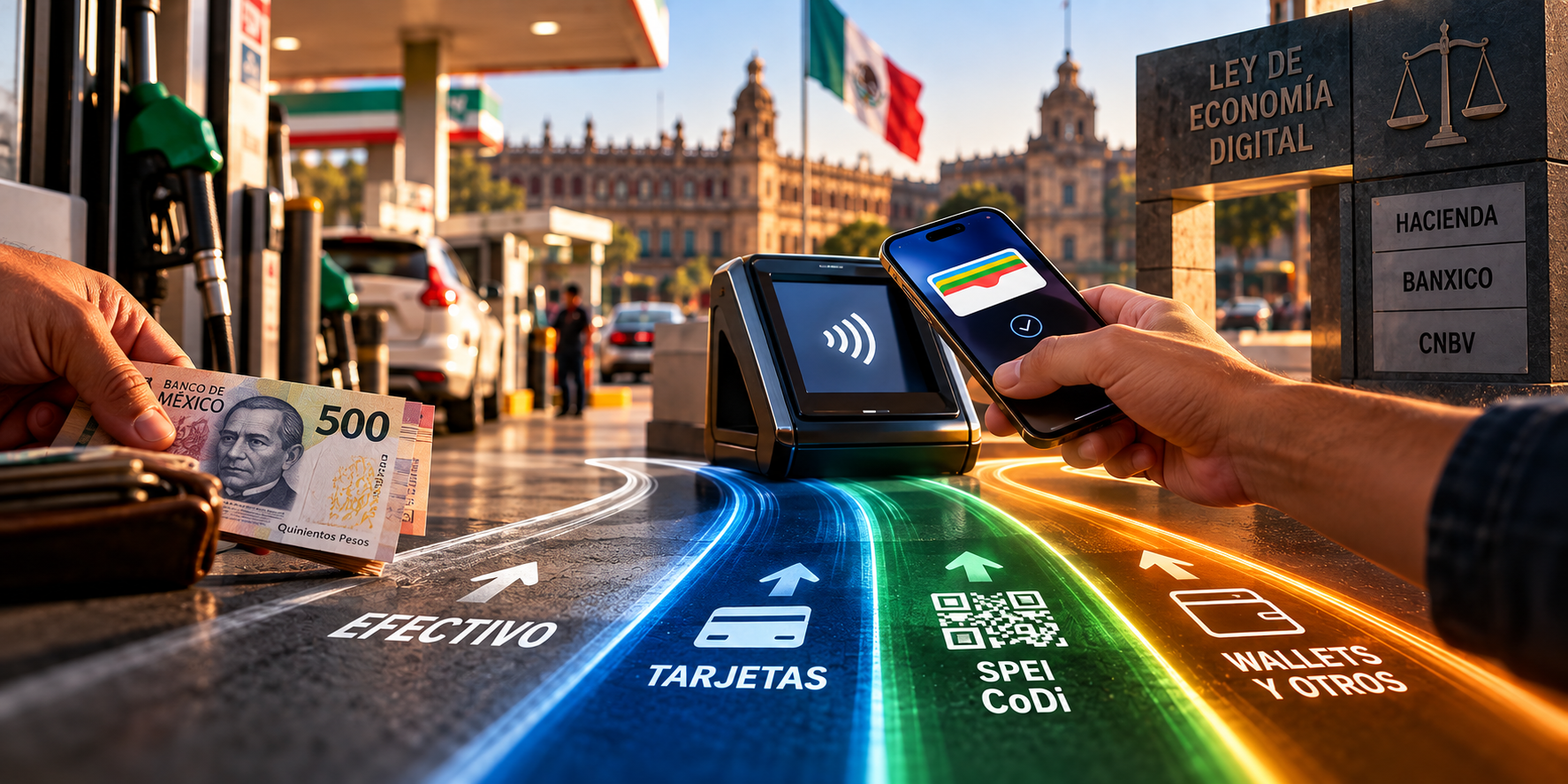
My thesis is that it comes down to who finances acceptance
The Digital Economy Law for Digital and Electronic Payments, approved by the Finance Committee of the Chamber of Deputies on October 1st, is discussed in Mexico as the end of cash. My reading is that it is something else: a deferred decision on who finances acceptance. Mexico has already run the only available test—six months of zero interchange fees at gas stations—and that experiment left three lessons that the law does not resolve. The subsidy came from the issuer. It did not reach commerce in full. And the permanent rule that Banxico and CNBV are preparing eliminates precisely the instrument with which it was implemented. What remains in place is Article 19: QR settled on SPEI at each point-of-sale terminal.
What the law says and what it does not say
The bill reached Congress on September 8th along with the 2027 Economic Package. It is a short framework law. Its most-cited section, by White & Case, summarizes it thus: it recognizes the Digital CURP and the Citizen Digital Record to contract financial services remotely, grants new powers to Banxico and CNBV over point-of-sale acceptance, and authorizes the Treasury to designate sectors where digital payment may be the only accepted form of payment. It has no penalties, no dates, and names no sectors.
That last point corrects much of the coverage. Gas stations and toll booths do not appear in the articles. They come from the Executive's strategy since March and April. Article 11 states that private suppliers "may" implement digital means; there is no general acceptance mandate for the private sector. The real mandate lives in Article 13, which empowers the Treasury to determine "strategic sectors and relevant activities" where digital payment "may be" the only route, and in Article 14, which leaves to each sector's regulator the conditions, requirements, and transition timelines. Cash and checks are preserved in cases of force majeure, which cannot be invoked permanently or recurrently.
The transition timelines are short. The Treasury would have fifteen business days from the law's entry into force to publish its first designation, and sectoral regulators another fifteen to issue rules. There is no additional budget. The committee approved the report by 25 votes against 4 according to Expansión (Milenio reports 24), with the PRI and PAN opposed, and the approved reservations were characterized as matters of form. The full chamber is scheduled to vote on October 6th.
The legislative preamble relies on INEGI's 2024 ENIF survey. Between 2021 and 2024, the proportion of people declaring cash as their most frequent means for purchases up to 500 pesos fell from 90.1% to 85.2%, while transfers and applications rose from 1.6% to 4.4%. It is worth reading the figure carefully: it is the proportion of people who name cash as their usual means, not the proportion of purchases paid in cash. The government contends that the infrastructure exists (SPEI, CoDi, DiMo, simplified-level accounts) and that the problem is adoption.
The test: six months of zero interchange
The government did not wait for the law to test the mechanism. On April 27th, the Treasury, the Mexican Bankers Association, and card issuers signed an agreement that brought interchange fees to zero at gas stations from May 1st to October 31st. Before the agreement, the gas station paid 0.45% per debit transaction and 1.00% per credit transaction. The Treasury presented the savings as 2.57 pesos per average debit transaction and 7.45 per credit transaction, and a reduction of 1.10 pesos in closed-network gift cards. According to the secretary himself, interchange represented around 80% of total fees.
The regulatory basis was provision 10ª Bis, added on April 27th to the rules for payment networks. It creates an exceptional regime to register interchange reductions exclusively in the gas station sector, without the thirty-day prior notice, in force until October 31st, 2026.
The Treasury's figures allow us to derive the implicit ticket sizes: 2.57 pesos at 0.45% equals an average ticket of around 571 pesos in debit, and 7.45 pesos at 1.00% around 745 pesos in credit. Banxico data cited by Onexpo give an average card ticket at gas stations of around 618 pesos in 2025, consistent with that range.
What the issuer paid
No one has published the cost of the subsidy. It can be estimated. PetroIntelligence calculates that between January and July 2026, gasoline sales totaled around 97,683 million pesos monthly, of which 33,721 million were paid with debit and 33,332 million with credit. Applying the rates prior to the agreement, the interchange that the issuer stopped collecting amounts to around 485 million pesos monthly, or roughly 2,900 million in six months. This is my own estimate, only for regular and premium gasoline, excluding diesel and gift cards, and assumes the value mix from January to July held steady. It serves to scale: the subsidy was in the hundreds of millions of pesos per month, absorbed by issuers voluntarily.
How real is the push toward digitization?
A push is measured against a starting point, and regarding gas stations, no one has agreed on what that is. The Treasury presents digital payment at gas stations as progress that only needs to be completed; gas station operators describe it as a minority. Here appears the first evidence problem. The available figures do not measure the same thing.
| Source | Measure | Figure |
|---|---|---|
| Banxico via Onexpo (2025) | Card payments at gas stations | 778.4 million transactions, 481,373 million pesos |
| Banxico via Onexpo (2025) | Gas stations as share of all card payments | 7% of 11,261.8 million |
| PetroIntelligence (Jan–Jul 2026) | Share of value paid with card | 68.6% (cash 29.3%) |
| Treasury (Apr 2026) | Share of digital fuel sales | 53% |
| Onexpo (Mar 2026) | Share of sales with card | around 30% |
The 7% has been reported in several outlets as if it were the share of gas station transactions paid with card. It is not: it is the share of all card payments in the country that occurred at gas stations. The difference between Onexpo's 30%, the Treasury's 53%, and PetroIntelligence's 68.6% likely reflects counting versus value and the inclusion or exclusion of gift cards, but no source publishes its complete methodology. What is consistent is the pattern: cash dominates in transaction count, especially in the Center (38.5% of transactions) and the North (41%), while card dominates in value. Large purchases are already digital. What remains to be digitized is the small purchase, which is precisely where the discount rate weighs more heavily against margin.
Whether it reached commerce
The second lesson is the most uncomfortable. The acquirer pays interchange to the issuer on each authorization and passes it to commerce within the discount rate. Lowering interchange to zero does not automatically lower the discount rate: it depends on whether the acquirer or aggregator passes the reduction through. On September 23rd, the president of Concanaco Servytur said that not all gas stations or all service providers reduced the rate in line with the government's commitment. The same body calculates that the average discount rate in retail commerce is 2.94% in credit and 2.77% in debit.
There are no public data to measure how much of the eliminated interchange stayed within the acquiring chain. It is the central empirical question of this entire experiment, and no one has answered it.
Whether it survives October 31st
The price-fixing agreement with gas station operators was renewed on August 31st through February 2027, with regular gasoline below 24 pesos and diesel below 27. Notes on the renewal mention commission reduction among the pillars of the strategy, but I found no primary confirmation that provision 10ª Bis or the agreement with the ABM will be extended after October 31st. The presidential goal of 100% digital payment at gas stations by last September came and went without mandate.
The permanent rule strips the special tariff for gas stations of force
The gas station experiment depended on an exclusive interchange tariff for that sector, and the rule that Banxico and CNBV are preparing would prohibit exactly that. While the trial was running, both regulators published the draft of new dispositions for payment networks, submitted to CONAMER on August 26th. The consultation closed on September 24th with 53 comments from banks, aggregators, and associations.
The caps are concrete. For credit, 1.30% per transaction and an aggregate limit per issuer of 1% of volume transacted in twelve months. For debit and non-credit-linked means, 10.80 pesos per transaction and an aggregate of 0.30% in twelve months. The transition would be up to 36 months. An earlier draft, under consultation in late 2025, proposed 0.6% in credit and 0.3% plus one UDI in debit; the current text is considerably more relaxed for the issuer.
The point that connects to gas stations is another. The draft establishes that interchange fees can no longer be differentiated solely by business sector, but must be linked to real, verifiable costs, such as operational risk and technology. The zero interchange at gas stations was, precisely, a sector-based tariff. If the final rule preserves that principle, the government loses the tool with which it financed its test. Any future subsidy to a designated sector would have to be done another way: a voluntary agreement outside the fee registry, a change in the definition of costs, or a rail that carries no interchange.
The draft also changes the mechanics on the commerce side. Aggregators would have to settle to their merchants on the same calendar day, maintain separate accounts for those funds, and abandon sub-aggregation. For a merchant forced to accept only digital means, the settlement date is as relevant as the rate: cash is settled on the spot.
Article 19 gives us the answer
If issuer subsidy is not permanent and the permanent rule forbids sector-based tariffs, someone has to bear the cost when the Treasury designates the first sector. The law already suggests who.
Article 19, Section IV, empowers Banxico to issue, together with CNBV, dispositions requiring entities that offer card acceptance at point-of-sale terminals to also accept QR payments, in accordance with Banxico's technical specifications. A QR that settles on SPEI carries no interchange fee. Commerce pays what its institution charges to receive the transfer, and there is no card issuer taking a cut in between.
Banxico is preparing the ground from the payer side. Reforms to Circular 14/2017 equalize the experience of mobile transfers in bank apps, including CoDi and DiMo, with compliance due in December. The central bank projects that the number of SPEI transactions will exceed card payments by year-end 2026, and estimates that 73.5 million adults already use it.
The distance between that infrastructure and the gas pump remains enormous. In 2025, CoDi recorded 4.4 million transactions for the entire year, with a maximum of about 12,700 daily in October; DiMo added 3.1 million interbank transactions. Gas stations alone processed 778 million card payments that same year. SPEI is massive in transfers between people and businesses; QR-based point-of-sale collection is not.
Together, the pieces form a coherent architecture: cards with a regulatory ceiling, mandatory A2A collection at each terminal, and the Treasury choosing where commerce loses the cash option. What is not written is the split. If the sectoral rules of Article 14 accept any recognized means, the choice is left to the payer in front of the pump, and there card wins through habit, revolving credit, and rewards. If they privilege the QR, the obligated volume migrates to SPEI and the card issuer loses a high-volume sector. That is the market structure decision, and the law delegates it entirely.
The toll booths show that the State already knows how to do this without card. Capufe finished in July the modernization of its 129 plazas and 1,050 lanes to accept TAG, with the Digital Transformation Agency. Cash remains permitted. But the digital rail on the highway is not the card at point of sale: it is a prepaid device or recurring charge, operated by TAG issuers. It is a reminder that "digital payment" in the law does not mean "card," and that each designated sector may end up with a different rail.
The Digital CURP does not eliminate the branch; it turns it into enrollment
The other dominant reading is that the biometric CURP eliminates the branch and opens the financial system to millions of people. The text is more modest. It speaks of Digital CURP, not biometric CURP, and recognizes it as an additional trust mechanism: Article 6 lets the user choose between it and any other official ID. The effect on KYC depends on CNBV rules that do not yet exist.
Biometric enrollment, moreover, is voluntary and in-person, at RENAPO or Civil Registry offices. The physical visit does not disappear; it moves from the branch to a government office. For institutions, however, acceptance of the biometric CURP is already mandatory when the holder presents it, by Article 91 Bis of the General Population Law.
The practical value for the issuer lies in the Citizen Digital Record. Article 9 gives its documents the same legal effect as physical ones, and Article 8 makes them portable at the user's request. That lowers the cost of integrating and refreshing the record: pay slips, birth certificates, credentials. It does not resolve identity verification itself, nor identity fraud, which is where the risk of remote opening is concentrated.
There is also no reliable adoption figure. In July 2025, the RENAPO director reported 145 thousand voluntary applications and 23 million biometric records already in the database from other processes, like passports. A month later, the figure of 27 million applications circulated. No official source has published a comparable breakdown since then.
What is the strongest counterargument to all this?
The strongest argument against this reading is that it overstates the law's relevance. White & Case puts it plainly: the bill, on its own, changes no obligation for any institution or any merchant. The mandate is permissive, conditioned on a Treasury designation, and lacks teeth to sanction. And government behavior so far favors negotiation over imposition: zero interchange was a voluntary agreement with the banks, and the price pact is voluntary with gas stations. It is plausible that Article 13's power is used little or not at all outside fuel.
There is a second objection, on exclusion. In committee, Héctor Saúl Téllez of the PAN warned that restricting cash will affect people without accounts, seniors, and communities without connectivity. Citizens' Movement noted that terminals, internet, and processing networks charge fees. Onexpo holds that the form of payment should be decided by the consumer. The ABM calculates that more than 25 million people, 19% of the population, use no banking service. the Network in Defense of Digital Rights has questioned since 2025 the concentration of identity in the biometric CURP.
Both objections are correct in what they describe. But neither changes the underlying question. If Article 13 is used little, Article 19 and interchange caps still redefine the economics of acceptance across the entire country. And if it is used, the exclusion problem becomes a cost problem: a merchant forced to reject cash needs a cheap rail for the low-ticket customer, and that rail is not a card with a discount rate of nearly 3%.
What I could not verify
I did not obtain the text of the report in the Parliamentary Gazette; I work from the bill and the description of reservations as matters of form. There is no primary confirmation of an extension of zero interchange after October 31st. There are no public data on the effective discount rate at gas stations before and after May 1st, which is the only way to measure pass-through. The figures on card participation as a payment means at gas stations are not comparable to each other. I found no official data on TAG penetration at Capufe. And the biometric enrollment figure has no recent official breakdown.
What comes next and what to watch for
The first inflection point is the San Lázaro plenary, scheduled for October 6th, and what the Senate does: whether it adds sanctions, names sectors, or touches Article 19. The second is October 31st, when provision 10ª Bis expires. An extension converts issuer subsidy into de facto policy; its expiration without a replacement means the first designated sector will launch at the full cost of the card. The third is the final version of the payment network rules, and in particular whether it preserves the ban on differentiating interchange only by sector. The fourth, fifteen business days after the law's publication, is the Treasury's first designation and, above all, the sectoral rules that accompany it: it will be the first time we see which rail the State chooses when it mandates, and who ends up paying for acceptance.
The Payments Corner
30+ years across payments, fintech, banking, and financial infrastructure. Operator-level perspectives on the systems that move money.
Disclosure: The Payments Corner's founder is employed at Euronet Worldwide, a global infrastructure and transaction processing company. The publication may discuss securities or assets touching that domain. Content is provided for informational and editorial purposes only and should not be considered investment advice.
Related Insights
Bank charters split into two distinct fintech strategies, each with different economics and points of failure
The 2025–26 surge in OCC de novo applications masks two economically separate charter routes—uninsured trust banks for custody and digital-asset firms, and insured deposit-taking banks for payments and lending platforms. Each trades different benefits against different constraints, and regulators have demonstrated that operational capability, not just a compelling business case, determines approval.
The stablecoin remittance case rests on the on-ramp and off-ramp, not the blockchain
A dollar-backed stablecoin offers no inherent financial return and occupies the same monetary value as fiat currency. The economic argument for stablecoins in cross-border payments depends entirely on whether they reduce the total cost of money movement—on-ramps, settlement, and off-ramps combined—and whether those savings actually reach the consumer sending the money.
Offline authorization is not resilience — it's the foundation of it
European payment networks are mandating offline card capabilities across the continent, but the real challenge lies not in the terminal's ability to approve locally, but in how issuing infrastructure, issuer processors, and merchants manage the gap between the moment of authorization and the eventual settlement of accounts.