
The Stablecoin Field Guide: A Structural Map for Payments Professionals
Stablecoins have moved from crypto curiosity to a cross-layer force reshaping the payments stack. This field guide decodes the economics, regulators, and competitive moves by starting from the one fact that matters: a fiat-backed stablecoin issuer is a narrow bank that captures 100% of reserve float and cannot share it with holders—making distribution, not issuance, the actual prize.
The Stablecoin Field Guide
A practitioner's frame for reading the stablecoin market structurally
Built for people who track this daily and want the map made rigorous — not an explainer. A note on currency: specific figures below are directional, anchored to 2025–26, and move. The durable value here is the frame — the mechanics, economics, and value-chain logic that don't change when the numbers do.
A note from the editor: why stablecoins, and why now
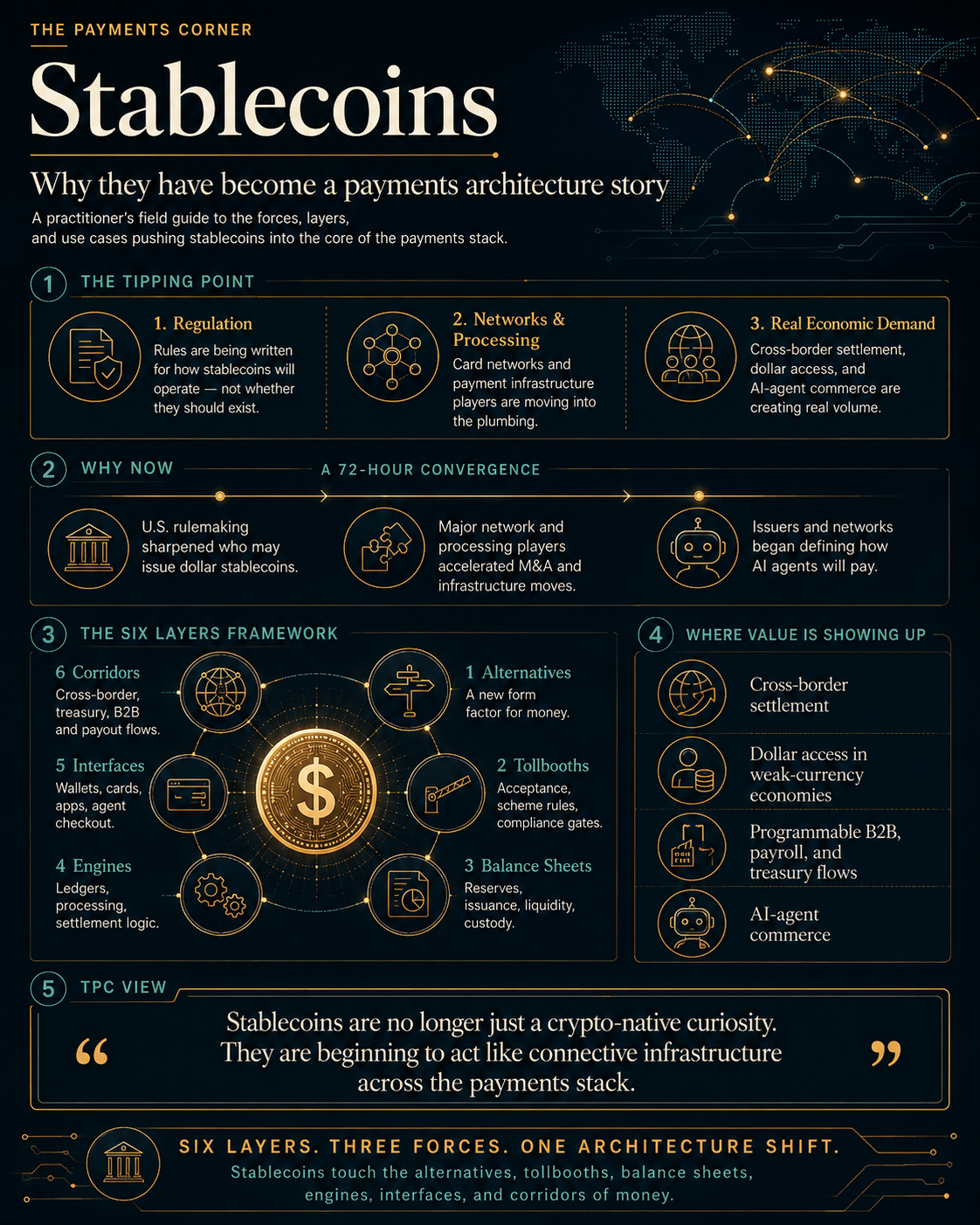
I don't decide to write about a subject at The Payments Corner lightly. I try to distinguish between topics that are simply popular and those that have reached a genuine tipping or inflection point. To me, stablecoins have crossed that threshold.
For most of the last decade, I would have put them in the first category: a crypto-native curiosity, interesting mainly to people trading other crypto — loud, but not yet load-bearing.
What changed my view this August is the convergence of three different but related forces that, until now, I had tended to consider separately.
First, regulators stopped debating whether stablecoins should exist and began defining how they will operate — GENIUS in the United States, MiCA in Europe, and the Bank of England's coexistence regime.
Second, card networks and processors stopped treating stablecoins primarily as a threat and began investing directly in the infrastructure around them.
Third, real economic demand — cross-border settlement, dollar access in weak-currency economies, and now AI-agent commerce — began surfacing at a scale that is increasingly difficult to dismiss as crypto simply circulating within crypto.
Over the past week, those forces became especially visible. The U.S. Treasury advanced the rules governing who may legally issue a dollar stablecoin and how offshore issuers will be treated; Mastercard absorbed a stablecoin-settlement business while Visa pursued infrastructure of its own; and the networks and issuers continued defining how AI agents will transact.
These are different parts of the payments stack, moving for different reasons. But they are moving in the same direction.
That, to me, is the signal.
This is no longer just a news cycle around a new form of digital money. It is becoming a question about the architecture of money itself — where value is stored, how it moves, who controls access, and where the economics accrue.
That is why I have taken the subject on directly as writer and editor.
I want TPC's view of stablecoins built the same way I look at the rest of the payments ecosystem: through the framework's six layers, not through the lens of technology or price.
Stablecoins are particularly interesting because they refuse to remain in one layer. They belong initially under the Alternatives — the wager that the rails themselves change — yet they are already pressing into the Tollbooths, Balance Sheets, Engines, Interfaces, and Corridors at the same time.
This field guide is the foundation for that work.
It is deliberately a practitioner's frame rather than an explainer, and it is a living document. I expect parts of my view to change as the market develops and the evidence becomes clearer.
That is part of the reason for publishing the work in the first place: to develop the thesis in the open, test it against what actually happens, and revise it when the facts require it.
— Franco Di Pietro, Writer & Editor, The Payments Corner
0. The one thing to hold in your head
A fiat-backed stablecoin issuer is a narrow bank that earns float and does not lend. Almost everything else — the competitive wars, the regulatory fights, the bank lobbying, the distribution deals — is downstream of that single sentence. When a stablecoin headline confuses you, return here first and ask: who earns the float, and who controls the distribution? Those two questions decode most of the market.
This is why treating stablecoins as a technology story is the most common analytical error. The blockchain is plumbing. The business is a balance sheet.
1. The economics — where all the leverage is
The float model
A fiat-backed issuer takes $1, gives you a token redeemable for $1, and invests the dollar in short-dated safe assets (T-bills, overnight repo, bank deposits, money-market funds). The issuer keeps the yield. You, the holder, get nothing — you hold a non-interest-bearing bearer claim.
So the issuer's gross revenue is essentially reserve balance × short-term rate. At a 4–5% policy rate, a $100B issuer generates ~$4–5B a year in gross interest income against a tiny cost base. This is one of the highest-margin business models in finance, and it is almost entirely a bet on two variables: how many dollars sit in reserves and where short rates are. Note the rate exposure — a stablecoin issuer's P&L is structurally long the front end. A return to zero rates would gut the model; the whole sector is, in part, a leveraged play on "higher for longer."
The interest prohibition is the pivot of the whole regime
Under the U.S. GENIUS Act (and echoed in other regimes), issuers may not pay interest or yield to holders. This is not a detail — it is the load-bearing rule that shapes competition. Because the issuer captures 100% of the float and legally cannot share it with holders directly, two things follow:
- Holders have no yield reason to prefer one compliant coin over another, so competition shifts to distribution, trust, liquidity, and integration rather than price paid to the user.
- The float becomes the prize that gets fought over through distribution deals, not consumer rates. The economics get routed to whoever controls the user relationship and the on-ramp, because that party can extract a share of the issuer's float in exchange for driving balances.
Keep an eye on the ways issuers try to route around the ban — "rewards," loyalty points, affiliate structures, paying exchanges and wallets rather than users. The regulatory perimeter around what counts as prohibited "interest" is a live and consequential frontier.
Distribution captures the value — the Circle/Coinbase lesson
The canonical illustration: Circle issues USDC but shares a very large portion of USDC reserve income with Coinbase, and effectively cedes essentially all the income on USDC held within Coinbase. The issuer mints the coin; the distributor captures the economics. This is the single most instructive fact in the sector, and it generalizes:
In stablecoins, issuance is a commodity and distribution is the moat. The party that owns the wallet, the exchange, the merchant, or the on-ramp can command the float — because it controls where balances actually sit.
This is why banks, networks, exchanges, and fintechs all want to be in the stablecoin stack: not to mint (minting is easy) but to sit at the layer that controls balances. It is also why Tether is so anomalously profitable — it built distribution (emerging-market demand on the Tron rail) that costs it almost nothing to serve, so it keeps nearly all the float.
Unit economics vs. cards
The bull case for stablecoins in payments is cost: a stablecoin transfer can settle for cents versus card interchange of ~150–350 bps plus the multi-day, multi-intermediary correspondent chain in cross-border. But be disciplined — the raw transfer being cheap is not the same as the end-to-end system being cheap once you add on/off-ramp spreads, compliance, FX, chargeback/dispute substitutes, and merchant integration. The real cost advantage is clearest in cross-border B2B and remittances (where the incumbent is correspondent banking, not cards) and weakest in domestic card-present retail (where cards are already cheap, fast, and carry consumer protections). Match the use case to where the cost edge is genuine.
2. Taxonomy — sort by what backs the peg
- Fiat-backed (reserve-backed): 1:1 claims against a reserve of cash and cash-equivalents. USDT, USDC, PYUSD, RLUSD. This is ~all of the economically relevant market. The narrow-bank model above.
- Crypto-overcollateralized: backed by on-chain assets held in excess (e.g., DAI/USDS via MakerDAO/Sky). Decentralized, but capital-inefficient and reflexive in a crypto downturn; economically small relative to fiat-backed.
- Algorithmic (mostly dead): maintained peg via supply mechanics and a paired volatile token, no full reserve. Terra/UST's ~$40B collapse in May 2022 discredited the model and hardened regulators against it — GENIUS effectively bans it. Treat any "algorithmic stablecoin" pitch as carrying that history.
- Tokenized deposits (a different animal — do not lump in): a bank's deposit liability represented on-chain. Stays inside the banking system, remains fractional-reserve and interest-bearing, and settles between regulated banks. This distinction is becoming the fault line (see §8) — a stablecoin is a fully-reserved bearer instrument that pulls money out of banks; a tokenized deposit keeps it in. Regulators and banks are pushing tokenized deposits precisely because they preserve credit creation and monetary transmission.
Peg mechanics and depeg risk
Fiat-backed coins hold the peg through redemption arbitrage: authorized parties can mint and redeem at $1, so any market deviation is arbitraged away — as long as redemption is credible and reserves are good. Depegs happen when that credibility breaks. The clean case study is USDC's March 2023 depeg to ~$0.88 when ~$3.3B of Circle's reserves were stranded at the failing Silicon Valley Bank over a weekend — reserve quality was fine, but reserve access and redemption certainty briefly weren't. The lesson: peg stability is a function of reserve quality × redemption access × secondary-market liquidity, and the second factor is the one people underweight.
3. Stablecoins through the TPC framework — how one instrument colonizes all six layers
The TPC index reads the payments stack as six load-bearing layers. Stablecoins are filed in the sixth — the Alternatives — but the reason they earn a research stream is that they refuse to stay there. Run them through the framework layer by layer and the pattern is the same each time: stablecoins press into an incumbent layer, and the incumbents in that layer scramble to absorb them rather than be routed around. That absorption contest, not the token itself, is where the value moves.
01. The Tollbooths (card networks). The original stablecoin threat was disintermediation — money moving A-to-B on-chain for cents, routing around interchange entirely. The networks' answer is to relocate the tollbooth: rather than tax the card swipe, tax the stablecoin settlement. Mastercard bought BVNK, Stripe bought Bridge (~$1.1B), Visa is out to market for a settlement partner — each converting a would-be bypass into a new toll they own. The toll migrates from interchange to compliant multi-jurisdiction settlement, but it is still a toll.
02. The Balance Sheets (issuing banks & lenders). This is the layer stablecoins most directly threaten, and the most under-appreciated. A fiat-backed issuer is itself a new kind of balance sheet — a narrow bank that holds reserves and earns float but does not lend. Every dollar that moves into a stablecoin is a dollar that leaves a traditional deposit base, stripping funding and, with it, credit creation. Tokenized deposits are the incumbents' defense: keep the money on the bank's balance sheet, interest-bearing and lendable, rather than let it drain into a fully-reserved bearer coin. Watch this layer for deposit-flight evidence — it is where the systemic argument lives.
03. The Engines (processing & infrastructure). The stablecoin "engine room" is the reserve managers (BlackRock-run funds behind USDC), the custodians, the chains themselves (most USDT payment volume runs on Tron, not Ethereum — the chain choice tells you the real use case), and the orchestration layer (BVNK, Bridge) that abstracts chains, coins, and ramps for businesses. The incumbents of this layer — Fiserv, FIS, Global Payments — face the build-or-be-bypassed question, while the orchestration engines are being acquired straight into the Tollbooths (layer 01). The engine is quietly the most contested real estate in the stack.
04. The Interfaces (consumer & merchant platforms). Whoever owns the surface the user touches owns the balances — and whoever owns the balances captures the float. This is the Circle/Coinbase lesson made structural: the issuer mints, but the interface commands the economics. PayPal (PYUSD) is the purest expression — it already owns the wallet and merchant base and is testing whether owning the user lets it own the float. Merchant acceptance remains the immature sub-layer that would turn stablecoins from a settlement/treasury tool into a real point-of-sale instrument.
05. The Corridors (cross-border). The most credible disruption of all. Cross-border is where the incumbent is slow, expensive correspondent banking rather than cheap domestic cards — so the stablecoin cost edge is real and large. USDT-on-Tron remittance corridors already move meaningful value; B2B settlement is routing around the correspondent chain; postal/instant-rail experiments (the Qatar–India UPI corridor in the Aug 21 Radar) point the same way. This layer's incumbents — Western Union, Wise, Remitly — face the sharpest margin threat.
06. The Alternatives (crypto & alt rails). Where the index files stablecoins — "the wager that the rails themselves change." The whole point of the section above is that the wager is no longer contained here. Stablecoins have stopped being an alternative to the stack and become a solvent moving through it.
The strategic synthesis: stablecoins are not a seventh category — they are a cross-layer force, and the war is over which incumbent layer absorbs them. Read every stablecoin development by asking which of the six layers it presses into, and which incumbent is trying to absorb it. Minting is never where the war is.
4. The players — map by model and strategy, not by market cap
- Tether (USDT): the incumbent by a wide margin (~$150B+ range). Offshore, historically opaque on reserves though now more disclosed, extraordinarily profitable, distribution rooted in emerging-market dollar demand on Tron. The GENIUS regime's extraterritorial reach and reciprocity gates are aimed squarely at USDT's U.S. accessibility (see the GENIUS deep dive). Its moat is real-economy EM demand that no U.S. rule can directly reach.
- Circle (USDC): the "compliant Western" issuer, U.S.-regulated, publicly listed (IPO'd 2025), reserves managed transparently. Its structural weakness is the flip side of Tether's strength: it shares most of its float with distributors (Coinbase), so it is far less profitable per dollar. Circle is a distribution-dependent business.
- PayPal (PYUSD): a distribution-first play — PayPal already owns the wallet and merchant base, so it is testing whether owning the user lets it own the float. Small today, strategically interesting.
- Ripple (RLUSD) and a wave of exchange/fintech coins: mostly bids to own a slice of settlement or treasury flows.
- Bank & network consortium coins (the Open USD orbit; bank tokenized-deposit efforts): built natively inside the regulatory perimeter. Their whole thesis is that regulation favors those who sit inside the fence — which the GENIUS issuance rule tends to confirm.
A useful lens: Tether = real-economy EM demand; Circle = compliant institutional/Western demand; PayPal/consortium coins = owned-distribution bets. Most competitive moves are one of these three archetypes reaching for another's territory.
5. Use cases — separate real economic use from circular volume
The most common measurement error in the sector is treating on-chain volume as economic adoption. Much stablecoin volume is crypto-native and circular: collateral for trading, moving between exchanges, DeFi looping. That is real usage, but it is not the payments story. Sort demand into buckets and weight them:
- Trading/DeFi collateral (largest, mostly circular): the base of the market; sensitive to crypto cycles.
- Cross-border B2B settlement (real, growing): businesses moving value between countries faster and cheaper than correspondent banking. This is the most credible "disrupts payments" use case.
- Remittances (real, EM-led): USDT-on-Tron corridors already move meaningful value; the threat is to money-transfer operators and exchange houses.
- Dollar access / store of value in high-inflation economies (real, under-measured): Argentina, Turkey, Nigeria, Lebanon — people holding digital dollars because their local currency is failing. This is genuine demand invisible to Western analysts and a large part of Tether's moat.
- Treasury/cash management (emerging): firms holding stablecoins for 24/7 programmable dollar liquidity.
- Agentic commerce (nascent, watch closely): stablecoins as the settlement layer for AI-agent transactions — the newest demand vector and one converging with the network strategy (Radar, Aug 21).
When you assess an adoption claim, ask which bucket it's in and whether the volume is economic or circular.
6. The regulatory map — and why reciprocity is the new lever
- United States — GENIUS Act (July 18, 2025): federal framework for "payment stablecoins." Defines permitted issuers (federal and state paths), mandates full high-quality-liquid-asset reserves and redemption rights, prohibits paying interest to holders, bars algorithmic models, and — via the Aug 2026 Treasury issuance NPRM — draws the licensed perimeter with extraterritorial reach and a reciprocity gate for foreign issuers. (See the separate GENIUS deep dive.)
- EU — MiCA (live since 2024): regulates fiat-backed coins as e-money tokens (EMTs) and broader baskets as asset-referenced tokens (ARTs). Requires authorization, reserve rules, and — notably — caps on the use of non-euro EMTs as a means of payment, an explicit monetary-sovereignty guardrail. MiCA has already pushed some non-compliant coins (Tether) off regulated EU venues.
- United Kingdom: the Bank of England is building a systemic stablecoin regime with per-issuer holding caps (a proposed ~£40bn) and an explicit coexistence stance (stablecoins + tokenized deposits + a possible digital pound as interoperable rails). The caps quietly favor bank-led tokenized deposits over standalone stablecoins.
- Singapore (MAS), UAE, Hong Kong, Japan: each has moved to a licensing framework; the GCC and Hong Kong are positioning as regulated hubs. These matter now because of reciprocity — under the U.S. regime, a foreign coin's U.S. accessibility depends on whether its home regulator strikes a comparability deal, turning market access into an instrument of financial statecraft.
The frame: regulation is not converging on one model — it is sorting digital money into stablecoins vs. tokenized deposits vs. CBDCs, and each jurisdiction is weighting those three differently based on how much it wants to protect its banks and its monetary sovereignty.
7. The live structural debates — where TPC can be differentiated
- Stablecoins vs. tokenized deposits vs. CBDCs. Three models of digital money with different implications for credit creation, bank funding, and monetary control. The most important question in the space; most coverage flattens it.
- Bank disintermediation / deposit flight. If deposits migrate into fully-reserved stablecoins, banks lose cheap funding and the system loses credit creation — the core of bank lobbying against stablecoins and for tokenized deposits. Watch whether deposits actually move.
- Correspondent-banking displacement. Cross-border is where stablecoins most credibly disintermediate an incumbent (the correspondent chain). Watch B2B settlement volumes and which corridors go first.
- Dollar hegemony and the T-bill bid. Stablecoin issuers are becoming a marginal buyer of U.S. Treasuries — U.S. policy openly frames stablecoins as a tool to extend dollar dominance and Treasury demand. This reframes the whole regime as geopolitics, not consumer protection.
- The settlement-layer contest. Networks converting stablecoins from threat to owned rail (Stripe/Bridge, Mastercard/BVNK, Visa's RFP). Who owns compliant multi-jurisdiction settlement captures the economics regardless of which coin wins.
- Adoption vs. circular volume. The measurement problem in §5, elevated to a thesis: how much of "stablecoin growth" is real economic penetration?
- Agentic commerce as a demand vector. Whether AI-agent transactions become a genuine new source of stablecoin demand, and where the authorization/fraud economics land.
Each of these is a candidate TPC research stream. The differentiated move is almost always to take the balance-sheet or value-chain view where others take the technology or price view.
8. Leading indicators — what to actually watch
- Reserve composition and disclosures (quality and access, not just size).
- Redemption volumes and secondary-market depth (the real peg-stability signal).
- On-chain volume split by chain and by "economic vs. circular" (Tron vs. Ethereum tells you the use case).
- Distribution deal terms (who is capturing the float — the true competitive scoreboard).
- Bank tokenized-deposit pilots (the counter-move to stablecoins).
- Which regulators strike reciprocity/comparability deals (determines foreign-coin market access).
- Merchant acceptance progress (the gate to point-of-sale relevance).
- Deposit-flight data (the test of the disintermediation thesis).
9. Glossary — the terms that carry analytical weight
- Float / seigniorage-like income: the yield an issuer earns on reserves; the core revenue.
- Narrow bank: a fully-reserved institution that takes deposits but does not lend — the closest analog to a compliant stablecoin issuer.
- Tokenized deposit: on-chain representation of a bank deposit; stays in the banking system, interest-bearing, preserves lending.
- Authorized participant / redemption arbitrage: the mint/redeem mechanism that holds the peg.
- Orchestration layer: the B2B infrastructure abstracting chains/coins/ramps (BVNK, Bridge).
- On/off-ramp: the fiat↔crypto conversion point; high-margin, compliance-heavy, distribution-controlling.
- EMT / ART: MiCA's e-money token / asset-referenced token categories.
- DASP: digital-asset service provider — the GENIUS classification that, per the Aug 2026 NPRM, also attaches to issuers.
- Reciprocity / comparability: the bilateral mechanism determining whether a foreign coin can reach U.S. persons.
10. Primary sources worth actually reading
- The GENIUS Act text (esp. §§ 3, 4, 18) and the Treasury issuance NPRM (Federal Register 2026-16796) — the U.S. perimeter.
- MiCA Titles III/IV (EMTs/ARTs) — the EU model and its payment-use caps.
- Bank of England systemic-stablecoin policy statement and Digital Pound Lab outputs — the coexistence model.
- BIS work on the "singleness of money," tokenized deposits, and the unified ledger — the intellectual case against stablecoins and for tokenized deposits.
- Circle's public filings (post-IPO) — the clearest window into real issuer economics and distribution-cost drag.
- President's Working Group / Treasury reports framing stablecoins and Treasury demand — the dollar-hegemony thesis in official language.
This is a living document. I expect to extend it — a deeper economics build-out, a tokenized-deposit companion, a corridor-by-corridor cross-border map — as the material warrants, and to revise it in the open as the evidence comes in.
The Payments Corner
30+ years across payments, fintech, banking, and financial infrastructure. Operator-level perspectives on the systems that move money.
Disclosure: The Payments Corner's founder is employed at Euronet Worldwide, a global infrastructure and transaction processing company. The publication may discuss securities or assets touching that domain. Content is provided for informational and editorial purposes only and should not be considered investment advice.
Related Insights
Why installment lending has remained peripheral to U.S. card issuing
BNPL has reached 16% of U.S. adults and $156.7 billion in annual originations, yet traditional card issuers lag fintech competitors at the financing decision.
Bank charters split into two distinct fintech strategies, each with different economics and points of failure
The 2025–26 surge in OCC de novo applications masks two economically separate charter routes—uninsured trust banks for custody and digital-asset firms, and insured deposit-taking banks for payments and lending platforms. Each trades different benefits against different constraints, and regulators have demonstrated that operational capability, not just a compelling business case, determines approval.
The stablecoin remittance case rests on the on-ramp and off-ramp, not the blockchain
A dollar-backed stablecoin offers no inherent financial return and occupies the same monetary value as fiat currency. The economic argument for stablecoins in cross-border payments depends entirely on whether they reduce the total cost of money movement—on-ramps, settlement, and off-ramps combined—and whether those savings actually reach the consumer sending the money.