
Why installment lending has remained peripheral to U.S. card issuing
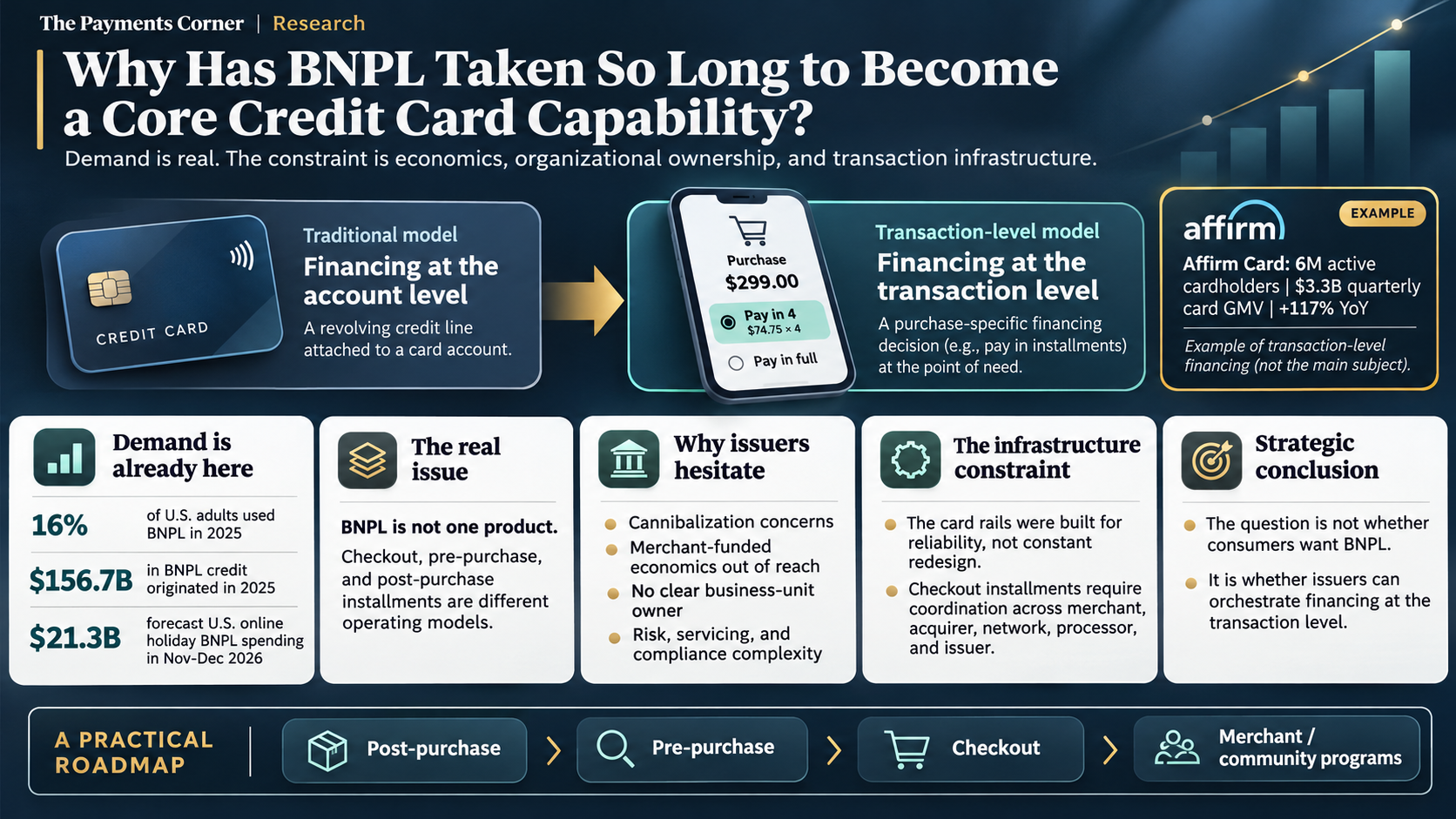
BNPL has reached 16% of U.S. adults and $156.7 billion in annual originations, yet traditional card issuers lag fintech competitors at the financing decision.
A debit card is winning the financing decision
In the quarter ended September 30, Affirm Card generated approximately $3.3 billion in gross merchandise volume, up 117% year over year, with 6 million active cardholders. It now accounts for roughly 23% of Affirm's $14.4 billion in quarterly GMV, which itself grew 34%.
Affirm Card is a debit card. The customer can pay in full or finance an eligible individual purchase through an installment loan. The financing decision no longer has to be tied to a traditional revolving credit card account; it can be offered around a specific purchase. A financing specialist is using a general-purpose card credential to reach purchases far beyond the merchant checkouts where it started, while many established card issuers are still deciding where installments belong in their organization.
That contrast is the question I keep returning to. Why has something so close to consumer credit taken so long to become a standard capability of the credit card itself?
Demand is not the explanation
The Federal Reserve reported that 16% of U.S. adults used BNPL during 2025. A separate Federal Reserve analysis estimated that major BNPL providers originated approximately $156.7 billion of credit in 2025, about half of it pay-in-four and the rest short- and longer-term installment products. One figure measures usage and the other originations; both describe an established financing category.
This holiday season points the same way. Adobe forecasts $21.3 billion in U.S. online BNPL spending during November and December 2026, up 6.6%. Against Adobe's $275.1 billion forecast for total online holiday spending, that is approximately 7.7% of projected online spending by dollar value—a share of online dollars, not of transactions or of all retail. Separately, NerdWallet found that 38% of holiday spenders plan to use BNPL, which is a measure of intention rather than of purchases funded.
The absence of installment technology does not explain it either. The networks support installment programs, leading banks already offer pay-over-time features, and fintechs have shown that financing can live inside the shopping journey. Banks can also win on experience: J.D. Power's 2026 study gave bank-branded BNPL services an average satisfaction score of 704, against 603 for fintech brands. Yet the same study notes that bank-branded services still represent only a fraction of total BNPL spending.
That gap raises a distribution and operating-model question. Satisfaction data alone cannot establish why adoption differs, but it does suggest that customer experience is not the only obstacle. An industry with decades of consumer-lending experience, established credit lines, transaction data, funding capacity, and near-universal acceptance has let other providers lead at the moment an individual purchase is financed.
My thesis is that BNPL exposes several structural limitations of card issuing at once. The product definition is confused. The economics cross business-unit boundaries. Merchant incentives sit outside many issuers' reach. Risk management and servicing differ from ordinary revolving credit. And the version that competes directly at checkout—financing presented during the purchase—requires coordination with payment infrastructure no single issuer controls.
That last constraint may be the most important.
One name, several products
BNPL is not a single operating model. The label covers merchant-presented pay-in-four, longer-term point-of-sale financing, a pre-purchase credit offer, post-purchase conversion of a posted card transaction, and an installment plan attached to an existing credit line. Customers may see these as similar. Their economics, risk, timing, and technology requirements differ materially.
A merchant-presented fintech offer competes for the financing decision before the purchase is completed. A bank's post-purchase installment feature ordinarily acts after the card has already won the transaction. A network-enabled installment offer can bring the issuer into checkout, but only where merchants and other participants support it.
J.D. Power's data shows how evenly that line splits for card-based plans: 52% of decisions to use a credit card fixed-payment plan happen after the purchase, when the customer reviews or pays the bill, and 48% happen at checkout. Each half is a different product with a different business case.
An issuer evaluating a post-purchase plan as though it were a merchant-funded checkout product will reach the wrong conclusion about pricing, profitability, incremental spend, and implementation effort. The boardroom question should not begin with Should we offer BNPL? It should begin with At which point in the purchase and financing journey do we intend to compete?
The financing decision is moving from the account to the transaction
Credit card programs were built around account-level decisions. The issuer approved the customer, set a limit and a pricing framework, and let transactions accumulate on a revolving account. The cardholder later chose whether to pay in full or carry a balance.
Installments add a second decision: how should this particular purchase be financed? The answer may depend on the amount, the merchant, available credit, customer behavior, repayment capacity, promotional eligibility, and whether the issuer believes an offer can retain or generate spend.
This is a more programmable form of portfolio management. Instead of treating every purchase as an addition to one revolving balance, the issuer sets different financing terms for different circumstances—provided it can administer the exposure, disclosures, servicing, and accounting that follow.
Affirm Card is the clearest illustration of where that leads. The contest is over the financing relationship attached to the transaction, not the payment credential. Affirm does not need to own the customer's credit card to win that relationship; it needs to be present when the customer decides how to pay.
The economics do not fit a card portfolio P&L
Cannibalization is a legitimate issuer concern. If a cardholder converts a purchase that would otherwise revolve at a higher APR into a lower-yield installment plan, the issuer gives up interest income without adding a transaction.
But that is one outcome among several. Without the offer, the purchase might have been paid in full, placed on a competitor's card, financed by a third-party BNPL provider, made with a debit card, or abandoned. Only one of those is straightforward revolving-income cannibalization.
A credible business case separates transactions repriced from existing revolving balances from spend retained, captured, or genuinely created. It also accounts for funding costs, program fees, interchange where applicable, credit losses, servicing, promotional subsidies, and the lifetime economics of the relationship.
Card analytics are built around the performance of the whole portfolio, not the counterfactual for a single purchase. The existing revolving balance is visible. The transaction that migrated quietly to another financing provider is not.
Ownership is the harder problem. Cards focuses on yield and purchase volume; consumer lending on underwriting; digital banking on the customer journey; risk and compliance on exposure, disclosures, and complaints; merchant services on checkout distribution; technology on processor and network integrations. Each owns part of the proposition. Often no one owns the economics from offer presentation to repayment.
Fintech providers started without those boundaries. They began with the financing decision and built the operating model around it.
Merchant funding sits outside the issuer's reach
Merchant-funded economics sit at the center of many checkout BNPL propositions. A merchant pays for financing because it expects better conversion, larger baskets, or customers who would otherwise walk away. That relationship is most accessible to the provider embedded in checkout.
A community bank or credit union can issue the card and provide the credit while having no relationship with the merchant, gateway, or acquirer presenting the financing option. It can carry the financing risk without receiving the merchant revenue that pays for a promotional 0% plan.
That is part of the appeal of post-purchase installments for traditional issuers. They can be priced and operated largely inside the issuer's environment, with no merchant participation. But they arrive after the customer has chosen how to pay. They protect the receivable already on the card; they do not help win the original transaction.
Checkout installments, pre-purchase offers, and post-purchase conversion are not interchangeable features.
Responsible lending and information gaps are real constraints
Credit unions and community banks are right to ask whether the product improves members' and customers' financial outcomes. Installments can create predictable payments; they can also encourage overextension or conceal aggregate obligations when a borrower holds plans across several providers. The Federal Reserve's 2025 household survey found that 26% of BNPL users reported paying late, and 11% said a BNPL payment triggered an overdraft or insufficient-funds fee at their bank.
The operating requirements are substantial: repayment-capacity assessment, exposure limits, fraud prevention, plan disclosures, collections, returns, partial refunds, disputes, credit reporting, third-party oversight, and complaints. The OCC's BNPL risk bulletin is useful, though its scope is narrower than the industry: it addresses loans payable in four or fewer installments with no finance charges, not longer-term interest-bearing products.
The regulatory picture needs the same precision. The CFPB withdrew its 2024 BNPL interpretive rule in May 2025. Other consumer-protection, fair-lending, servicing, and credit-reporting obligations still apply, and each issuer has to analyze the actual structure of its own product.
Credit data is moving, slowly. In October 2026, TransUnion began offering a limited set of BNPL and point-of-sale lending attributes to one lender partner. The attributes cover certain balances, repayment behavior, and delinquency trends; they are not comprehensive BNPL tradelines and do not currently affect consumer credit scores. Underwriting visibility is improving. The data gap is not closed.
A mature issuer can use these developments to design transparent, fixed-term credit that complements the fintech model rather than copying it. Whether its systems and operating model can deliver that consistently is the open question.
Latin America shows how the coordination problem can be addressed
In several Latin American card markets, installments are part of the card's native transaction. The consumer selects terms at the point of sale, and merchant, acquirer, network, and issuer process the installment information through an established arrangement. The ecosystem treats installment data as part of payment execution, not as a separate credit product.
Brazil and Mexico illustrate different ways to allocate installment economics among merchants, acquirers, and issuers. Brazil's central bank distinguishes between parcelado lojista—installments offered by the merchant without financing charges to the cardholder—and parcelado emissor, financing provided by the card issuer, generally with interest. In merchant-arranged installments, the merchant typically receives its proceeds over time and may discount the receivables to obtain earlier payment. That allocation of costs and cash flows is part of an established card operating model.
In Mexico, meses sin intereses commonly puts the financing obligation with the issuing bank while the merchant pays a financing fee linked to the term. Adyen's description of the model shows the issuer carrying credit risk, the merchant receiving payment, and the merchant bearing a program fee; implementation details vary by issuer program and acquiring arrangements. Merchant economics can therefore support issuer-financed installments when the scheme and commercial agreements coordinate them.
Neither model can simply be imported into the United States. But both show that installment terms and their costs can be coordinated through established card acceptance and settlement arrangements. The barrier is not that a conventional card transaction is inherently incapable of coexisting with an installment plan; it is making the necessary participant incentives, technical interfaces, and servicing arrangements work together.
The U.S. credit card ecosystem developed around a different default: authorize a purchase amount, clear and settle it, and post it to a credit card account. That model is extraordinarily reliable. It does not, by default, coordinate a live choice of financing terms among merchant, gateway, acquirer, network, processor, issuer, and customer interface. Each participant has its own commercial incentives, certification requirements, release cycles, and risk tolerance.
The industry's noli me tangere
Noli me tangere—"touch me not"—captures something about the authorization flow and the infrastructure around it. The system is not obsolete. It is so critical, interoperable, and intolerant of disruption that participants are reluctant to change it for a feature whose benefits may accrue elsewhere in the value chain.
A change that looks modest to a product team can touch fraud controls, authorization response times, clearing, reversals, chargebacks, merchant acceptance, routing, certification, and backward compatibility. The card system's greatest strength, interoperability, is also its constraint on coordinated product innovation.
That is one reason post-purchase conversion has generally been easier for U.S. issuers to deploy widely than issuer-funded installments presented at checkout. Once the purchase posts, the issuer acts within its own systems. At checkout, it must coordinate with systems and participants it does not control.
The answer is not to tear apart the established rails. It is to build a more adaptable financing layer around them.
What the processing layer must do
Visa's Installment Transaction Service documentation illustrates the separation. In one supported checkout flow, the full purchase is authorized through the ordinary ISO transaction, while installment eligibility, available plans, and plan selection are coordinated through APIs. The issuer then associates the selected plan with the underlying transaction and services it. Both major U.S. networks offer installment capabilities; reach at checkout still depends on merchant and acquirer participation, issuer readiness, and workable commercial terms.
Conceptually, there are two connected layers: a payment execution layer that keeps the reliability of authorization, clearing, and settlement, and a financing orchestration layer that manages eligibility, offers, selection, credit terms, plan accounting, and the customer experience.
That is more than a pay-over-time button in mobile banking. A usable platform needs at least five capabilities:
- Configurable credit rules. Eligibility, pricing, terms, existing-line or separate-line treatment, exposure caps, and the interaction of multiple simultaneous plans.
- Plan-level accounting and servicing. Principal, interest or plan fees, repayment schedules, early payoff, delinquency, charge-off, statements, and customer support.
- Transaction-lifecycle reconciliation. Authorizations that settle for a different amount, reversals, refunds, partial refunds, merchant disputes, and plan changes after payments have begun.
- Real-time integration. APIs and events connecting digital channels, credit decisioning, networks, partners, and merchant-facing programs where available.
- Portfolio-level measurement. Data that can estimate cannibalization, retained spend, incremental volume, customer outcomes, servicing cost, and risk-adjusted returns.
These capabilities are what it takes to begin. They make the first two stages of the roadmap below executable inside the issuer's own environment. They do not by themselves deliver checkout presence, which still depends on networks, acquirers, and merchants.
A staged roadmap for regional and community issuers
The objective is not to build another Affirm or Klarna. It is to establish transaction-level installment lending as a durable issuer capability and move it progressively closer to the purchase decision.
Stage one: Post-purchase installments
Allow eligible posted transactions to become fixed-payment plans. This avoids most acquiring-side dependencies and gives a controlled setting to test pricing, demand, servicing, repayment behavior, and the effect on revolving yield. It is an entry point, not the strategy: the issuer has already won the payment before it offers financing.
Stage two: Pre-purchase financing
Let customers request an eligible amount and term in mobile or online banking before shopping, then use their existing card for the purchase. This moves the issuer closer to the moment of choice without requiring merchant integration. The design has to make approval, available credit, offer expiration, and transaction matching clear.
Stage three: Network-enabled checkout installments
Connect eligible customers and programs to network installment services and participating merchant channels, so the issuer can offer financing at checkout where the ecosystem supports it. This requires reliable coordination among offers, acceptance, authorization, matching, clearing, servicing, and refunds—and an economic and distribution model, not just an API connection.
Stage four: Merchant- and community-specific propositions
Develop focused programs in categories that matter to the institution's customers and local market: home improvement, healthcare, travel, education, energy-efficiency projects, auto repair, local retail. Merchant-supported terms, targeted promotions, or tailored repayment structures can create propositions national providers will not prioritize. Each still needs a clear risk and funding model.
The sequence matters. An issuer can build the accounting and servicing capability first, validate demand and economics, and extend toward checkout as commercial relationships and network participation mature.
What success should look like
Counting plans is not enough. A product can generate substantial plan volume while merely repricing purchases that would already have appeared on the issuer's card. The scorecard should answer four questions.
Did the feature change payment choice? Measure incremental purchase volume, spend shifted from outside providers or competing cards, card activation, and transaction frequency—with control groups or other credible attribution where possible.
Did it improve risk-adjusted economics? Measure plan yield after funding and servicing costs, interchange or merchant revenue where applicable, revolving-interest cannibalization, credit losses, and the full portfolio contribution.
Did it work operationally? Track reconciliation breaks, refund and dispute resolution, servicing cost, plan errors, and the time required to add a new offer or partner.
Did it produce better customer outcomes? Track repayment performance, fees, complaints, repeat usage, retention, and whether customers receive predictable, understandable terms.
No single metric settles it. The test is whether installment financing makes the card relationship more useful, more economically durable, and more competitive.
The real strategic choice
Traditional issuers already hold what BNPL specialists had to acquire or work around: established relationships, credit and transaction data, broad acceptance, funding capacity, servicing infrastructure, and trusted brands. The J.D. Power results show those advantages register with customers.
They are not self-executing. A bank does not compete at the financing decision because it owns the card account, and installing an installment module does not guarantee the right experience, economics, or merchant participation.
The 2026 evidence makes the gap hard to ignore. BNPL is a normal part of consumer spending. Affirm is extending its financing model through a widely accepted card credential. Credit reporting is only beginning to capture the obligations these products create. For traditional issuers still deciding whether installments belong in cards, lending, digital, or merchant services, the organizational question has become harder to separate from the competitive one.
That is why BNPL has taken so long to become a core credit card capability. It asks the issuer to move from managing credit at the account level to orchestrating financing at the transaction level, inside a payment system designed for reliability rather than constant redesign. The rails do not need to be replaced. The financing architecture around them needs to become more flexible, and someone inside the institution has to own it.
For credit unions, community banks, and regional banks, the decisive question comes before any technology choice: who owns the financing decision, from the offer to the final payment—and does that owner have the mandate, the economics, and the tools to compete for it?
The Payments Corner
30+ years across payments, fintech, banking, and financial infrastructure. Operator-level perspectives on the systems that move money.
Disclosure: The Payments Corner's founder is employed at Euronet Worldwide, a global infrastructure and transaction processing company. The publication may discuss securities or assets touching that domain. Content is provided for informational and editorial purposes only and should not be considered investment advice.
Related Insights
Bank charters split into two distinct fintech strategies, each with different economics and points of failure
The 2025–26 surge in OCC de novo applications masks two economically separate charter routes—uninsured trust banks for custody and digital-asset firms, and insured deposit-taking banks for payments and lending platforms. Each trades different benefits against different constraints, and regulators have demonstrated that operational capability, not just a compelling business case, determines approval.
The stablecoin remittance case rests on the on-ramp and off-ramp, not the blockchain
A dollar-backed stablecoin offers no inherent financial return and occupies the same monetary value as fiat currency. The economic argument for stablecoins in cross-border payments depends entirely on whether they reduce the total cost of money movement—on-ramps, settlement, and off-ramps combined—and whether those savings actually reach the consumer sending the money.
Offline authorization is not resilience — it's the foundation of it
European payment networks are mandating offline card capabilities across the continent, but the real challenge lies not in the terminal's ability to approve locally, but in how issuing infrastructure, issuer processors, and merchants manage the gap between the moment of authorization and the eventual settlement of accounts.