
AI Agents Can Initiate Payments. Who Gives Them Authority?
Hyundai Card and Kinexys tested AI-initiated treasury transactions under institutional controls, raising a critical question for agentic payments: who grants authority and remains accountable?
AI Agents Can Initiate Payments. Who Gives Them Authority?
Hyundai Card and Kinexys by J.P. Morgan have demonstrated AI-initiated treasury instructions and simulated FX execution under institutional controls. The more consequential development is how financial institutions establish authority, enforce limits, and maintain accountability when software makes financial decisions.
The question facing banks is no longer whether artificial intelligence can identify a liquidity requirement, compare foreign exchange quotes, or prepare a transaction. Those capabilities are increasingly within reach.
The harder question is what happens when an AI agent is authorized to act on its decision.
On November 18, Hyundai Card and Kinexys by J.P. Morgan announced the completion of a proof of concept in which AI agents coordinated treasury activities, including cash management, foreign exchange, and funding instructions, without requiring human approval at every step.
The announcement deserves attention, but not primarily because an AI agent identified a funding shortfall or selected an FX counterparty. Conventional treasury systems already automate substantial portions of those activities.
What matters is the infrastructure surrounding the decision: how an institution defines what an agent may do, how the executing bank verifies that authority, and who remains accountable when autonomous software initiates a financial obligation.
Agentic payments introduce a new transaction initiator into an infrastructure built around delegated authority and institutional accountability.
From treasury automation to autonomous execution
The Hyundai Card–Kinexys experiment used a familiar corporate treasury scenario.
An AI agent was assigned responsibility for maintaining a minimum euro balance in a Frankfurt account, using funds from a sterling-denominated account in London when necessary.
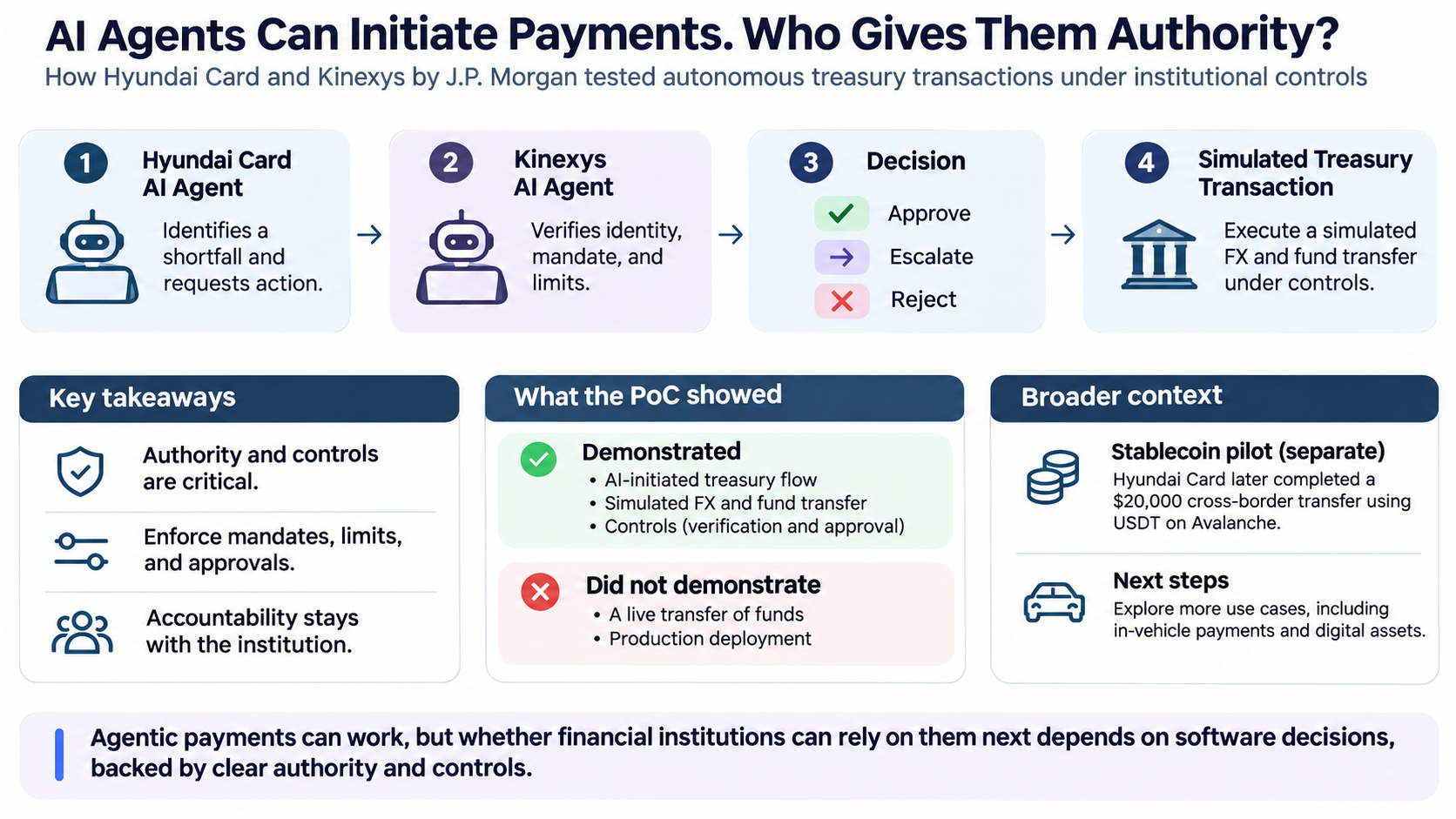
When the balance fell below its designated threshold, the Hyundai Card agent identified the shortfall, requested FX quotes from three banks, selected the preferred counterparty, and submitted an execution request.
A separate Kinexys agent then evaluated whether the requested transaction was permitted.
Hyundai Card designed the transaction scenario and authorization framework. Kinexys developed the participating agents and implemented the identity verification, authorization, and execution-control mechanisms.
The distinction between the two agents is fundamental.
One agent determined what transaction should occur. The other evaluated whether the instruction could be executed under the authority previously granted.
A compliant request could proceed automatically. A transaction requiring additional authorization could be escalated to a human. An instruction outside the approved mandate would be rejected.
The demonstration included these different outcomes, with a simulated FX transaction booked in the primary scenario.
No real funds moved during this proof of concept. J.P. Morgan describes it as a controlled test integrated with back-end systems, not a live commercial service.
What was demonstrated was a working authorization and control process for agent-initiated financial instructions—not autonomous settlement across multiple banks in production.
An AI decision is not financial authority
Banks have spent decades defining who may initiate, approve, and execute financial transactions.
Authorized signatories, transaction limits, approval hierarchies, entitlements, and segregation of duties are fundamental elements of institutional payments infrastructure.
AI agents complicate this structure because they can make decisions and initiate actions without direct human involvement at each step.
An employee operates within an established legal and organizational accountability framework. An autonomous agent cannot independently assume those same responsibilities.
Its authority must therefore remain attributable to an identifiable principal.
Kinexys approaches this through three linked elements: the principal granting authority, the agent acting on its behalf, and the mandate defining the permitted activities.
In the Hyundai Card experiment, the agent operated through a cryptographically verified identity associated with the institution it represented. Its authority was contained in a machine-executable mandate approved by the principal.
An interesting design choice is that the agent could propose a mandate, but could not approve its own authority.
The principal remained responsible for authorization, while the bank enforced the approved limits.
Those limits covered elements such as permitted accounts, currency pairs, transaction amounts, and operating conditions.
This establishes a separation between an AI system's decision-making capability and its authority to create financial obligations.
An agent may determine what it wants to do. That does not mean it has permission to do it.
Controls must be enforced at execution
The most relevant architectural feature of the Hyundai Card experiment is that authorization did not depend solely on the AI model following instructions correctly.
When the Kinexys agent received a transaction request, it evaluated the requesting agent's identity, the principal it represented, and whether the requested activity complied with the approved mandate.
The framework combined deterministic checks with an additional AI-based assessment of whether the instruction was consistent with the agent's stated objective.
Each request could be approved, escalated, or denied.
This is familiar banking control logic applied to an unfamiliar type of transaction initiator.
The distinction matters because autonomous systems can initiate instructions at machine speed. A poorly constrained agent could generate multiple transactions before an operator recognizes that its underlying decisions are inappropriate.
Transaction-level authorization is therefore only part of the operating challenge.
Financial institutions must also consider cumulative exposure, transaction velocity, counterparty concentration, authorization expiration, revocation, and emergency suspension.
Another important requirement is the separation of transaction states.
A request being submitted is not the same as its being approved. Approval is not execution, and execution does not necessarily establish final settlement.
In a production environment, these transaction states must remain distinct. The Kinexys proof of concept demonstrated an audit trail linking the participating agents, approved mandate, control evaluations, and simulated transaction outcome.
This creates the basis for reconciliation, investigation, and supervisory review.
For payments operators, that traceability is not a secondary feature. It is essential to maintaining control of financial activity.
What the experiment has not established
The technical demonstration is meaningful, but its boundaries deserve equal attention.
According to J.P. Morgan's detailed case study, the experiment operated within a narrowly defined treasury scenario involving one bank-client relationship.
The agent was deployed within the bank's agent-as-a-service environment, allowing the interaction to be tested without resolving the larger challenges of connectivity and governance across independent financial institutions.
That means the demonstration does not yet establish a common authorization framework that multiple banks can independently recognize.
A mandate approved by one financial institution is not automatically portable to another.
This creates questions that become more difficult as agentic payments scale.
How will a bank verify authority granted through another institution? Which party is responsible when an agent makes an economically unfavorable but technically authorized decision? How should institutions investigate disputed transactions involving several autonomous agents?
And how will they distinguish a valid instruction from one that complies with transaction limits but is based on manipulated or inaccurate information?
These are questions of institutional governance and operating responsibility, not simply AI capability.
A signed mandate establishes a boundary of authority. It does not guarantee that every decision made within that boundary is commercially sound.
Hyundai Card is testing more than one part of future payments infrastructure
The Kinexys collaboration follows a separate Hyundai Card initiative involving stablecoin-based corporate remittances.
In July, Hyundai Card helped coordinate a cross-border pilot involving Hyundai Motor subsidiaries in the United States and Mexico, alongside Tether, Avalanche, and settlement infrastructure provider Axiym.
That pilot involved an actual transfer of $20,000 using USDT on Avalanche. The transfer and verification process took approximately seven minutes, according to the participating companies.
The distinction between the two experiments is important.
The stablecoin pilot examined how corporate funds could be transferred across borders using alternative settlement infrastructure.
The Kinexys experiment examined how autonomous agents could be authorized to initiate and execute financial instructions within institutional controls.
One addresses the movement of value. The other addresses the authority to initiate that movement.
These are complementary infrastructure questions, but the experiments do not establish that the capabilities have been integrated into a single production system.
Hyundai Card has also indicated interest in extending its Kinexys collaboration into areas such as in-vehicle payments.
That would introduce additional questions involving machine identity, delegated purchasing authority, transaction limits, and accountability across participants.
The challenge ahead is interoperability
The Hyundai Card demonstration suggests that the basic components of controlled agentic transactions can be assembled using existing technology.
The more difficult challenge is establishing a framework that works across institutions.
An autonomous treasury agent may eventually communicate with several banks. A purchasing agent may negotiate with multiple suppliers. A connected vehicle may initiate transactions involving merchants, financial institutions, and service providers.
Each participant will need confidence that the agent is genuine, properly authorized, and operating within enforceable boundaries.
That requires more than allowing AI agents to exchange messages.
It requires common approaches to machine identity, portable authorization mandates, transaction controls, auditability, and responsibility when instructions fail or produce unexpected consequences.
Banks and payment infrastructure providers have an important role in establishing those mechanisms.
The opportunity is not simply to create another interface through which AI can initiate payments. It is to provide the trust and control infrastructure that makes autonomous financial activity acceptable to institutions.
Hyundai Card and Kinexys have demonstrated one way to separate autonomous decision-making from enforceable execution authority.
The broader industry challenge is ensuring that separation remains reliable as transactions cross institutional boundaries.
The future of agentic payments will depend less on whether software can decide to move money than on whether financial institutions can reliably control what happens next.
Sources
The Payments Corner
30+ years across payments, fintech, banking, and financial infrastructure. Operator-level perspectives on the systems that move money.
The author is employed at Euronet Worldwide, a card issuer processing company. The author may own securities or assets referenced across The Payments Corner ecosystem. Content is provided for informational and editorial purposes only and should not be considered investment advice.
Related Insights
Authorization in agentic payments shifts from moment to chain
As AI agents execute transactions on behalf of consumers and businesses, the payment industry must move beyond narrow technical authorization to operationalize legal and regulatory proof of delegated authority. The question of what a user actually authorized an agent to do—and who is liable when outcomes diverge from intent—will determine whether agentic commerce scales.
Banks risk losing visibility into customer spending as AI agents move transactions off the payment rail
When AI agents autonomously spend against prepaid accounts at platforms like Stripe, banks see only the funding event—not the thousands of micro-transactions or the logic that triggered them. Control over machine-spend policy may matter more than control over the card itself.
Agentic AI in Payments Isn't Just Another Innovation Layer
AI agents are no longer simply assisting consumers. They're increasingly executing payments autonomously on their behalf. Not hypothetically. In present tense. That changes the architecture of payments itself — and forces a deeper question about whether infrastructure can support that level of machine autonomy safely.