
AI concentration risk in payments runs deeper than vendor contracts
Banks diversifying fraud detection and identity verification across multiple vendors may unknowingly concentrate their operational risk on a single technology stack several layers below. As AI becomes critical to authorization and risk decisions, applying proven resilience discipline—fallback testing, dependency mapping, documented contingencies—has moved from optional to necessary.
Payments Has a New Concentration Risk. It Isn't a Bank.
What NVIDIA's leadership crisis reveals about the technology underneath fraud detection, risk decisions, and the vendors payments companies believe they have diversified.
When Jensen Huang resigned as NVIDIA's chief executive on November 11, attention turned to the succession and what the change might mean for the AI industry. Colette Kress, NVIDIA's chief financial officer since 2013, is now interim CEO while the board searches for a successor, according to the company's SEC filing.
My perspective and analysis are narrower. Mine are a payments point of view and a question.
A bank can buy fraud scoring from one vendor, identity verification from a second, and cloud capacity from a third, and still have all three resting on the same computing hardware and software ecosystem several layers down. The vendor list looks diversified. The underlying dependency may not be.
That is a concentration risk I believe deserves closer scrutiny, particularly because it may not be visible in a bank's traditional inventory of processors or network providers.
Nothing has broken. Deployed models do not stop working because a supplier changes its chief executive; NVIDIA's engineering organization remains in place, and its board has said it expects operations and the product roadmap to continue without interruption. I am not suggesting that Huang's departure will disrupt payment processing.
But leadership is not the only source of uncertainty. Export restrictions, hardware availability, licensing terms, and changes in support priorities can have consequences for customers far removed from the original supplier. NVIDIA already operates in an environment shaped by geopolitical and export-control considerations. That is a more plausible channel through which developments at one technology company could eventually affect a financial institution that has never contracted with it directly.
NVIDIA is already in the payments stack
In March 2026, Mastercard described its work on a proprietary AI foundation model trained on structured transaction data rather than text. Using NVIDIA's accelerated computing platform alongside Databricks, training began with billions of anonymized transactions, with plans to scale to hundreds of billions and incorporate authorization, merchant, chargeback, fraud, and loyalty information.
Cybersecurity is an early priority. Mastercard is also exploring whether the technology could eventually reduce the thousands of separate models it currently develops and maintains.
These are experimental capabilities, not evidence that the new model is already making live authorization decisions. But the direction is clear, and so is the infrastructure supporting its development.
American Express provides a different example. In a blog post on AI in fraud detection, NVIDIA reported that Amex had improved fraud-detection accuracy using deep-learning models and had employed NVIDIA's TensorRT optimization software and Triton Inference Server. That is NVIDIA's description of a customer deployment, not an independently verified account of Amex's current architecture.
Still, the distinction matters. NVIDIA technology was described as supporting not only model development but also inference, the process of generating a risk assessment from a trained model.
An institution that trains on NVIDIA hardware but deploys elsewhere has a development dependency. One that also relies on NVIDIA technology in production may have an operational dependency. The implications for continuity, cost, and technology portability are different.
For banks purchasing these capabilities through third parties, the underlying architecture may be considerably less visible.
The dependency goes beyond the chip
Financial institutions have considerable experience evaluating processors, networks, and other critical providers. They understand contracts, service-level commitments, escalation procedures, and, at least in principle, the alternatives available when a service fails.
AI introduces dependencies that can be harder to identify.
A bank may obtain fraud detection through a specialist vendor, identity verification through another provider, and AI-powered analytics through its cloud environment. Each service can involve additional layers of hardware, software libraries, model-serving technology, and development frameworks selected by someone else.
NVIDIA's position is unusual because its ecosystem extends well beyond GPUs. CUDA provides a widely used development environment for accelerated computing. TensorRT optimizes trained models for inference, while Triton supports their deployment and execution.
Moving applications away from this environment is technically possible. But depending on how they were developed and optimized, doing so can require additional engineering, validation, and performance testing. A successful alternative may achieve comparable results, but an institution needs to establish that before relying on it.
For a fraud model, the implications are measurable. Processing latency can affect decisions inside tight authorization windows. Changes in model accuracy can affect false declines and fraud losses. Both have commercial consequences.
The question, therefore, is not simply whether another technology exists. It is how much it would cost to move, how long the transition would take, and whether the alternative could operate at the required volumes and service levels.
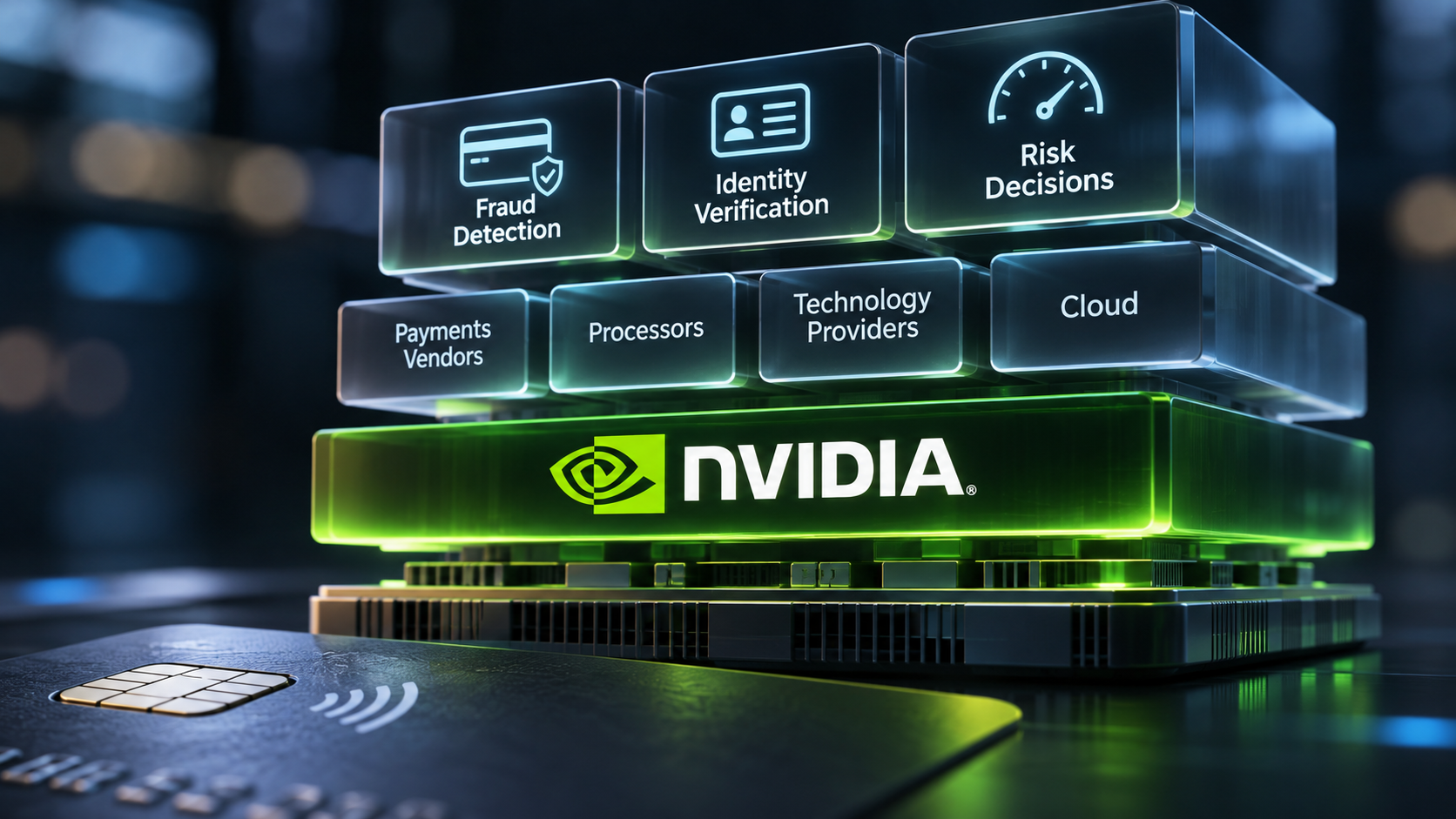
When multiple vendors depend on similar infrastructure, an institution can also find itself exposed to common risks despite having diversified its direct suppliers. A change in licensing, technology support, or computing availability may affect several providers simultaneously.
Resilience now includes the decisions behind a payment
In payments operations, resilience has traditionally meant keeping transactions authorized, routed, cleared, and settled when individual systems experience problems. As AI becomes more important to fraud prevention, identity verification, and transaction monitoring, that discipline needs to extend to the technology influencing those decisions.
Consider a processor that relies on a sophisticated model to score card transactions. If the model becomes unavailable, the processor might fall back to established rules or a secondary scoring system. The payment rails could continue operating, but the outcomes may change.
A conservative fallback could increase false declines, affecting legitimate cardholders and merchant sales. A more permissive approach could increase fraud exposure. Neither is necessarily the wrong decision, provided the tradeoff is understood, quantified, and accepted before an incident occurs.
Mastercard's approach offers an interesting reference point. The company says it intends to combine its existing cybersecurity models with its new foundation model rather than simply replacing them. That does not establish a tested failover capability, but it shows that introducing more sophisticated models need not require abandoning existing systems.
Regulators are already paying attention to the broader dependency problem.
In an October 15 speech, Denis Beau, First Deputy Governor of the Banque de France and Delegated Chairman of the ACPR, identified technological concentration, dependency, and vendor lock-in as concerns for financial institutions increasingly reliant on cloud and AI providers.
In the United States, interagency guidance on third-party risk management addresses subcontracting, critical activities, ongoing oversight, and transition planning. Europe's Digital Operational Resilience Act similarly addresses concentration risk associated with critical technology providers.
The principles are established. The challenge is applying them to technology stacks where the institution may have limited visibility beyond its immediate vendor.
And the accountability remains with the financial institution, regardless of who supplied the technology supporting its decisions.
An operator's question
The answer is not to abandon NVIDIA, avoid advanced AI models, or require every bank to maintain two entirely separate technology stacks. That could introduce considerable cost and complexity without necessarily improving operational resilience.
I was part of the operator team that ran a credit card portfolio migration at a large bank, working from business requirements through the migration plan. One lesson from that experience has stayed with me: redundancy on an architecture diagram is a claim, and readiness is a tested fact.
A contingency has value when the people responsible for executing it know what to do, the alternative has been validated, and the business understands what changes when it is activated.
I would apply that same discipline to AI-supported risk decisions.
If the primary model becomes unavailable, how quickly can the institution activate its fallback? What happens to false declines and fraud losses when it does? And when was that contingency last tested under realistic transaction volumes? I would want documented numbers for the first two, rather than assurances that a fallback exists.
I would also want to understand the dependencies beneath the contracted service. Which components are supplied by third parties? Are several apparently independent vendors relying on the same infrastructure? What would changing that infrastructure require?
Those are questions worth putting to technology providers during the next vendor review, with the answers documented rather than assumed.
NVIDIA's leadership transition may ultimately have little direct effect on financial institutions using its technology. Its engineering capabilities and established ecosystem remain substantial, and the payments industry has good reasons to continue investing in the improvements AI can deliver.
But the concentration question exists regardless of who leads NVIDIA.
Payments has spent decades making sure the infrastructure that moves money is dependable. It now needs to apply the same discipline to the technology that decides whether, when, and how that money moves.
The next important concentration risk may sit several layers beneath the service a bank believes it has purchased.
The Payments Corner
30+ years across payments, fintech, banking, and financial infrastructure. Operator-level perspectives on the systems that move money.
The author is employed at Euronet Worldwide, a card issuer processing company. The author may own securities or assets referenced across The Payments Corner ecosystem. Content is provided for informational and editorial purposes only and should not be considered investment advice.
Related Insights
Agentic AI in Payments Isn't Just Another Innovation Layer
AI agents are no longer simply assisting consumers. They're increasingly executing payments autonomously on their behalf. Not hypothetically. In present tense. That changes the architecture of payments itself — and forces a deeper question about whether infrastructure can support that level of machine autonomy safely.
Banks risk losing visibility into customer spending as AI agents move transactions off the payment rail
When AI agents autonomously spend against prepaid accounts at platforms like Stripe, banks see only the funding event—not the thousands of micro-transactions or the logic that triggered them. Control over machine-spend policy may matter more than control over the card itself.
Arc reshapes processor value, not the payments stack itself
Circle's new blockchain, backed by Visa, Mastercard, and major market utilities, will compress settlement costs and cross-border friction—but the real competitive pressure lands on processors, not networks, and only for those still extracting margin from pipes rather than judgment.