
BNPL, Rates, Tariffs, Bonds and Unemployment: What Do They Have to Do With Each Other?
Pay in 4 looks like a checkout feature. It is a loan, and loans live and die by the cycle.
Subscriber · Sign in to listen to the audio briefing
Audio briefings are available to subscribers. Sign in with the email you used to subscribe — we'll send a one-time code.
A loan with a friendly button
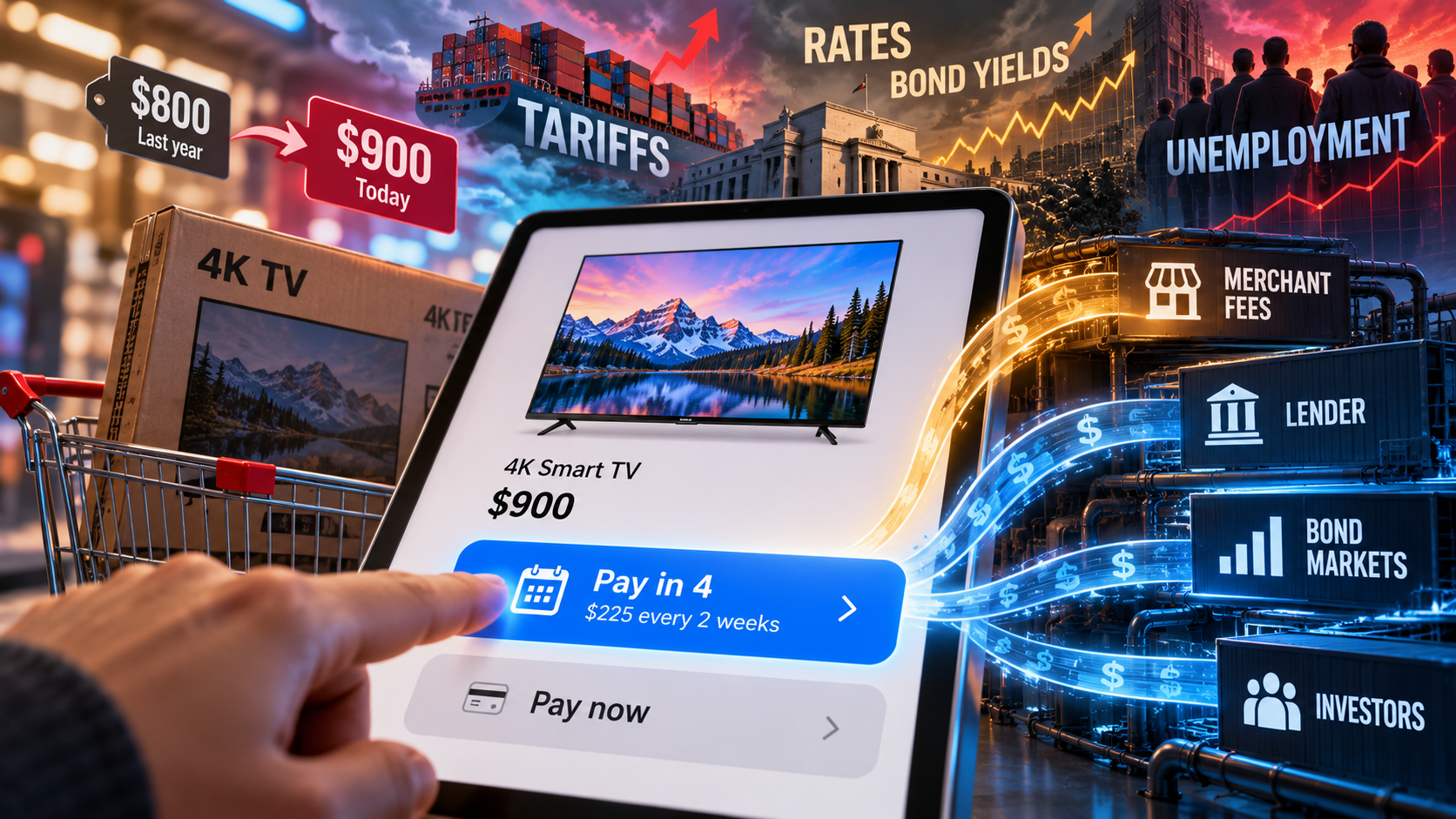
A television that cost $800 last year costs $900 today. Nobody's paycheck went up a hundred dollars to match, so at checkout plenty of people do the sensible thing and split it into four payments.
That button looks like a payments feature, but in fact, it is really a loan. Once you see it as a loan, everything in the wider economy starts to matter: rates, bond yields, tariffs, unemployment.
When you let someone pay later, someone else has to put up the money now to pay the seller. The experience may not make that apparent, and the shopper sees 0%, but somebody is still paying for it. Usually the merchant contributes, through a fee that tends to run well above what a card costs them. The provider — in this case, for clarity, I will name it the lender — covers the rest: what it costs to borrow the money it lends, and the customers who never pay it back.
So far things keep looking pretty simple, so let's unravel the complexity a bit more, just because BNPL is in fact much more than a button or option at checkout.
Tariffs push both ways
Higher prices make installments more appealing, don't they? Isn't $900 harder to swallow in one go than $800 was? I wish it were that easy, but it isn't: the same conditions that push prices up can also make the money behind those installments more expensive.
Now, I will introduce one more element — just for fun. The bond market is where that expense shows up. BNPL companies do not lend out of their own pockets. Most of them borrow from banks, sell their loans to private credit funds, and package them into securities for investors, and when bond markets get nervous about inflation, government debt, or where rates are heading, all of that borrowing gets more expensive.
How much it hurts depends on the ticket size as well as the term. On a six-week Pay in 4 plan and a small purchase, the cost of money barely registers. On a two-year monthly plan for an expensive purchase, it will painfully add up.
Unemployment is the part I watch most
Up to this point the question has been whether people can afford to buy. When unemployment rises, the question becomes whether they can afford to pay back, and that is a much harder problem.
Imagine prices staying high, more people leaning on installments, money staying expensive, and then layoffs starting. BNPL is most useful to shoppers at the exact moment it is most dangerous for lenders. Add the fact that one person can hold plans with three lenders who cannot see each other, and trouble can build quietly before it shows up in the numbers.
To be fair, BNPL has one real advantage in a downturn. Its loans are short, so a lender that tightens approvals sees the effect within weeks, while a credit card portfolio takes far longer to turn. Whether lenders actually move that fast, and how merchants react when fewer of their customers get approved, is a totally different story.
Rails versus lending
This is why I do not like lumping BNPL in with Visa, Mastercard, ACH, wallets or real-time payments. Those are the pipes or rails money moves through. BNPL is a lending decision sitting on top of those pipes, the same way a credit card's credit line sits on top of the card network. And lending always depends on what the economy is doing.
Whether people like BNPL is not for debate here. Clearly many do. The more useful questions are about what happens when the cycle turns. Who is putting up the money, and what is it costing them? Who absorbs the losses? How fast can approval standards change, and what does that do for merchants? And what happens when shoppers need installments the most?
My guess is that BNPL will matter most right when it is hardest to make money on. That is when people will stop seeing it as a checkout button and start seeing it as what it is: a loan, with the whole economy riding on it.
Franco Di Pietro
The Payments Corner
30+ years across payments, fintech, banking, and financial infrastructure. Operator-level perspectives on the systems that move money.
The author is employed at Euronet Worldwide, a card issuer processing company. The author may own securities or assets referenced across The Payments Corner ecosystem. Content is provided for informational and editorial purposes only and should not be considered investment advice.
Related Insights
Citi's card-linked offer acquisition bets on cost, not on proven category economics
Citi's acquisition of Kard Financial rests on operational and financial logic—lower rewards spend, faster platform build—but the card-linked offer category itself has never demonstrated standalone profitability. Cardlytics, the only pure-play, has burned $1.15bn cumulatively since its 2018 IPO and generated negative shareholder equity last year.
The banks' dollar token is insurance against disintermediation, not a product for treasurers
Twenty-one major financial institutions are forming a company to issue a dollar token by 2027, but the real beneficiary is not the corporate treasurer—who already has better speed and yield through faster bank networks—but the banks themselves, buying an option against the possibility that dollars migrate into blockchain-native rails they don't control.
Grab's Atome deal consolidates checkout control, not BNPL market entry
Grab is not entering buy-now-pay-later; it already operates PayLater in Southeast Asia. The US$1.49 billion acquisition of Atome integrates a consumer lending book with wallet, acceptance and settlement—collapsing the stack that card schemes and acquirers currently mediate—and hinges on regulatory approval from Singapore's competition and banking authorities.