
Are Issuers Giving Up Too Much Control to Their Processors?
Lately, I've been thinking about program management in card issuing. And one question keeps surfacing — who actually controls the business? Whose logo is on the card? Who carries the credit risk? Execution can be delegated. Control cannot — at least, not without meaningful long-term trade-offs.
Subscriber · Sign in to listen to the audio briefing
Audio briefings are available to subscribers. Sign in with the email you used to subscribe — we'll send a one-time code.
Lately, I've been thinking a great deal about program management in card issuing. And the more I think about it, the more one question keeps surfacing — who actually controls the business? Whose logo appears on the card? Who carries the credit risk? Who underwrites the loan? Who owns the member or customer relationship? Who ultimately defines the experience?
These questions may sound straightforward. But operationally, the answers are often more complicated than many institutions initially realize. Over time, a large number of regional banks and credit unions have outsourced substantial portions of card-program execution to processors and third-party program managers. There are understandable reasons for that — speed-to-market, operational efficiency, scale advantages, staffing constraints, compliance complexity, and infrastructure requirements. For many institutions, outsourcing became the practical default.
To be clear, I'm not arguing that every issuer — especially smaller institutions — should attempt to build a massive internal card operation from scratch. That is neither operationally realistic nor economically efficient in many cases. But there is an important distinction that increasingly feels strategic rather than operational. Execution can be delegated. Control cannot — or at least, not without meaningful long-term trade-offs. Because when institutions relinquish too much control over product configuration, lifecycle management, underwriting flexibility, partner relationships, servicing models, or data visibility, they may also gradually lose control over differentiation, strategic agility, member experience, and portfolio direction itself.
The industry context helps explain how we arrived here. The United States still contains thousands of banks and credit unions, many of which historically lacked the scale necessary to support fully internalized card infrastructures. Outsourcing became normalized because it solved real operational problems. But common practice does not automatically make something strategically optimal. And increasingly, the surrounding environment is changing.
Regulatory guidance consistently reinforces an important reality — outsourcing operational functions does not outsource accountability. Institutions still retain responsibility for credit risk, compliance, operational integrity, and portfolio performance. At the same time, many processors are fundamentally optimized around scale, standardization, operational efficiency, and repeatability — not necessarily around helping issuers maximize product differentiation, configurability, strategic flexibility, or member-centric innovation. That distinction matters more today because the issuing environment itself is becoming significantly more dynamic.
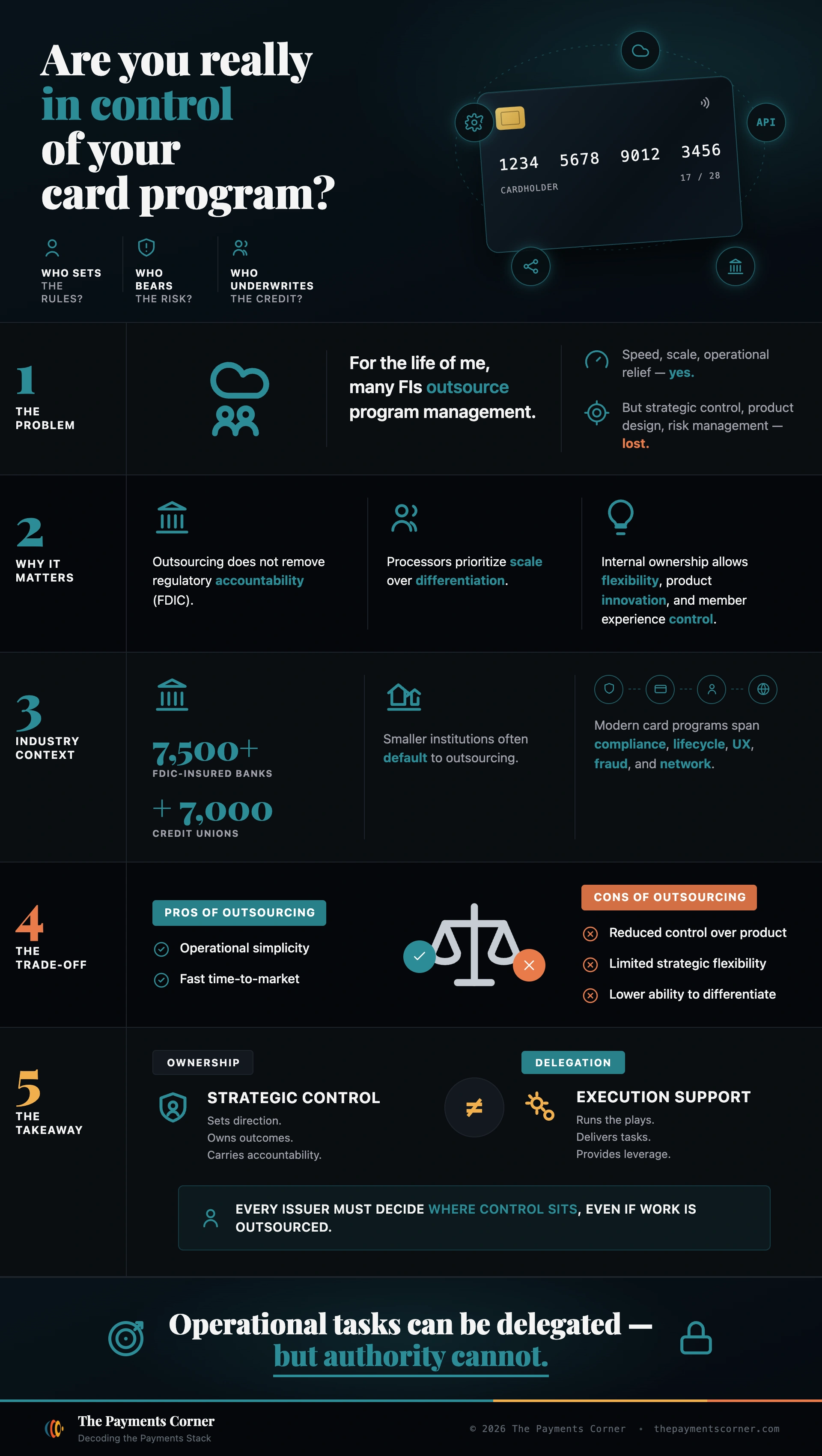
Modern card programs increasingly involve embedded finance, lifecycle orchestration, configurable lending structures, real-time servicing, fraud coordination, loyalty integration, network partnerships, and increasingly sophisticated digital engagement. Research from firms such as BCG, Accenture, EY, and industry analysis from organizations like PYMNTS consistently suggests that modernization is no longer purely an efficiency initiative. It is increasingly tied to value creation, adaptability, portfolio control, and long-term strategic positioning.
Which raises a deeper question. If institutions are modernizing their infrastructure, exploring greater issuing flexibility, considering sponsor-bank models, or competing against increasingly agile fintech environments — why would they willingly cede the very functions that define control, risk ownership, strategic direction, and customer experience? Perhaps the answer is not fully internalizing everything. Perhaps the future is more hybrid. Operational execution may remain distributed. But strategic authority increasingly feels like something institutions may want to reclaim.
Ultimately, the conversation around program management is no longer simply operational. It is becoming architectural. Strategic. And increasingly tied to institutional identity itself.
Execution can be delegated. Control cannot.
Franco Di Pietro
The Payments Corner
30+ years across payments, fintech, banking, and financial infrastructure. Operator-level perspectives on the systems that move money.
The author is employed at Euronet Worldwide, a card issuer processing company. The author may own securities or assets referenced across The Payments Corner ecosystem. Content is provided for informational and editorial purposes only and should not be considered investment advice.
Related Insights
Infrastructure Modernization Is No Longer About Selecting a Processor
Something deeper is shifting in how regional banks and credit unions approach infrastructure modernization. This is no longer simply about selecting a processor. Increasingly, it's about regaining control of the stack itself — and reclaiming the strategic authority that decades of outsourcing slowly distributed away.
Kraken's card is a bet on controlling the funding decision, not the transaction
Kraken's debit card—with its 2% rewards across multiple asset balances—is not a payments product disguised as one. It is a wallet-stickiness play that inverts traditional card architecture: instead of a card accessing a single account, the platform now decides which of many balances funds each purchase, moving the locus of control from the network to the issuer's financial operating system.
Banks risk losing visibility into customer spending as AI agents move transactions off the payment rail
When AI agents autonomously spend against prepaid accounts at platforms like Stripe, banks see only the funding event—not the thousands of micro-transactions or the logic that triggered them. Control over machine-spend policy may matter more than control over the card itself.