
The Perimeter Was the Product
The FDIC's pending list is quietly becoming a fintech index. Affirm filed in January, Klarna in July, dozens reportedly behind them — the scaled survivors of the fintech decade concluding, one by one, that the perimeter they built around was the moat all along.
Subscriber · Sign in to listen to the audio briefing
Audio briefings are available to subscribers. Sign in with the email you used to subscribe — we'll send a one-time code.
The FDIC's pending-applications list is quietly becoming a fintech index. Affirm filed for an industrial bank charter in January. Klarna — the company that built its brand as the alternative to the card system — followed on July 6, applying to the Utah Department of Financial Institutions and the FDIC to establish Klarna Bank USA. The trade press counts dozens more behind them. Taken one at a time, these are company news. Taken together, they are the latest entries in a sequence that settles an argument: Square's industrial bank was approved in 2020. Varo received the first de novo national charter granted to a consumer fintech the same year. SoFi converted to a bank holding company in 2022. And in 2026, the applications have become a wave.
The fintech decade — call it 2012 to 2022, the venture era built on unbundling the banks — began from a specific premise: that the perimeter — charters, capital requirements, supervision — was the incumbents' burden, the overhead that made banks slow and disruption possible. That era closed with the 2022 rate cycle, but the verdict on its premise has been arriving in filings ever since: the scaled survivors concluding, one by one and years apart, that the premise was wrong — with Klarna, in July, the largest to concede it yet. The perimeter is not overhead. It is where the durable economics sit.
The migration has a measurable driver: over roughly five years, three costs changed sign.
Funding. A lending book financed through warehouse lines and securitization pays market rates, and market rates reprice sharply in tightening cycles. The same book funded with insured deposits carries a structurally lower and more stable cost of funds. SoFi's post-charter economics made this line visible to every lender still operating outside.
The cost of renting access. Operating through sponsor banks and banking-as-a-service arrangements was inexpensive when BaaS was treated as a growth business. It became expensive when it became a supervised chokepoint: the consent orders that ran through sponsor banking, the Synapse failure and the customer funds it stranded, and the agencies' tightened expectations for bank-fintech arrangements all raised the price of renting the perimeter — while the price of owning it stayed roughly constant. When rent rises and the mortgage does not, tenants become buyers.
Control. Every product decision routed through a partner bank's risk committee costs time. At startup scale that cost is acceptable; at Klarna's scale it compounds into the largest expense nobody books. The fintechs that survived to scale are exactly the ones for which that cost now exceeds the cost of direct supervision.

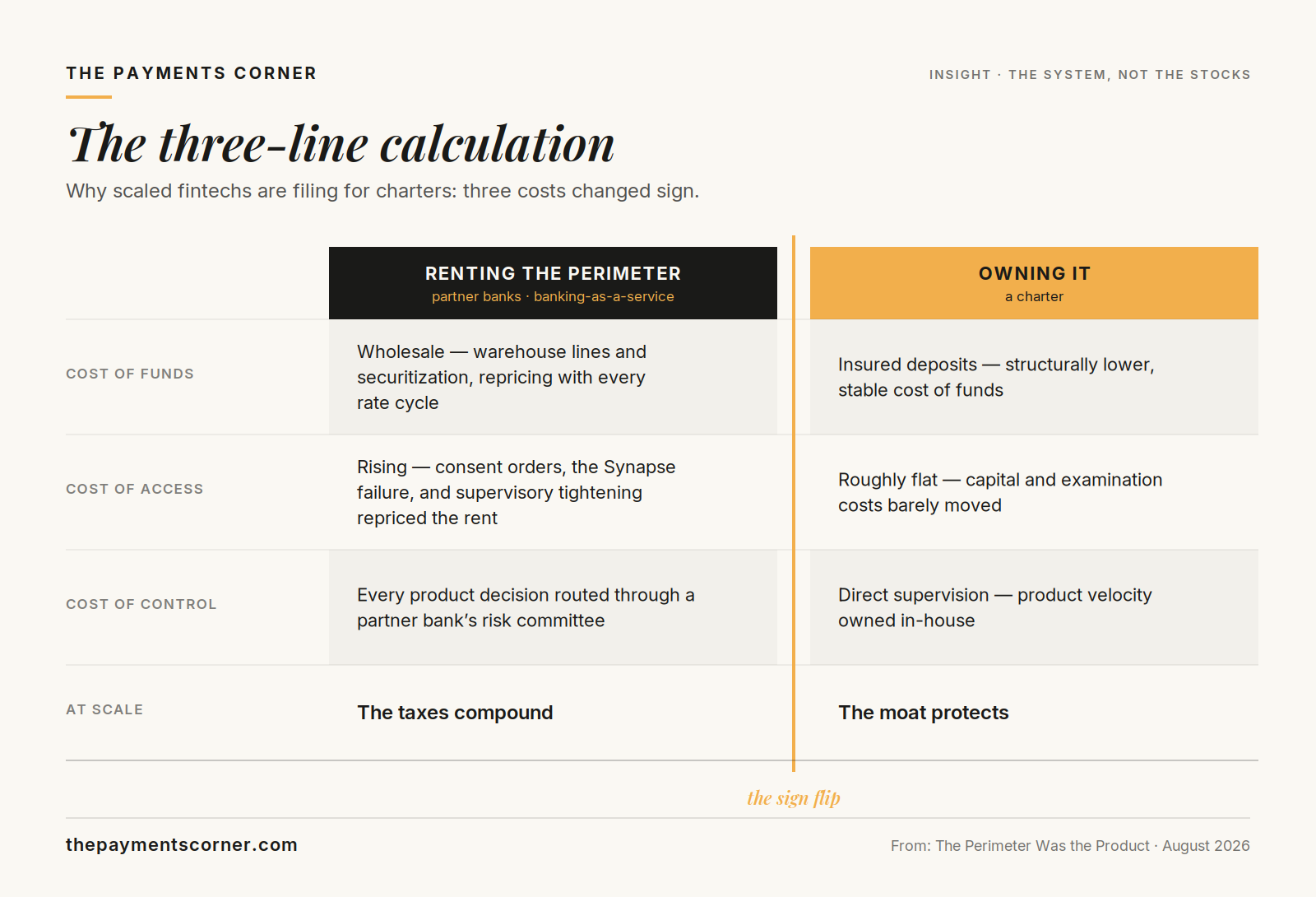
Reverse those three signs and the original premise inverts with them. The perimeter was never the incumbents' weakness. It is the moat — and capital and examination are the recurring cost of the moat: expensive to enter, protective once inside.
The pattern is visible in the 50 TPC Index. Klarna sits in The Interfaces — the consumer and merchant platforms — and is now moving, in real time, toward The Balance Sheets. SoFi made that move already. Nubank was chartered from the start and built the category's strongest economics on that foundation. Chime is the deliberate counter-case: public, at scale, and charter-less by design — a bet that renting remains viable when the platform is large enough and the products stay on the deposit side of the line. The index categories are lenses, not fixed labels, and a company changing categories is usually the most informative event in the universe.
What matters from here is not any single application. Industrial bank reviews run well over a year, and the community-bank lobby — which has contested nearly every ILC bid and pressed Congress for a three-year moratorium on approvals — will contest these. What matters is that the queue is no longer a forecast. It formed in the first half of 2026, it is lengthening, and every scaled fintech can now run the same three-line calculation — funding, rent, control — that increasingly produces the same answer. The informative events from here are two: who files next, and who, like Chime, keeps declining to.
Ten years of operating outside the perimeter — and four more of watching who applied to come inside — established what it is worth.
The perimeter was never the burden. It was the product.
Franco Di Pietro
The Payments Corner
30+ years across payments, fintech, banking, and financial infrastructure. Operator-level perspectives on the systems that move money.
The author is employed at Euronet Worldwide, a card issuer processing company. The author may own securities or assets referenced across The Payments Corner ecosystem. Content is provided for informational and editorial purposes only and should not be considered investment advice.
Related Insights
The banks' dollar token is insurance against disintermediation, not a product for treasurers
Twenty-one major financial institutions are forming a company to issue a dollar token by 2027, but the real beneficiary is not the corporate treasurer—who already has better speed and yield through faster bank networks—but the banks themselves, buying an option against the possibility that dollars migrate into blockchain-native rails they don't control.
BNPL Isn't a Checkout Feature. It's Credit.
BNPL is often discussed as a checkout experience or a UX innovation. But increasingly, the market is beginning to price it for what it fundamentally is. Credit. Yesterday's market activity, paired with New York's proposed regulatory framework, reinforced that distinction clearly.
How are FIs successfully migrating to modern core banking systems?
Visa's core migration playbook cites an anonymous national bank. The Kansas City Fed names it: Zions, $90 billion. The patterns are right — but they assume a negotiating position most institutions don't have.