
The Phone Didn't Replace the Card. It Unbundled It.
Same device, opposite outcomes: what the smartphone did to payments depends on the rail underneath it
Subscriber · Sign in to listen to the audio briefing
Audio briefings are available to subscribers. Sign in with the email you used to subscribe — we'll send a one-time code.
Do you remember when everything started with the card in your wallet?
Early in my career I knew all sixteen digits and the CVV of every card I carried. I was also a little obsessed with what happened to those digits after I handed the card over: the terminal, the acquirer, the network, the issuer, and back again in a couple of seconds. Today, when you tap your phone, the number it sends isn't even yours. It's a token, and I'd bet none of you could recite it. The journey is still there, but more hands now touch it.
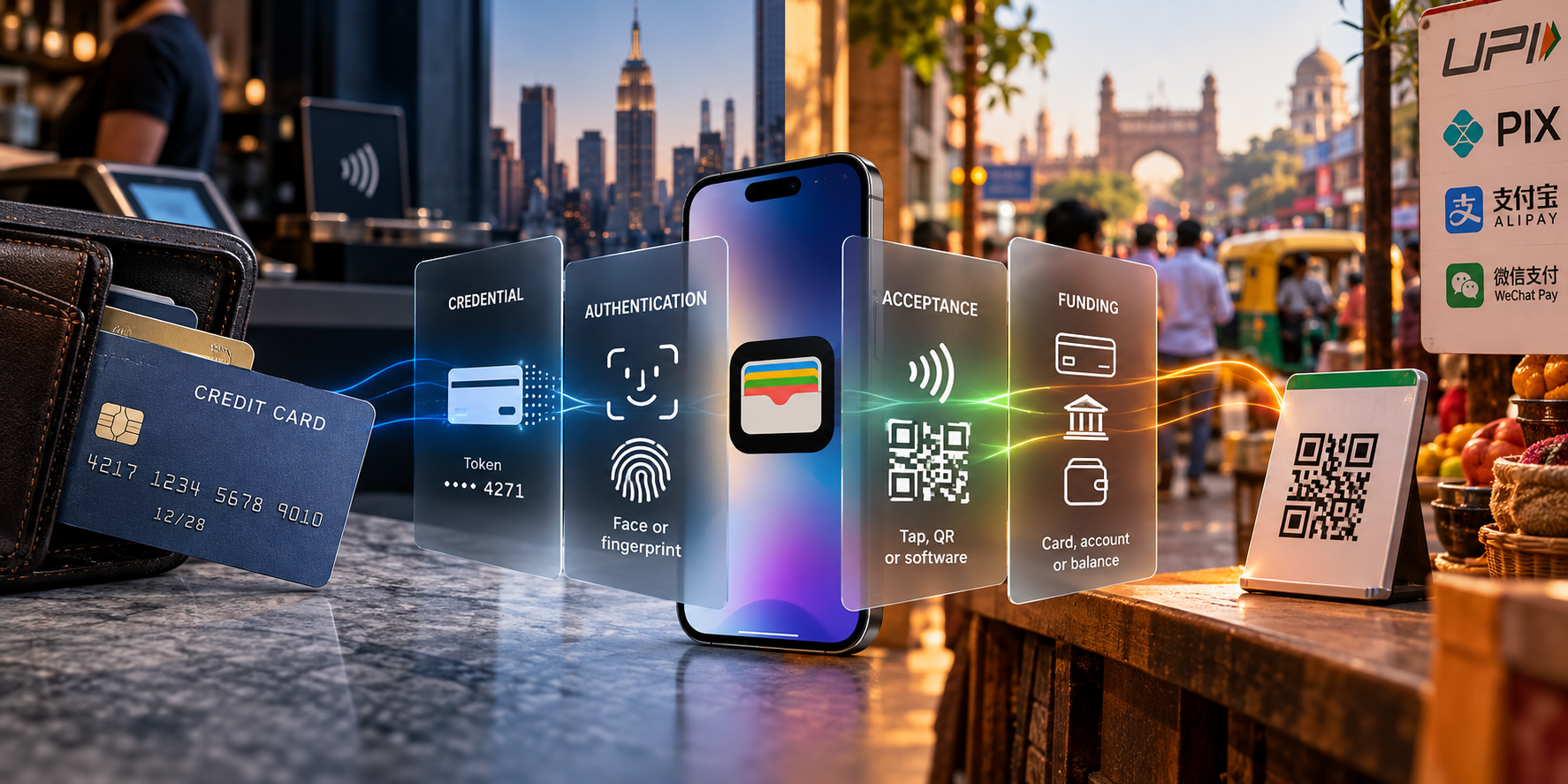
The card was never one thing. It was designed to do four jobs at once: carry a credential, the number; authenticate you, first with your signature and later with a PIN, while the chip proved the card itself was genuine; get accepted, because a terminal knew how to read it; and, maybe the most important, point to the funding source, the account behind it. Whoever issued that piece of plastic owned the relationship with you.
Keep those four jobs in mind, because the rest of this insight is about what happened to them once mobile wallets arrived, starting with Google Wallet in 2011, almost exactly fifteen years ago.
What the phone, and more precisely the mobile wallet, did to the plastic
You'll often hear that the smartphone digitized the card. It didn't. What the phone did was pull the four jobs apart.
The credential became a token in a secure chip, and a stolen token is worthless. Authentication moved to your face or your fingerprint, which is the strongest verification most of you have ever used, and your bank doesn't control it. Acceptance moved onto the phone itself, through QR codes and software terminals, so a small merchant no longer needs special hardware. Funding became a choice you make behind a screen, where a card, a bank account or a balance can sit side by side.
Here is the point to underline: once the jobs are separated, each one can be owned by someone different.
Same device, opposite results, depending on where you are
Everyone has roughly the same phone, yet the outcomes across countries look nothing alike.
In the United States, digital wallets accounted for only 17 percent of in-store spending in 2025, against a global average of 33 percent. Even inside those wallets, cards remain the preferred funding source. Apple Pay and Google Wallet didn't replace the card. They wrapped it.
Now look at India. UPI processed 24.51 billion transactions in August 2026, a record, and wallets carry about 61 percent of in-store spending. In Brazil, Pix settled more than 318 million operations in a single day this September.
So what explains the gap? It isn't the phone. It's the rail underneath it. Where a mature card network with rewards already worked, the phone became a better envelope for the card and part of its value proposition. Where a central bank built a real-time rail with no interchange, the phone became the payment instrument itself, and the card had nothing left to hold on to.
Who owns the front door now?
Once the bundle is broken, who controls the moment you choose how to pay?
In the US, it's the operating system. The wallet decides which card shows up first. In India, it's a small number of apps that route most of the country's volume. In both places, the bank lost the front door it held by default when you reached for plastic.
My takeaway, and yours to think about
The unbundling isn't finished. Once credential, authentication and acceptance all live on a device, what the card still uniquely offers is narrower than it looks: credit, the right to dispute a charge, and rules that merchants and consumers trust. That core is defensible, but it's a smaller franchise than the one the plastic protected. Don't get me wrong: if you have read me before, you know I believe trust remains the networks' biggest asset.
Thirty years later, I still want to understand every step of the journey, the way I did when I knew my card numbers by heart. The difference is that today each step can belong to a different company. If you end up working at a bank in a card-first market, the question won't be whether to be in the wallet. It will be whether your card is the one the phone picks, and whether what stands behind it earns that choice.
Franco Di Pietro
The Payments Corner
30+ years across payments, fintech, banking, and financial infrastructure. Operator-level perspectives on the systems that move money.
The author is employed at Euronet Worldwide, a card issuer processing company. The author may own securities or assets referenced across The Payments Corner ecosystem. Content is provided for informational and editorial purposes only and should not be considered investment advice.
Related Insights
The banks' dollar token is insurance against disintermediation, not a product for treasurers
Twenty-one major financial institutions are forming a company to issue a dollar token by 2027, but the real beneficiary is not the corporate treasurer—who already has better speed and yield through faster bank networks—but the banks themselves, buying an option against the possibility that dollars migrate into blockchain-native rails they don't control.
The Fourth Phase — Agentic Commerce (1 of 4)
Agentic commerce isn't a faster checkout. It's a different actor at the checkout.
Top of Permission — Agentic Commerce (3 of 4)
Issuers face a fork: be the passive endpoint of an agent's decision, or the layer that governs it.