
Bancomat Is Not in the Pilot, but Its Role in the Digital Euro Remains to Be Defined
When the ECB announced the 36 payment service providers selected for the digital euro pilot, Bancomat did not appear directly by name—but it participates through isybank. The real question is what space it will occupy when the public digital currency begins to circulate, and whether its pan-European initiatives can coexist with a common European infrastructure.
Subscriber · Sign in to listen to the audio briefing
Audio briefings are available to subscribers. Sign in with the email you used to subscribe — we'll send a one-time code.
The Scheme That Does Not Appear on the List
When in July the ECB published the list of 36 payment service providers selected for the digital euro pilot, Italy stood out for the number of participants. Seven operators appear under the Italy heading: UniCredit, Monte dei Paschi di Siena, Banca Sella, isybank, Nexi, Numia and Poste Italiane. To these we can add Satispay, present through the Luxembourg-based company Satispay Europe.
It is a representation that tells us much about our payments system: large banking groups, specialized institutions, payment infrastructure, a postal network and a digital operator born outside traditional banking models. But the name that struck me most is the one that does not appear on the list: Bancomat, the domestic scheme that millions of Italians have used for decades.
Its absence, however, requires clarification. The ECB selected payment service providers that are authorized, not schemes as such. And Bancomat is not at all outside the project. Intesa Sanpaolo has confirmed that isybank will participate with the technological support of BANCOMAT, while Mooney will contribute to the analysis of possible innovative functionalities.
So Bancomat is there, even though it does not figure directly among the 36.
The question I ask myself is a different one: what role will it be able to play when the digital euro is actually available?
The Commission Gap
In February, before the ABI executive committee, Piero Cipollone explained an important aspect of the economic model envisaged for the digital euro. The cap on commissions paid by merchants should be lower than that of international schemes, but higher than that of domestic schemes.
A choice far from secondary.
After many years in the world of schemes, I have learned to look at these mechanisms not only to understand how much a transaction costs, but above all to understand what incentives they create and who benefits from them. In this case, the ECB seems to want to preserve the competitiveness of domestic solutions while at the same time offering a European alternative to international schemes.
Of course, a commission cap does not necessarily correspond to the price that each merchant will end up paying. The actual conditions will depend on the final rules and commercial agreements applied by PSPs.
But the principle is interesting. The digital euro is not born to beat Bancomat on price. On the contrary, the proposed model seems to recognize the value of national schemes.
The problem is that being price-competitive does not automatically guarantee remaining relevant in the payments architecture. Commissions are only one part of the equation. Acceptance, processing, interfaces with banks and merchants also matter, and above all, who controls these steps.
Where Habits Are Formed
The operational pilot will begin in the second half of 2027 and will last twelve months. It will involve employees of central banks, PSPs and selected merchants, using a beta version of the digital euro without legal tender status. Payments between individuals, in stores and online will be tested.
At first glance it seems mainly a technical exercise. In part it is. But those who have participated in the introduction of new payment instruments know that these tests also serve to understand how users behave, what problems merchants encounter and which integrations actually work.
The requirements, interfaces and operating processes that are tested today can influence the choices of tomorrow. They do not necessarily determine them, but having direct experience at this stage is an advantage.
The Italian context makes all this particularly interesting. According to the ECB's survey on payment habits, the numerical share of daily payments made online in Italy rose from 6% in 2019 to 24% in 2024.
We are no longer talking about a secondary channel. And precisely in e-commerce, public money, represented today essentially by cash for retail payments, cannot be used directly.
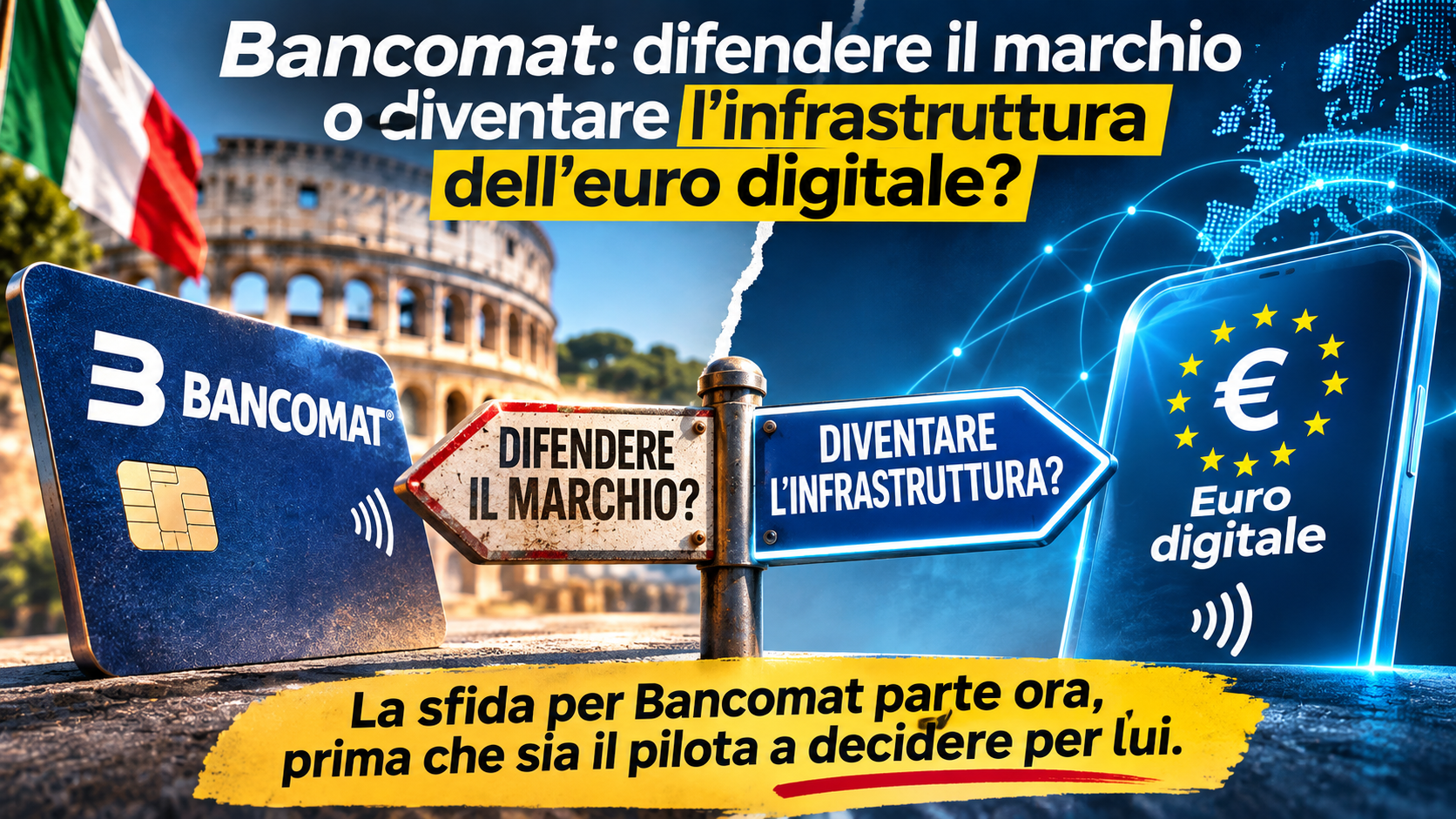
This is one of the spaces that the digital euro intends to occupy.
Two European Paths
Bancomat, in the meantime, is already moving on another front.
In February it signed, together with Bizum, EPI, SIBS and Vipps MobilePay, an agreement to develop the interoperability of European payments. On 30 September, the partners announced the establishment of the European Network for Payments, a joint company that will have the task of connecting the respective solutions through a shared infrastructure, while maintaining existing brands and user experiences.
It seems to me an important choice, also because it shows that Bancomat is not simply defending its domestic market. It is trying to participate in the construction of a more integrated European system.
But here arises a question that, in my view, deserves greater attention.
On one hand we have national schemes seeking to build a pan-European interoperable system. On the other hand we have the Eurosystem developing a new infrastructure for public digital money.
These are different initiatives, with different objectives and governance models, but they will eventually meet in the same places: in banking applications, on merchant terminals and in the daily experiences of consumers.
The ECB itself has indicated co-badging and the use of common digital euro standards as possible opportunities for domestic schemes. It is therefore not obvious that the digital euro should rely on Bancomat's infrastructure. The opposite could also happen, with Bancomat using some components of the common European ecosystem to extend its services.
And this changes the discussion quite a bit.
The Place to Conquer
I believe that Bancomat has an industrial heritage that would be difficult to replicate: a consolidated acceptance network, connections with the banking system, operational experience and a brand that is recognizable to practically anyone in Italy.
But I do not believe that these advantages alone are sufficient to assure it an important position in the evolution of European payments.
Technological participation in the pilot through isybank is a first concrete element, although we do not yet know which components will be used or whether that model can be extended to other PSPs. The European Network for Payments represents a second path, this time on a pan-European scale.
In my view, the question is how to make these two initiatives coexist and, where possible, exploit their complementarities.
This is not about abandoning the Bancomat brand. Nor about necessarily transforming the scheme into a mere technology provider. It is about understanding which parts of the Bancomat system it can continue to manage, which services it can develop and where it can create value when some standards and infrastructure components will be common to the entire euro area.
The digital euro project still depends on the adoption of European legislation and subsequent ECB decisions. Nothing is final. But the technical and operational choices that precede the pilot are already underway.
And it is precisely for this reason that I believe now is the right time to address the issue.
The risk for Bancomat is not losing its brand to the digital euro. It is keeping the brand and discovering that an important part of the value has moved elsewhere.
The Payments Corner
30+ years across payments, fintech, banking, and financial infrastructure. Operator-level perspectives on the systems that move money.
The author is employed at Euronet Worldwide, a card issuer processing company. The author may own securities or assets referenced across The Payments Corner ecosystem. Content is provided for informational and editorial purposes only and should not be considered investment advice.
Related Insights
The Day CLABE Stopped Mattering
SPEI turned 22 and the conversation shifted to cards. The rail was never the problem. What was missing was an identifier that the payer didn't have to enter, and that asset is now at stake.
The Rise of Brazilian Fintechs Was a Bet on Interest Rates
Brazilian fintechs rose far more than the market after the first round and continued climbing even as the index stalled. The election was the trigger; what sustained the move was the yield curve.
How are FIs successfully migrating to modern core banking systems?
Visa's core migration playbook cites an anonymous national bank. The Kansas City Fed names it: Zions, $90 billion. The patterns are right — but they assume a negotiating position most institutions don't have.