
Pix becomes the acceptance point that global wallets want to reach
Alipay+ and Weixin Pay arrived at Pix within a six-day interval, signaling a structural shift in how international payment networks access Brazilian commerce.
Pix becomes the acceptance point that global wallets want to reach
Alipay+ and Weixin Pay arrived at the Pix ecosystem within a six-day interval. The shift goes beyond tourism and raises questions about the economics of international acceptance.
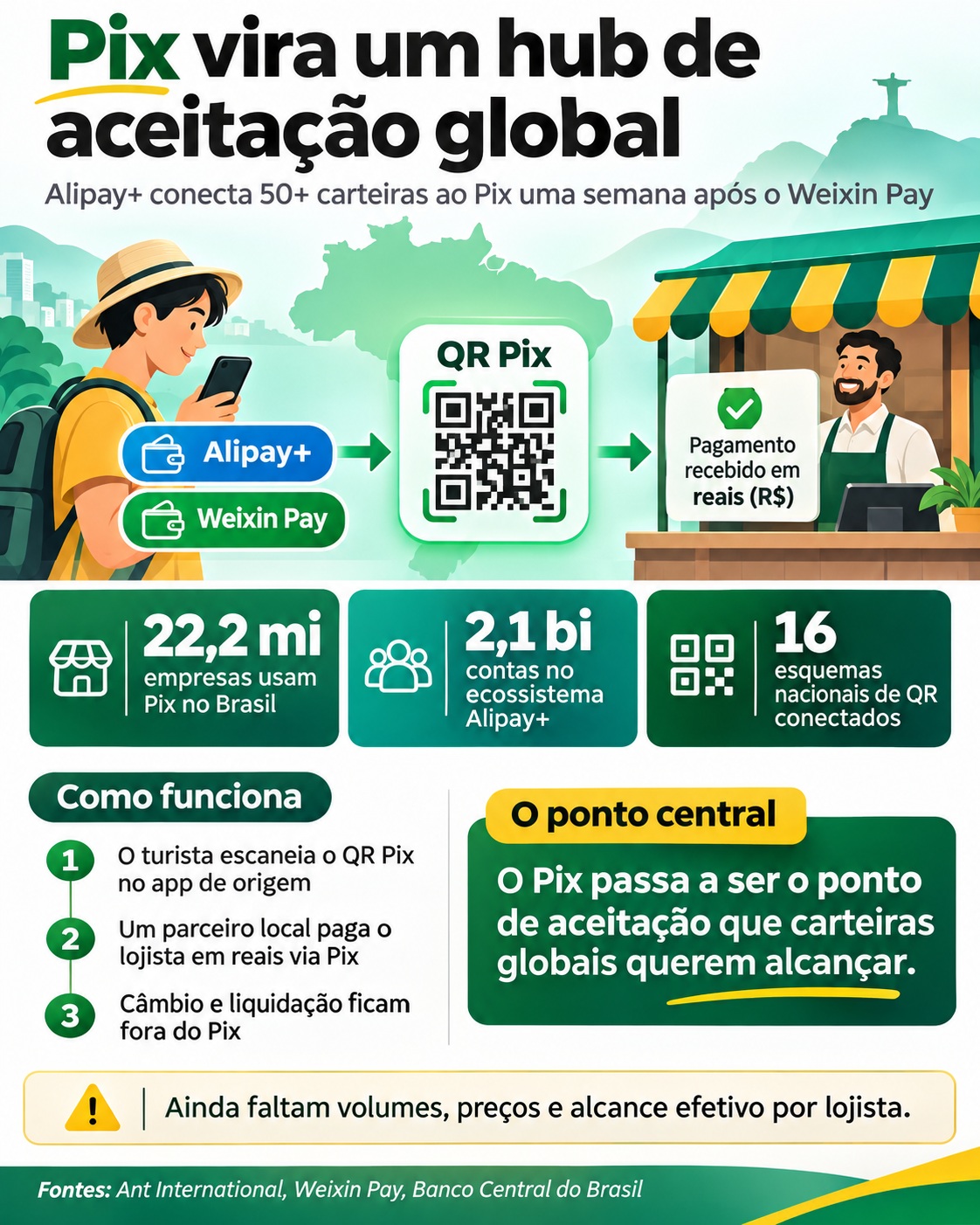
On November 19, Alipay+ announced its connection to Pix, six days after Weixin Pay presented a similar solution for Chinese tourists. Both initiatives signal a shift in how international payment networks reach merchants. Rather than requiring Brazilian establishments to adopt another foreign payment method, digital wallets from other countries now access an infrastructure that merchants already use. For me, the most relevant question is not how many wallets Pix can attract, but who controls the payment relationship when a domestic network becomes the common acceptance point.
Two announcements, one same model
According to Ant International, Alipay+ connects more than 50 digital wallets and banking applications, which together represent 2.1 billion user accounts, and reaches approximately 150 million merchants worldwide.
With Pix as its 16th national QR code payment system integrated, Alipay+ extends this connection to Brazilian commerce.
The announcement came following Weixin Pay's initiative, presented on November 13. Through it, Chinese visitors can scan Pix codes from participating merchants using WeChat, pay in renminbi, and allow the retailer to receive in reais.
The six-day interval is striking. Two major digital wallet networks announced access to the same Brazilian infrastructure practically at the same time.
But the novelty is not just in the number of applications. It is in the direction of the integration.
International acceptance traditionally depends on the merchant, or its acquirer, operating within the infrastructure and rules of global networks. This remains the dominant model in international card payments.
Pix offers another path: the foreign provider adapts to the payment method that the Brazilian merchant already accepts.
The retailer does not necessarily need to recognize the foreign wallet. Its payment service provider needs to participate in the arrangement that allows the wallet to initiate a Pix payment.
This difference changes the discussion around distribution and acceptance.
The merchant's infrastructure remains Brazilian
The Central Bank of Brazil has already described how these arrangements involving Pix and foreign payers can work.
A visitor scans the merchant's Pix QR code using an application from a foreign institution. A Brazilian partner executes the local transfer in reais, while the foreign institution debits the amount in the customer's currency.
Afterward, the partners settle their international obligations outside the Pix infrastructure.
Therefore, this is not an international settlement made by Pix itself. It is an international payment experience whose final leg, to the merchant, uses a domestic instant transfer.
The distinction matters.
The establishment receives a local payment. The tourist uses an application they already know. Between the two, companies remain responsible for currency conversion, liquidity, regulatory compliance, and settlement between countries.
Pix did not eliminate these functions. It changed the infrastructure used in the payment-to-merchant stage.
That is where the economics of the operation become interesting.
Card networks built part of their value by connecting cardholders, issuers, acquirers, and merchants under a common set of rules and acceptance mechanisms.
In this other model, the domestic acceptance point already exists. It is international wallet providers who compete for access to it.
The merchant's acceptance relationship and the international service provided to the consumer become more separated.
And what about card economics?
The inevitable question is what happens with tourist purchases made with international cards.
A transaction with a card issued abroad can generate interchange, scheme fees, international operation charges, and foreign exchange revenue for different participants.
A Pix payment initiated by a foreign wallet may follow a different path.
If the consumer pays with balance or bank account, and the local partner executes the Pix transfer, the payment-to-merchant stage does not need to go through the traditional authorization, clearing, and settlement processes of an international card transaction.
This creates an alternative for certain in-person purchases made by foreign visitors.
But there is not yet a basis to claim we are facing significant card volume loss.
Neither of the two announcements discloses transacted volume, average ticket, the number of merchants actually enabled in these integrations, or commercial terms between foreign and Brazilian partners.
We also do not know the composition of funding sources used by the wallets. Some may be funded by cards, even when the merchant receives via Pix.
The cost argument demands the same care.
Accepting Pix in the domestic market can be inexpensive. This does not mean that a transaction initiated by a foreign wallet costs the merchant exactly the same as a local Pix payment. Currency conversion, intermediary compensation, risk management, and international settlement have costs.
There is also the value proposition for the consumer. International cards offer established dispute processes, access to credit, and broad acceptance across different markets. A wallet payment connected to Pix does not automatically reproduce these characteristics.
There is a concrete possibility of competition. Its commercial impact, for now, has not been measured.
The dispute centers on acceptance control
The aspect I consider most important is the possibility that domestic instant payment networks become the common infrastructure through which different international wallets reach merchants.
The Central Bank created Pix primarily to improve domestic payments, expand competition, and foster financial inclusion. It did not need to develop a global wallet to make the system interesting to foreign providers.
It needed to build a broad acceptance base in Brazil.
It is this base that now incentivizes new connections.
The model also changes the competitive position of intermediaries. Differentiation may increasingly depend on the quality of international routing, currency conversion execution, fraud controls, reconciliation and settlement, and less on owning a proprietary merchant network.
Alipay+'s initiatives in Argentina and Chile suggest that the approach is not limited to Brazil, although these markets have different infrastructures and commercial arrangements.
There is a broader lesson for countries developing their instant payment systems.
International interoperability does not need to start with direct connections between central banks' settlement systems. It can start with private companies converting foreign payment instructions into domestic transactions.
It is a less comprehensive solution than a unified global instant payments system, but perhaps more viable in the near term.
This also raises governance questions. The Central Bank defines core rules and operates Pix infrastructure. Private intermediaries determine much of the consumer experience, pricing, and international connectivity.
No single layer can deliver the complete service alone.
What to watch
In the next quarter, I will observe whether Alipay+ and Weixin Pay disclose actual volumes in Brazil, which wallets are truly operational, how many merchants can receive these payments, and how prices compare to international cards. It is also worth tracking new Pix connections and any regulatory clarifications on currency conversion and settlement in these arrangements.
The decisive indicator will not be another announcement with a list of connected wallets. It will be evidence that foreign consumers are choosing to pay by wallet and Pix at scale, with a sustainable commercial structure for merchants and intermediaries.
If that happens, Brazil will demonstrate something more important than a new convenience for tourists: a domestic network becoming a common international acceptance point, while competition shifts to the services built around it.
Sources
The Payments Corner
30+ years across payments, fintech, banking, and financial infrastructure. Operator-level perspectives on the systems that move money.
The author is employed at Euronet Worldwide, a card issuer processing company. The author may own securities or assets referenced across The Payments Corner ecosystem. Content is provided for informational and editorial purposes only and should not be considered investment advice.
Related Insights
The Rise of Brazilian Fintechs Was a Bet on Interest Rates
Brazilian fintechs rose far more than the market after the first round and continued climbing even as the index stalled. The election was the trigger; what sustained the move was the yield curve.
The Day CLABE Stopped Mattering
SPEI turned 22 and the conversation shifted to cards. The rail was never the problem. What was missing was an identifier that the payer didn't have to enter, and that asset is now at stake.
Bancomat Is Not in the Pilot, but Its Role in the Digital Euro Remains to Be Defined
When the ECB announced the 36 payment service providers selected for the digital euro pilot, Bancomat did not appear directly by name—but it participates through isybank. The real question is what space it will occupy when the public digital currency begins to circulate, and whether its pan-European initiatives can coexist with a common European infrastructure.