Research24 min read



The Payments Corner · Ecosystem access
Three layers of access
Operator-level analysis on payments infrastructure, embedded finance, credit systems, and the AI-assisted synthesis layer shaping the ecosystem. Enter at the layer that fits how you read.
I· Open Access
Open Access
The public reading experience. No signup required.
- Insights & analysis
- Latest Ecosystem Pulse briefing
- Research previews
Open to all readers.
II· Premium
Premium
The full intelligence stack — for people who work in the space.
- Full Markets intelligence suite
- Full Signals stream
- Friday Ecosystem Digest
- Per-category intelligence feeds
$7.00/mo or $70/yr (2 months free).
Open now · free through July 31.
III· Subscriber
Subscriber
Inside the ecosystem. Free newsletter participation.
- Full research reads + audio briefs
- Weekly editorial briefing
- Audio briefings archive
No paid subscription required.
Featured
Research · Latest
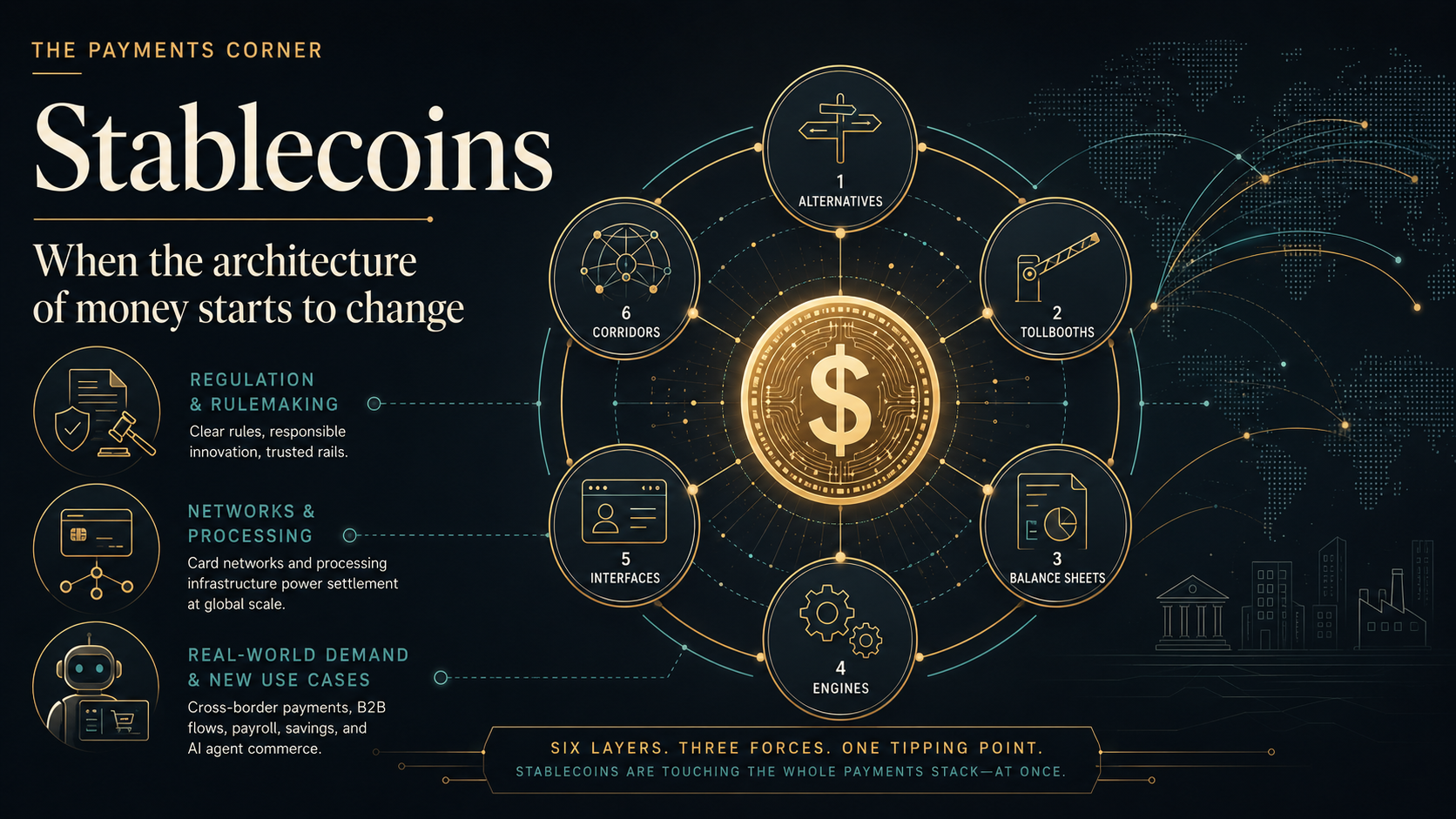 Research Article
Research24 min read · 3,660 words · 19 sections
The Stablecoin Field Guide: A Structural Map for Payments Professionals
Stablecoins have moved from crypto curiosity to a cross-layer force reshaping the payments stack. This field guide decodes the economics, regulators, and competitive moves by starting from the one fact that matters: a fiat-backed stablecoin issuer is a narrow bank that captures 100% of reserve float and cannot share it with holders—making distribution, not issuance, the actual prize.
Audio BriefListen to this research
Latest
All Research
ResearchAUG 17 · 2026
The use of an AI agent does not suspend existing consumer protection obligations.
The Payments Corner
AI, Payments Infrastructure·
Agentic Commerce and the New Role of Card Issuers
Why Processing Infrastructure Becomes the Control Plane for Delegated Payments
Audio BriefListen
Franco Di Pietro · Research
ResearchAUG 03 · 2026
The quantitative methodology behind the cohesion read the Pulse reports each week: market-adjusted residual correlation, a leave-one-out reclassification test…
The Payments Corner
Markets· 12 min read
Measuring Payments Cohort Cohesion: A Market-Adjusted Methodology
The quantitative methodology behind the cohesion read the Pulse reports each week: market-adjusted residual correlation, a leave-one-out reclassification test, and a full accounting of where the method fails.
Audio BriefListen
Franco Di Pietro · Research
ResearchJUL 28 · 2026
Not a watchlist of stocks. A map of how payments makes money — and a way to watch that map redraw itself.
The Payments Corner
Payments Infrastructure·
A Map, Not a Portfolio
The methodology behind the 50 TPC Payments Index — the reasoning that turns fifty tickers into an instrument for reading the payments ecosystem, and the discipline that keeps it from becoming a watchlist.
Audio BriefListen
Franco Di Pietro · Research
Featured
Insights · Latest

CardsAugust 19, 2026 · 5 min read
Featured Insight
Kraken's card is a bet on controlling the funding decision, not the transaction
Kraken's debit card—with its 2% rewards across multiple asset balances—is not a payments product disguised as one. It is a wallet-stickiness play that inverts traditional card architecture: instead of a card accessing a single account, the platform now decides which of many balances funds each purchase, moving the locus of control from the network to the issuer's financial operating system.
Audio BriefListenListen to the operator-level summary
Franco Di Pietro · InsightBy Franco Di Pietro · Insight
Latest
All Insights
SignalAUG 18 · 2026
When AI agents autonomously spend against prepaid accounts at platforms like Stripe, banks see only the funding event—not the thousands of micro-transactions…
The Payments Corner
Infrastructure· 7 min read
Banks risk losing visibility into customer spending as AI agents move transactions off the payment rail
When AI agents autonomously spend against prepaid accounts at platforms like Stripe, banks see only the funding event—not the thousands of micro-transactions or the logic that triggered them. Control over machine-spend policy may matter more than control over the card itself.
Audio BriefListen
Franco Di Pietro · Insight
SignalAUG 14 · 2026
SPEI cumplió 22 años y la discusión se fue al cruce con las tarjetas.
The Payments Corner
MARKET PERSPECTIVE · MÉXICO · En Español
Regulation· 7 min read
El día que la CLABE dejó de importar
SPEI cumplió 22 años y la discusión se fue al cruce con las tarjetas. El riel nunca fue el problema. Lo que faltaba era un identificador que el pagador no tuviera que capturar, y ese es el activo que ahora está en disputa.
Audio BriefListen
Franco Di Pietro · Insight
SignalAUG 13 · 2026
The perimeter was never the burden. It was the product.
The Payments Corner
bank Charters·
The Perimeter Was the Product
The FDIC's pending list is quietly becoming a fintech index. Affirm filed in January, Klarna in July, dozens reportedly behind them — the scaled survivors of the fintech decade concluding, one by one, that the perimeter they built around was the moat all along.
Audio BriefListen
Franco Di Pietro · Insight
Markets · Curated intelligence
View Market WatchWhere the payments stack stands today.
Five layers of the public payments universe, summarised at today's close. Click through for the full ticker table.
Signals
Signals From the Ecosystem
Curated developments across payments, banking technology, policy, and financial infrastructure — interpreted through an operator lens. View all →
Payments Rails
ACI Worldwide blog
July 2026
Legacy card platforms are no longer a technical debt problem — they are a competitive liability that now commands board-level attention, because the cost of inaction has become more visible than the cost of migration. Issuers still running monolithic authorization and processing stacks face compounding disadvantages in unit economics, real-time capability gaps, and the speed at which they can respond to network rule changes or regulatory mandates.
Fintech
Tearsheet
August 2026
Trade Press
PaymentsDive
August 2026
Trade Press
Finextra — Payments channel
August 2026
Trade Press
Digital Transactions
August 2026
Trade Press
Finextra — all headlines
August 2026
Trade Press
PaymentsJournal
August 2026
Trade Press
Digital Transactions
August 2026
Financial Press
Financial Times — Banks
August 2026
Trade Press
Finextra — all headlines
August 2026
WhitepapersAll whitepapers
Formal, deeply-sourced research deliverables — downloadable PDFs on payments infrastructure, credit evolution, and financial technology.
Featured
15 PP · PDF
Whitepaper · Credit Infrastructure The Payments Corner
BNPL and Modern Credit Architecture
The Payments CornerCredit InfrastructureMarch 2026
BNPL and Modern Credit Architecture
Buy Now, Pay Later is often treated as a checkout conversion tool. That framing is too narrow. BNPL is better understood as the visible edge of a deeper architectural shift: credit moving from static, account-level products toward contextual, transaction-level, embedded orchestration.
15 PAGES · PDF · 12-MIN READRead the paper
Cooperative FinanceFebruary 2026
The Cooperative Advantage
Whitepaper · Cooperative Finance
The Cooperative Advantage
Why Credit Unions Are Winning the Battle for the Modern Consumer
Franco Di Pietro · The Payments Corner Research
The U.S. consumer financial services market is entering a structural reset. Federally insured credit unions now represent a systemically meaningful segment of U.S. finance, with approximately $2.43 trillion in assets, $1.72 trillion in loans outstanding, and 144.7 million members at year-end 2025. The sector generated $18.8 billion in net income in 2025, up 31.5 percent from the prior year, even as the number of federally insured credit unions continued to decline. This combination — larger aggregate scale, stronger earnings, and fewer institutions — signals that the cooperative system is not simply growing; it is consolidating into more capable, more technology-enabled platforms. This paper argues that credit unions are no longer competing only on price or affinity. Their advantage is increasingly architectural: a member-owned economic model that can recycle surplus into lower loan rates, higher deposit yields, fewer fees, and stronger member outcomes; a trusted relationship model; and a technology ecosystem that is narrowing the historical digital gap versus large banks. The future competitive question is whether credit unions can convert cooperative economics into primary financial relationships at scale through digital onboarding, real-time payments, modern credit products, data-driven lifecycle engagement, and disciplined consolidation.
Page 1 · 11
Why Credit Unions Are Winning the Battle for the Modern Consumer
The U.S. consumer financial services market is entering a structural reset. Credit unions are no longer competing only on price or affinity — their advantage is increasingly architectural: a member-owned economic model translating cooperative economics into modern infrastructure.
Page 2 · 11
Preview · pages 1–2 of 11Read the paper
Community FinanceJanuary 2026
The Future of Community Finance
Whitepaper · Community Finance
The Future of Community Finance
Technology, Scale, and the Reinvention of Regional Trust
Franco Di Pietro · The Payments Corner Research
Community banks and credit unions remain a structurally important layer of the U.S. financial system, but the economics, technology stack, and customer expectations that defined the franchise for the last half-century are being re-priced in real time. The headline aggregates are reassuring: FDIC-insured institutions earned $295.6 billion in 2025; community banks contributed $29.9 billion (up 22.5 percent year over year) and accounted for roughly 90 percent of the 4,336 insured institutions still operating at year-end; federally insured credit unions held $2.43 trillion in assets and served 144.7 million members. Beneath those totals, however, the operating model is under structural pressure. This paper argues that community finance is not disappearing — it is being structurally redefined. The next era will belong to institutions that combine local trust with platform-grade infrastructure: real-time payments rails, flexible credit and servicing systems, permissioned data infrastructure that enables 'data as collateral' in small-business lending, AI-enabled fraud and decisioning capabilities, and partnership-enabled functional scale. Drawing on FDIC, NCUA, CSBS, Federal Reserve, NBER, and recent open-banking research, we frame the future of community finance as a shift from branch-centered proximity to lifecycle-centered financial infrastructure. The strategic question is no longer whether community institutions must modernize, but where they must modernize first, which capabilities they should own, and where partnerships can create functional scale without erasing local identity.
Page 1 · 20
Technology, Scale, and the Reinvention of Regional Trust
Community banks and credit unions remain structurally important, but the economics, technology stack, and customer expectations that defined the franchise for the last half-century are being re-priced in real time. The next era will belong to institutions that combine local trust with platform-grade infrastructure.
Page 2 · 20
Preview · pages 1–2 of 20Read the paper
Short Videos
Quick insights, explained clearly
Bite-sized videos breaking down complex payments topics in minutes — across LinkedIn, Instagram, YouTube, and TikTok.
06 live
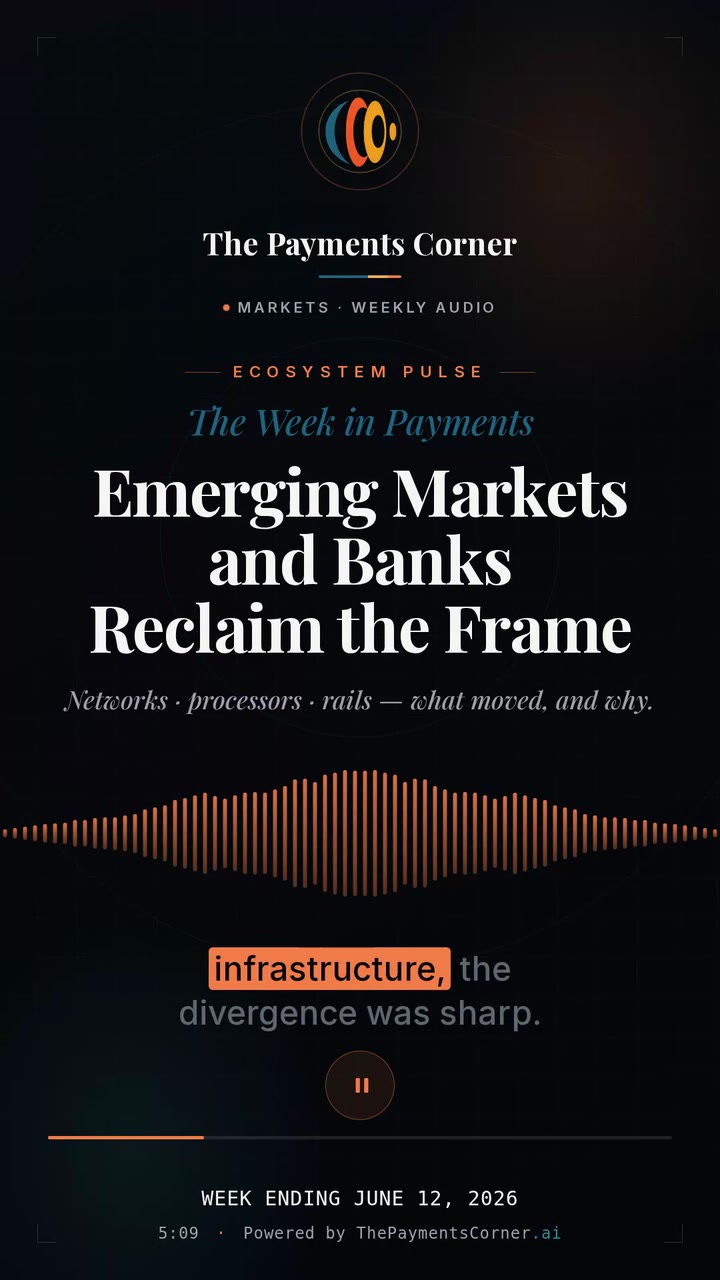
01 live
Coming soon
Instagram brief in production.
Coming soon
Instagram brief in production.
Coming soon
Instagram brief in production.
Coming soon
Instagram brief in production.
Coming soon
Instagram brief in production.
YouTube
Coming soon
Coming soon
YouTube brief in production.
Coming soon
YouTube brief in production.
Coming soon
YouTube brief in production.
Coming soon
YouTube brief in production.
Coming soon
YouTube brief in production.
Coming soon
YouTube brief in production.
TikTok
Coming soon
Coming soon
TikTok brief in production.
Coming soon
TikTok brief in production.
Coming soon
TikTok brief in production.
Coming soon
TikTok brief in production.
Coming soon
TikTok brief in production.
Coming soon
TikTok brief in production.
Follow for more insights
— From Inside the Stack
An editorial platform on the modern payments stack
The Payments Corner covers payments infrastructure, credit systems, embedded finance, issuer processing, and the intelligence layer reshaping the modern stack.
Coverage sits beneath the headlines: rails, settlement finality, decisioning systems, and the modernization pressure on incumbent processors, core vendors, and the institutions building around them.
The platform operates across formats — short-form video, long-form research, audio briefings, a weekly editorial cadence, and a curated stream of ecosystem signals. Each surface is authored from inside payments rather than alongside it, grounded in how the systems behave at scale rather than how vendors describe them.